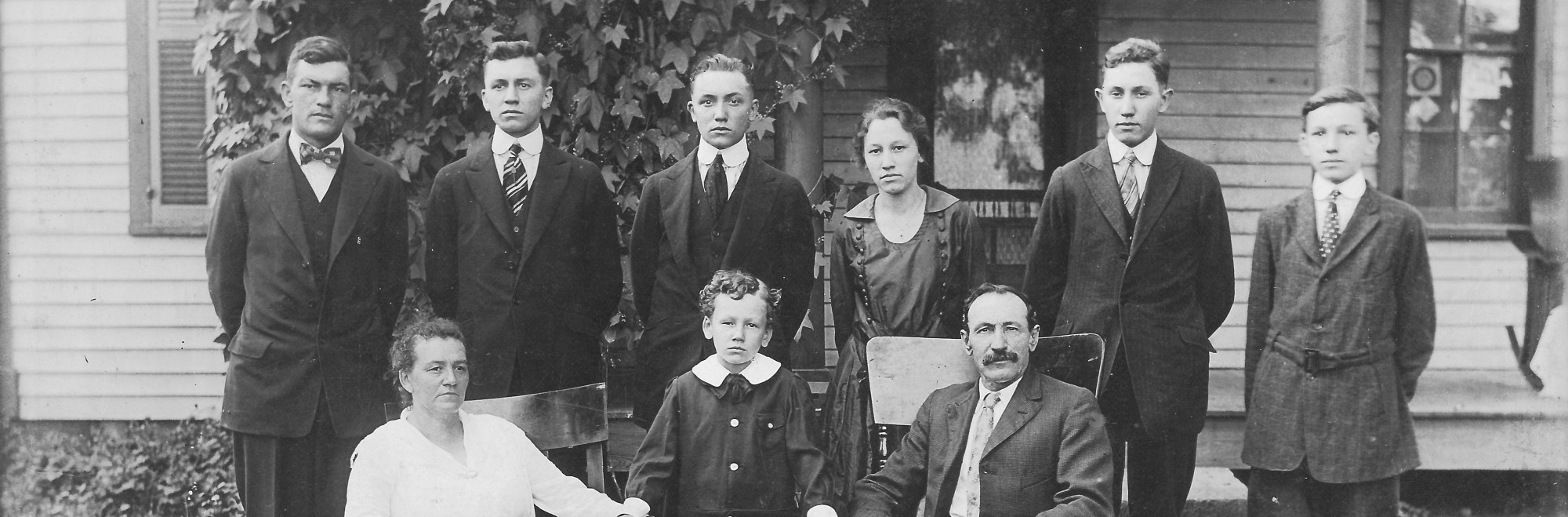
The following story is a fictional account of what life may have been life for my ancestor Sherman Scofield who moved to Connersville, Indiana around 1821-22. While I have taken liberties with some parts of the narrative, the structure of the story is based upon research I have completed on Sherman and his family.
“The practice will do you good,” Mother said, leaning over the washtub. She wiped a stray hair off her face. Though early in the morning, the day promised to be warm. She continued to scrub a shirt on the washtub as we talked.
“But Vester, Enzo, and I are planning to watch the flatboats on the river,” I groaned. As much as I missed our family, the last thing I wanted to do today was write letters.
“You are the only one with enough time to write,” she explained, with that tone of finality she has. There was no further use protesting; this discussion was over. The chore of writing letters now fell on my shoulders.
Spring 1823
Connersville, Indiana
Dear Aunt Martha,
Mother asked me to write. Her work keeps her far too busy to put pen to paper.
“Sherman, make sure you tell Aunt Martha that we send our love to her and Uncle Jonathon. Don’t forget to include that we are all doing well, and we hope everyone there is recovering. Your cousin Maria’s bout with influenza sounded miserable.”
“Send them hugs and kisses from all of us,” added Mary from her perch next to the butter churn, her arms methodically thumping away.
We finally received your letter dated the 16th of February last week. The mail service seems to be improving as this letter arrived more quickly than the last. Everyone here is fine. Mother sends her love to both you and Uncle Jonathon. Mary adds hugs and kisses. We were sorry to hear of everyone’s illnesses and hope all are better by now.
I wanted to make sure I commented on the news Aunt Martha sent us. After finding her last letter stashed away in Mother’s desk drawer, I returned to my writing spot. At seventy-nine, my grandfather still managed to do some work on his farm. He also rides daily into town to reminisce with his war buddies at the local tavern. We are all worried about my grandmother. Although a few years younger than Grandfather, her health has been poor the last few years. We anticipate receiving the news of her passing within the next few months. I will miss her and her apple pies.
We are all concerned about Grandmother and hope this present illness will not be her last. Is she able to bake much anymore? Please let us know if her condition worsens.
We are also pleased to learn that Grandfather is mobile enough to visit Mr. Weed and the other patriots down at Webb’s Tavern. I always loved listening to their Revolutionary war stories, especially the time when Great Aunt Elizabeth rode faster than the British soldiers to warn the village.
What crops is he planning to plant this year? With only limited space behind the house for a vegetable garden, we no longer worry about clearing and planting large fields of grain.
Letters from home have made the transition to life in Indiana easier. We nearly lost everything in Connecticut, and then in New York, so Father took a big risk moving us here. Just when we thought we had escaped our misfortunes, Seeley died, then Father, and Eliza, in quick succession. The swampy river bottom contained tainted water and infected mosquitos. Mother was on the verge of packing the rest of us up and returning east when a letter arrived from my grandparents. Their encouragement convinced Mother to stay and rebuild our lives here. The first few months were rough, but things are definitely improving.
In the fall, Mother predicts she will have enough saved so the three of us can continue our education. Currently, we cannot afford the tuition for the subscription school. Mary will be happy to relinquish her role as teacher—one of her many tasks. While Vester and I grudgingly agree that returning to school is a good thing, Enzo remains unconvinced.
“I have to sit still all day?” Enzo asked.
“Of course you do,” Vester responded, “and if you don’t, the schoolmaster might slap your knuckles with a ruler.”
“Can’t Mary continue to teach me my letters and numbers?” Enzo begged. He wanted to stay at home.
“Sorry, Squirt, Mary won’t have the time once Vester and I go back to school,” I explained. “Besides, you are old enough, you don’t want to stay at home with the girls all day, do you?”
Enzo sighed, and shook his head. He already knew several of the boys. Secretly, he really did want to attend school. He just wouldn’t admit it.
“You don’t have a choice in the matter, Enzo,” Mother said, as she looked up from the dough she was rolling on the table. “You boys have been running wild for far too long. It’s time to get back to your books and improve your minds. You don’t want to end up a farmer like your father.”
The three of us rolled our eyes. We had heard this speech before, but we knew she was right.
Married life seems to suit Betty. Fleming appears to be a decent fellow. While they were courting, Betty was insufferable. They have moved into a small log cabin on the other side of town, but Betty visits often enough while Fleming is engaged elsewhere on business.
“Fleming bought me the most beautiful braid for my bonnet,” she boasted. “It’s prettier than the one Mrs. Frybarger has!”
“It’s very lovely,” replied Mary, as she ran her fingers over the braid. “The color matches your eyes well.”
“When we marry, Fleming says he will build us a brick house closer to the river,” she explained, “so the breezes will keep the house cooler in the summer.”
Mary quietly nodded her head over her knitting as she listened to Betty describe her dream house. At twenty-six, Mary was nine years older and had yet to find a suitable man to marry. Was she jealous? I don’t know. Mary kept her opinions close. Always the responsible one, Mother depended on her for everything. She will make a great mother someday, but right now, she takes care of us, especially Sally, while Mother works to support us all.
Little Sally turns three this summer. The neighbors comment on how adorable she is, but her pretty looks disguise a mischievous imp! Just yesterday, Mary’s back was turned for a moment in the kitchen. Luckily, no damage was done, and Mary caught her before she broke her neck or the crockery.
When she turned back around, she shrieked, “Oh no! What are you doing?”
Standing on the table, Sally was half-way up the wall, reaching for the honey pot. Mary grabbed her off the table, sitting her down on the nearby bench.
“We do not climb the wall for things we cannot reach,” Mary explained, “You must always ask, please. I do not want you to hurt yourself.” After poking her on the nose, Mary cuddled Sally on her lap, eventually squeezing her so tightly that Sally giggled.
Since leaving the river bottom farm behind, Wes does odd jobs around town or works on neighboring farms, adding to the income Mother makes from laundry and other miscellaneous tasks. Some weeks he finds work at Mr. Conwell’s tannery. Fortunately, the tannery is located on the south side of town so we aren’t accosted by its fumes on a regular basis. But having those smells walk through the front door is a different matter.
“Oh my goodness, Wes, do not come in the house wearing those clothes! You stink and you are dripping everywhere!” Mother shouted.
We all gagged from the stench.
“I don’t think I’ll ever get these stains out of your shirt,” Mother remarked on laundry day. “Let me see if I can find your father’s old work shirt for the next time.”
Once a week, Wes works for Mr. Frybarger who owns the mercantile store. Wes helps unload the flatboat when it brings supplies in from Cincinnati. Vester, Enzo, and I enjoy watching him labor and flex his muscles for the young ladies strolling by the waterfront.
Back in February, the river flooded parts of town, even reaching up to Main Street. Several prominent ladies complained of soiling their long skirts in the muddy streets while promenading through town to do their shopping. Their complaints reached the ears of the town elders—several are their husbands. As a consequence, the elders plan to install wooden walkways in front of the businesses on Main Street. Connersville’s citizens pay Mother well for her laundry services, and we cannot afford to lose their business if they hear her complaints. Wes hopes to earn a few dollars laying down the sidewalk, once the project begins.
“Do not say anything outside these walls, children,” Mother instructed us, “but I will be very glad to never see a mud-stained petticoat like these again.”
Mother and Wes have been planning a surprise for my birthday this summer. They sat me down last week to explain their proposal.
“You will soon be old enough to contribute to the family finances,” Mother explained. “Thirteen is a good age to learn a trade.”
“I’ve been asking around town to see if anyone needs an apprentice,” Wes began, a big grin lit up his face. “I know how you like to build things so I checked over at the sawmill and the brickyard. The brickyard will take you, starting July 1st, right after your birthday.”
“Now, I still expect you to attend school in the fall,” Mother added. “Your education is important, and the brickyard knows my opinion on the matter. You can work every day until school starts, and then afternoons and Saturdays in the fall.”
My mouth dropped open in surprise.
“You might want to close that, so you don’t get bugs in your mouth,” Wes joked.
“Vester and Enzo will take over most of your chores, like feeding the chickens and weeding the garden,” Mother continued. “But you still need to assist when needed, like Wes does.”
I nodded my head, too happy to speak.
July cannot come soon enough. Until then, I have the rest of the spring and early summer to run wild with my brothers.
Your loving nephew,
Sherman
© 2024 Written by Deborah Sweeney
 Genealogy Lady