Tag Archives: dating photographs

Fashion Moments – The Bustle

Fashion Moments by Deborah SweeneyWelcome to my weekly fashion blog post. Each week I will discuss a piece of female clothing or fashion trend from the age of photography (1840s through the the 20th century). My goal is to educate family researchers and genealogists about the clothing worn by our ancestors. Dating photographs is an issue we all struggle with as family archivists. Additionally, anyone who writes about their family history should be aware of the environment in which their ancestors lived, and that includes the clothing they wore.

The Bustle

During the 1870s and 1880s (and even into the 1890s), women continued to wear long skirts which typically included a bustle. There are three distinct phases in appearance and style of the nineteenth century bustle. Being able to identify the bustle phase of a woman’s skirt is a plus for dating photographs.

Phase One (1867-1872)

The 1850s and 1860s were known as the era of hoop skirts. As the Civil War ended, fashion transitioned away from this style of skirt. The steel cages which had previously supported the various layers of petticoats and skirts were phased out. By the end of the 1860s, instead of wearing a structure that encircled the body (diagram on left), the crinoline or bustle evolved into an rear only structure (diagram on right).


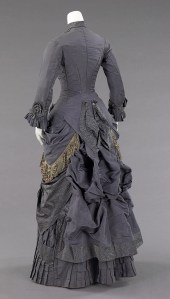
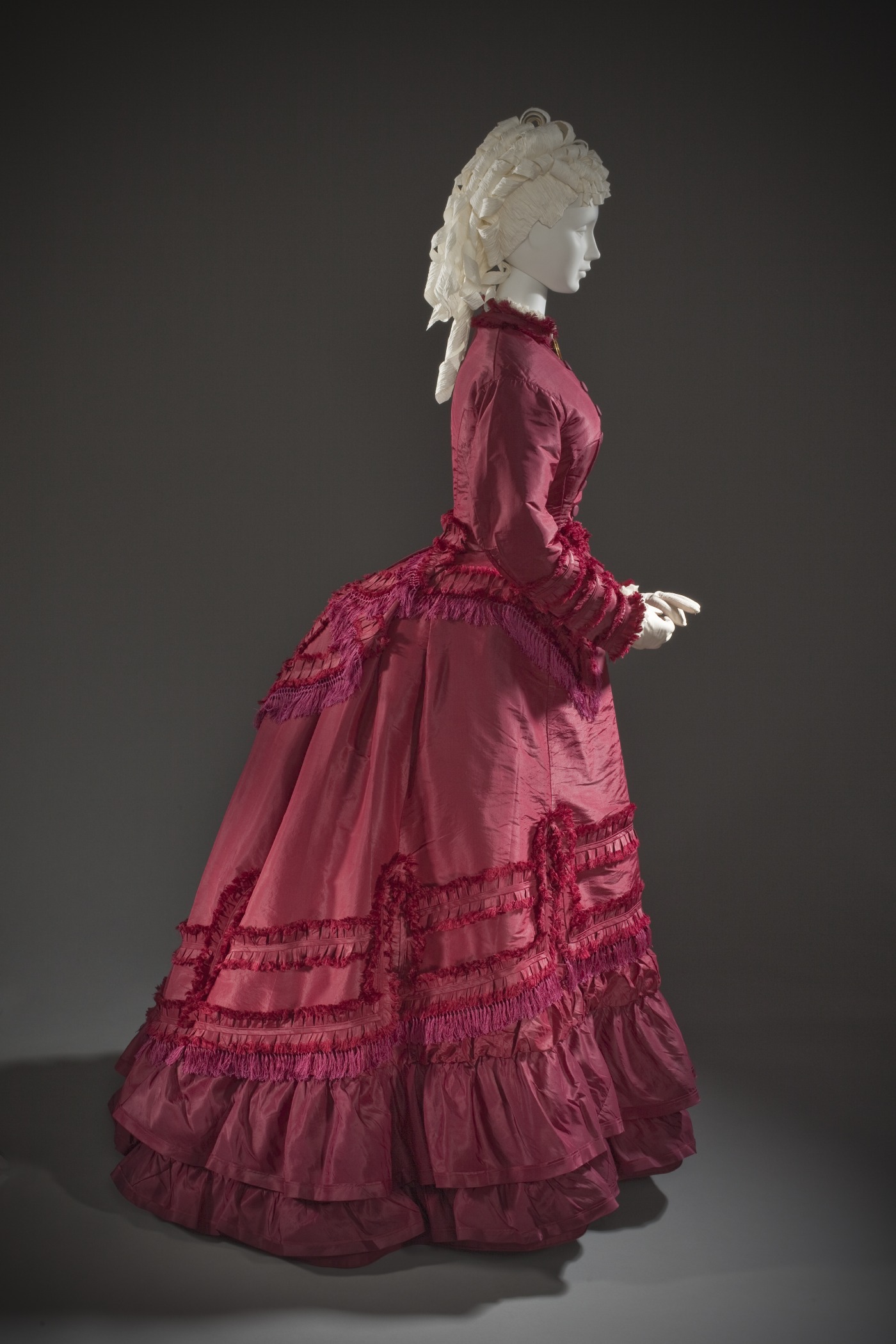
This beautiful silk gown from the collection of the Los Angeles County Museum of Art is a typical example of the transition style. (Link to the circa 1870 dress in LACMA’s collection). The decoration of the skirt is linear around the bottom half of the hem and the skirt’s volume is full and rounded.
Woman's_Promenade_Dress_LACMA_M.2007.211.773a-d_(5_of_5)

Woman’s Promenade Dress, c. 1870 (LACMA collection)

Phase Two (1869-1876)

The second phase of the bustle overlapped with the transitional phase for a few years. This phase of the bustle was characterized by a draped over skirt which gathered to the back. The overall fullness of the skirt began to diminish. The skirt were generally flatter in front with emphasis shifting to the back bustle. As sewing machines in the home began to be more common, decoration and flounces became increasingly excessive.

Interlude (1876-1881)

By the middle of the 1870s, the bustle dropped out of fashion. Bodices became long and narrow, extending over the hips; they were seamed in the princess style and were also known as the cuirasse bodice. Like their namesake the cuirass (a piece of close-fitting defensive armour), these bodices were made to fit as closely as possible. All over decoration and flounces on the back of the skirt were typical during these years.

Phase Three (1881-1889)

The bustle of the 1880s became the fashion nightmare of its day. During the eighties, fashion swung between a desire for simplicity and a tendency towards excess. The bustle of this era looked like a shelf (according to fashion illustrations) built upon the female posterior.

1885 dress

Dress, c.1885, from the collection of the Metropolitan Museum of Art, New York

By the 1890s, the bustle was on its way out. Some posterior padding continued until 1905, but in general, the bustle was finished. The average female did not engage in excessive bustling. However, the bustle was common enough to be ridiculed and satirized in the newspapers of the day. Most women did have access to fashion magazines such as The Ladies Standard Magazine and a growing number of households acquired sewing machines in the late nineteenth century. Women re-created what they saw in the magazines according to their abilities (and their wallets). Mail order catalogs like Bloomindales sold ready-made clothing. Butterick and McCall sold paper patterns. It would be foolish to assume that our ancestors were out-of-touch with the latest fashions. Whether or not they could afford to replicate them was a different matter entirely.

Some Additional Resources:

English Women’s Clothing in the Nineteenth Century by C. Willett Cunnington is a great comprehensive guide of the evolution of fashion during the nineteenth century.

Victorian Fashions & Costumes from Harper’s Bazaar, 1867-1898 edited by Stella Blum

American Victorian Costume in Early Photographs by Priscilla Harris Dalrymple

©2015 written by Deborah Sweeney
Post originally found: https://genealogylady.net/2015/06/12/fashion-moments-the-bustle/

Fashion Moments – The Shirtwaist

Fashion Moments by Deborah Sweeney

This is the first in a new weekly series on specific fashion trends. Each week I will present a different garment or piece of female fashion that was prevalent during the 19th and 20th centuries. My goal is to educate family researchers and genealogists about the clothing worn by our ancestors. Dating photographs is an issue we all encounter and struggle with as family archivists. Additionally, anyone who writes about their family history should be aware of the environment in which our ancestors lived, and that includes what clothes they wore.

The Shirtwaist

The shirtwaist was a mainstay of the female wardrobe from the end of the 19th century and into the 20th century. What exactly is a shirtwaist? To understand the evolution of the term, it is necessary to understand the definition of waist to a 19th century person. In modern times, the word waist refers to the part of the human body between the ribs and hips. In the past, waist was another term for the bodice of a woman’s dress.

Waist (wāst) n. The upper part of a garment, extending from the shoulders to the waistline, esp. the bodice of a woman’s dress.

As women became more independent and began working outside the home, their style of dress was modeled after male attire. A well dressed man of business typically wore a white shirt with a turned down collar and cuffs under his coat and/or vest. The term shirtwaist was a combination of the two terms: shirt + waist. Therefore, shirtwaist is a term only used to describe the female version of a male dress shirt.

 Shirtwaist (shȗrt’ wāst) n. A woman’s tailored shirt with details copied from men’s shirts.

A typical shirtwaist was unstructured (no boning or inner lining) and was made from a material such as cotton or linen. Occasionally they were made of silk. Another benefit of the shirtwaist was the ease of laundering. Boned and lined bodices were generally not washed often. Over time, shirtwaists evolved from the simple tailored version of a man’s shirt to beautiful feminine garments embellished with lace and trimmings.

Shirtwaist, c1895, American silk and cotton

Shirtwaist, American, c1895 (silk & cotton). Metropolitan Museum of Art Costume Collection

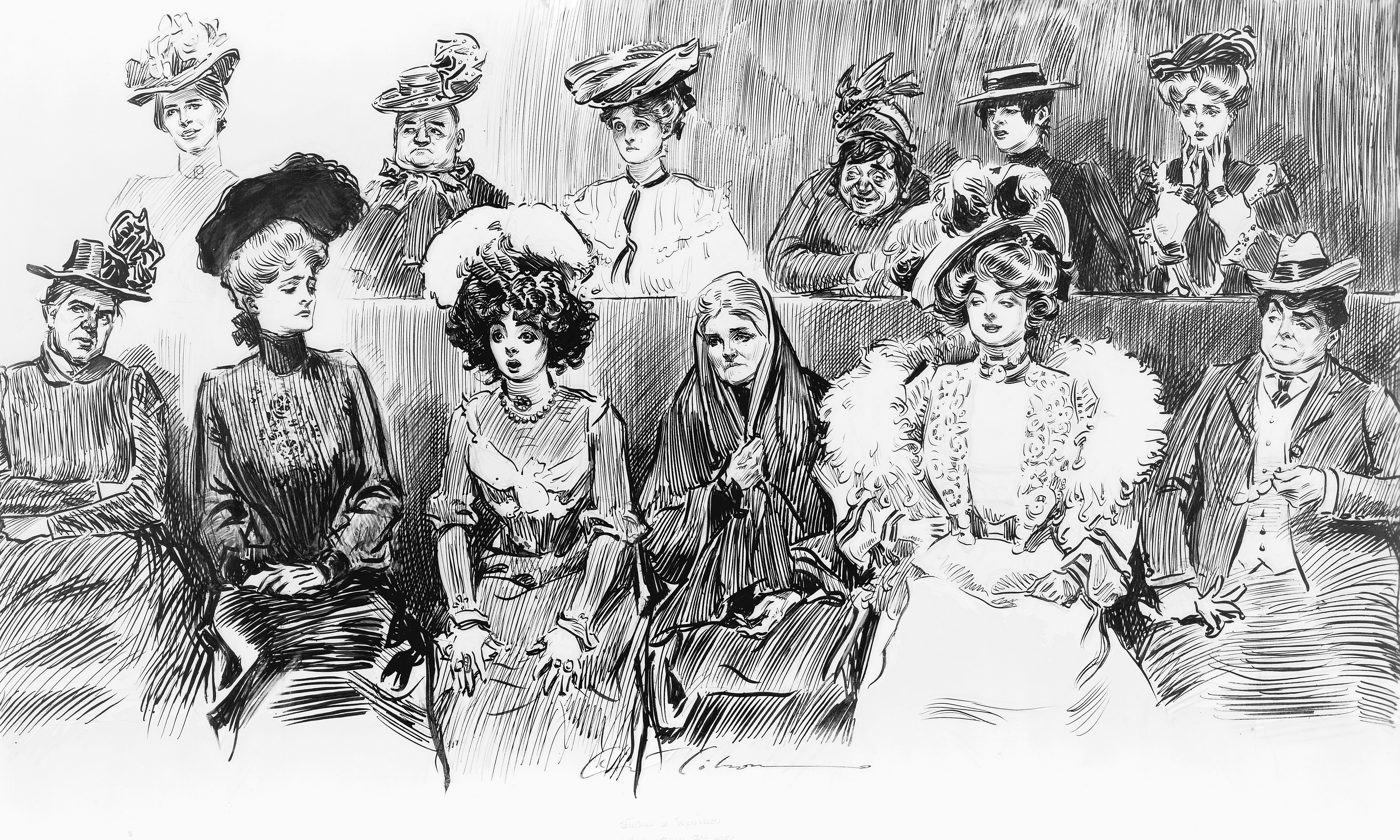
Although introduced as early as the 1860s, shirtwaists became more popular as the 19th century progressed. With illustrators like Charles Dana Gibson regularly drawing sporty and active women, women’s dress was finally changing. However, it would take another twenty or so years before the more natural styles of the 1920s became fashionable. By the mid 1890s, women were no longer being hampered by bustles and hoops as well as obsessive corseting. The movement to promote Aesthetic Dress (which began in England in the 1850s and was led by artists such as Edward Burne-Jones, Frederic Leighton and Lawrence Alma-Tadema) also influenced the trend towards healthier and non-restrictive clothing for women. The Aesthetic dress movement rejected the wearing of tight-laced corsets altogether.

Charles_Dana_Gibson_(1902)_Studies_in_expression._When_women_are_jurors

A study for “When Women Are Jurors,” by Charles Dana Gibson, 1902 (Image in the Public Domain via Wikipedia Commons)

The term shirtwaist, or waist for short, endured from the early 1890s though the 1920s. The term finally passed out of common usage with shirt and blouse being more commonly used today.

Perhaps one of the most well known events regarding the shirtwaist was the 1911 Triangle Factory fire in New York City. Shirtwaists were very popular and cheap to manufacture. Mail order catalogues as well as clothing stores all sold shirtwaists. See the links below to learn more about the Triangle Factory fire, and PBS’s documentary about this tragedy which killed hundreds of immigrant factory workers. The overwhelming majority of the victims were women.

Evolution of the Shirtwaist

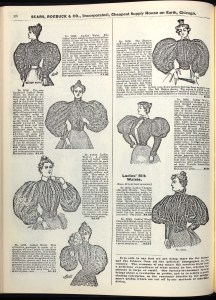
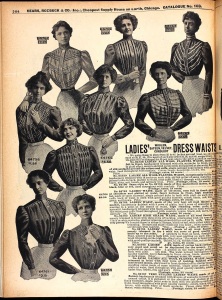
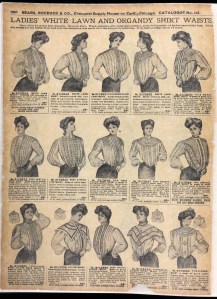
The style of the shirtwaist changed over the years. When dating photographs, it is important to note the changes to cuffs, collars and necklines as well as the rise and fall of the waistline.

Shirt waist patterns from the Modern Priscilla Magazine, 1906. (Image from the Library of Congress)
For Further Reading:

More about the fashion trends that influenced the Aesthetic Dress Movement:

http://www.maggiemayfashions.com/secondbustle.html
http://en.wikipedia.org/wiki/Artistic_Dress_movement
http://www.artfund.org/what-to-see/exhibitions/2015/02/17/liberating-fashion-aesthetic-dress-in-victorian-portraits-exhibition

On the Triangle Shirtwaist Fire and Shirtwaists:
http://www.pbs.org/wgbh/americanexperience/features/introduction/triangle-intro/
http://www.pbs.org/wgbh/americanexperience/features/general-article/triangle-shirtwaist/
https://prezi.com/4kvervvcyl3v/defining-the-shirtwaist-1890-1918/

©2015 written by Deborah Sweeney
Post originally found: https://genealogylady.net/2015/05/30/fashion-moments-the-shirtwaist/

Identifying Everyday Clues in Photographs, Part IV

Dating PhotographsToday I present the last part of this series focusing on dating the photograph of Elizabeth (Schwartz) Yegerlehner. My aim was to take the reader through the process of dating a single photograph by using clothing cues. Stay tuned for addition posts on specific fashion trends like the evolution of the sleeve, skirt shapes and hair styles. My goal is to make this a weekly post.

At the end of part three in this series, I said that we would look specifically at the clothing worn by the “granddaughter” in the photograph because it is easier to gauge the styles of the young. Before I do that, I want to focus on Elizabeth. I am lucky because I have several identified pictures of Elizabeth. I want to make a point about using hairstyles to date pictures.

Elizabeth Over Four Decades

The earliest photograph was taken in the 1880s. Elizabeth is standing while her husband, Christian Yegerlehner, is seated. The photograph is a fairly typical of the times.

Christian and Elizabeth (Schwartz) Yegerlehner, c1880s (Photograph courtesy of Eric Graham)

Christian and Elizabeth (Schwartz) Yegerlehner, c1880s (Photograph courtesy of Eric Graham)

The next photograph was taken in 1890-1 in front of the Yegerlehner farmhouse. The baby, William Otto Yegerlehner, was born on 8 March 1890. Elizabeth is standing behind the fence. Her two youngest daughters, Matilda and Sophia, stand with their niece, Bertha (the littlest girl with the doll who was about 4-5 years old).

Christian Yegerlehner Family, in 1891, in front of the farmhouse in Clay County, Indiana

Christian Yegerlehner Family, in 1890-1, in front of the farmhouse in Clay County, Indiana

The next photograph of Elizabeth was taken with one of her sisters, possibly Sevilla. It was likely taken in the late 1890s.

Elizabeth (Schwartz) Yegerlehner and her sister Sevilla Sheneman(Photograph courtesy of Eric Graham)

Elizabeth (Schwartz) Yegerlehner and her sister Sevilla Sheneman (Photograph courtesy of Eric Graham)

Here again is another photograph of Elizabeth. This time her daughter, Sophia, as well as another un-named sister are in the picture.

Yegerlehner, Elizabeth (Schwartz) with daughter Sophia and sister

Elizabeth (Schwartz) Yegerlehner with her daughter Sophia and an un-named sister, c1900 (Photograph courtesy of Eric Graham)

A few years later, Elizabeth took another photograph with Sophia. This time Sophia’s son, Russell, is in the picture. Russell was born in 1905 so this photograph was probably taken about 1909. Sophia lived in Indianapolis and she was very fashionably dressed for the times. Her hair is a wonderful example of the style.

Yegerlehner, Elizabeth (Schwartz) Yegerlehner with Russell & Sophia (Yegerlehner) Thatcher - c1910

Elizabeth (Schwartz) Yegerlehner with her daughter, Sophia, and grandson, Russell, c.1909. (Photograph courtesy of Eric Graham)

During the 1910s, Elizabeth sat for a photograph with Elizabeth (Krieble) Schiele. Both grandmothers lived with John Henry Yegerlehner and his wife, Lovina (Schiele) Yegerlehner, near the end of their lives. Both women died in 1922.

Elizabeth posed with some of her great grandchildren around 1919. She had only one granddaughter (with three children) by 1922. The only candidate is Mary Anna (Wolfe) Snedeker. Her oldest three children were Walter, Mary and Charles. The youngest was born in 1918. Elizabeth is wearing a white shirtwaist which is very a-typical of her! at least in comparison to her other photographs.

YEG1919 Elizabeth (Schwartz) with possibly Mary Anna (Wolfe) Snedeker and children

The one thing I want to point out about Elizabeth in these pictures is that her hair style did not change for 40 years – a part in the middle with a bun in back. Judging a photograph based on hair alone is NOT a good idea!

 Back to the Photograph!

Grace Wolf & Elizabeth (Schwartz) YegerlehnerSo far, I have written down every noticeable detail about the clothing in the photograph. I created age ranges based upon the possible candidates for Elizabeth’s grand-daughter. To recap, there are seven possible women:

  • Emma’s range (1899-1908)
  • Mary Anna’s range (1901-1910)
  • Bertha’s range (1902-1911)
  • Minnie’s range (1904-1913)
  • Pearl’s range (1911-1920)
  • Sophie Grace (1913-1922)
  • Bertha Steuernagel’s range (1902-1911)

Around 1910, fashion began moving away from from the trends of the 19th century. The women’s silhouette became more columnar, and excessive curves of the late 1890s and early 1900s became straighter. One result was skirts became less full, using less fabric. Instead of being triangular (narrow at the hips, wide at the base), skirts were more rectangular. The hobble skirt, a short lived fashion trend from 1910-1913 was the epitome of the straight and narrow. While I doubt that my unknown Indiana farm girl indulged in such fashion, it is important to know what was happening in the fashion world. Another result of the shift in fashion was the elevation of the waist line.

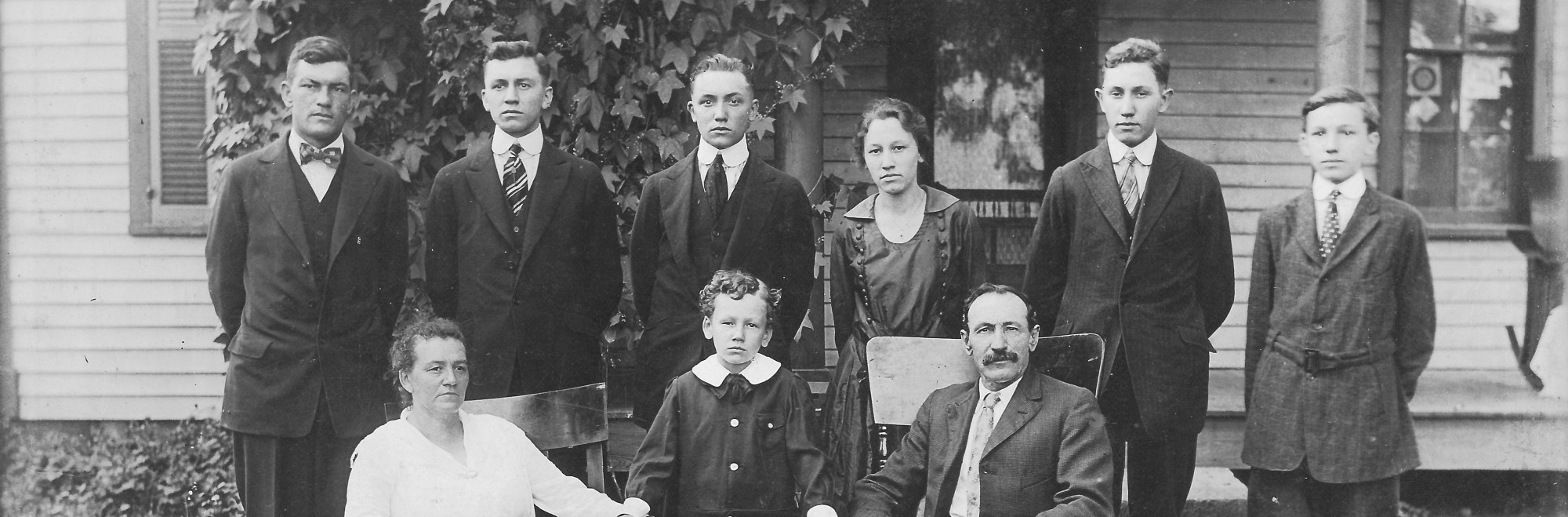
On the other side of Indiana in 1913, my great grandparents, Robert and Sara (Troxell) McGraw, celebrated their 50th anniversary. They had a large family and many friends came to celebrate the occasion. They all posed for a photograph. I am showing this photograph because they were of a similar socioeconomic status as my Yegerlehner relations. They also lived within 150 hundred miles of each other. Notice the waistlines on the women – young and old. The majority of the women are wearing dresses or shirtwaists and skirts that are higher than the natural waist.

McGraw 50th Anniversary (40) 200 bw

Robert and Sara McGraw 50th Anniversary, 1913, Fayette County, Indiana

Our mystery Wolf woman is wearing a dress that sits at her natural waist. I would deduce that my photograph was taken before 1910. Therefore this eliminates Pearl and Sophie Grace as likely candidates for the mystery girl. The earliest date in their ranges occurs after 1910. I would also point out (based upon the photograph of Elizabeth with her great grandchildren) that the mystery woman does not look like Mary Anna (Wolfe) Snedeker. So Mary is probably not the mystery girl either. So we are left with Emma, Bertha Wolfe, Minnie and Bertha Steuernagel as possible candidates. The remaining girls have ranges that are virtually identical so I am not likely to determine who the mystery girl is. My only hope at this point is to find a relative from the Wolfe or Steuernagel branches who can identify her.

The Years 1900-1910

Our mystery girl’s silhouette reminds me very much of the Gibson girl. Charles Dana Gibson was an illustrator from the 1890s onward. His illustration “Love in a Garden” was published in 1901.

Love_in_a_Garden,_Gibson

Love in a Garden by Charles Dana Gibson, 1901 (Image via Wikipedia Commons in the public domain)

In 1901, fashionable women were still piling their hair on top of their heads. Our mystery girl’s hair is not. She has fullness at the side of her head instead of on top. Here are some factory workers in 1908 in Indianapolis with some more realistic hair styles:

Lewis Hine Collection. Library of Congress. Young People in An Indianapolis Cotton Mill, Noon, Aug., 1908


I would also point out that several of the young woman are wearing half sleeves and their shirtwaists are collarless, in particular the woman in the front row with the checkered pattern.

Conclusion

Ultimately, we can only do our best to date photographs. Fashion is not static. We can learn the trends but we can not always account for all the variables. While I would estimate that this photograph was taken mid decade, I could be off by a couple years in either direction. There are many resources out there and many are free! If you are interested in honing your photography skills, check out Mauren Taylor’s website: http://www.maureentaylor.com/ She covers additional photo identifying techniques beyond clothing.

Come back next week to find out more about a specific fashion trend! If you have a topic that you would like me to cover, leave a comment below.

If you missed the first three posts in the series:

https://genealogylady.net/2015/05/02/identifying-everyday-clues-in-photographs-part-i/

https://genealogylady.net/2015/05/09/identifying-everyday-clues-in-photographs-part-ii/

https://genealogylady.net/2015/05/16/identifying-everyday-clues-in-photographs-part-iii/

 ©2015 copyright by Deborah Sweeney
Post originally found: https://genealogylady.net/2015/05/23/identifying-everyday-clues-in-photographs-part-iv/

Identifying Everyday Clues in Photographs, Part II

Dating PhotographsIn my first post in this series, I set out to date a photograph of my 2X great grandmother, Elizabeth (Schwartz) Yegerlehner and one of her granddaughters, an unidentified Wolfe. I went through the process of identifying clues in the photograph that would provide me with usable information. Each woman was broken down by age and by the various parts of her clothing.

Before we proceed further, I want to add a few fashion warnings. Dating photographs is never a precise process, and oftentimes, without other documentary evidence, may never be completely accurate. My goal is to help the average genealogist or vintage photography enthusiast to understand and recognize fashion trends as well as to give advice for finding resources.

  • Older people may not change their clothing fashions as quickly as younger persons do or be inclined to adopt new trends, however this is not always the case. A great example would be in the costumes of Downton Abbey. The Dowager Duchess was wealthy enough to buy new clothing every season but her clothing style evolved more slowly than some of the younger characters like those of her granddaughters: Mary, Edith and Sybil.
  • People from metropolitan areas are more fashionable than rural areas (sometimes!). With the advent of ladies and fashion periodicals, like Godey’s Lady’s Book, country women were able to see the latest fashions more quickly. Mail order catalogues, like Sears, Roebuck & Co. and the National Cloak & Suit Co., allowed women away from the big cities to purchase the latest fashions. Even if they made their own clothing, they could be inspired by the fashion plates. Pattern companies, like McCall’s and Butterick, also sold high fashion to rural customers.
  • Working class people dressed differently than wealthier people. One must always consider class when dating a photograph. The “best” dress for a poorer woman might last for many years while the “best” dress for a wealthy woman might last one season. People tended to hold onto clothing, and remade dresses year after year, as well as handing them down to young folk.

The second step is to Identify the Period Silhouette:

What is a period silhouette, you might ask? A handout from the The Secret Life of Costumes by Canada’s National Art Centre describes it thus….

“A silhouette provides an uncluttered outline of the basic shape of a person from a particular period in history as dictated by the clothing worn. Each shape is different from any in the century either before or after. The outline of your body wearing today’s styles would be very different from your great grandmother’s or grandfather’s shape at the same age.”

The pdf article contains wonderful advice as well as a fun activity for identifying some different silhouettes. Make sure you download it for future reference!

Fashion silhouettes can change very rapidly. They can also overlap as evidenced by my first point above. A woman from 1880 will have a different silhouette from a woman in 1860 or 1900. In both of my costume history courses, I was required to keep a sketchbook of period silhouettes for every century from the 1st through the 20th, for men and women. Within a hundred year period, fashion silhouettes can change a dozen times or more. Just for fun, I’m including two costume renderings from two different time periods, about 100 years apart. Try guessing the decades of the two pictures, and leave your answer in the comments!

Learning the intricacies of fashion trends takes time, and requires paying attention to little details.

There are many great resources for learning about historical fashion trends, in contemporary documents. Here are a few:

A couple sources for Godey’s Lady’s Book
http://www.accessible-archives.com/collections/godeys-ladys-book/
http://onlinebooks.library.upenn.edu/webbin/serial?id=godeylady

Ancestry has many Sears catalogs available for searching from 1896-1993. To find them, go to Ancestry’s main catalogue and search under Sears. You can browse by year. Many years had more than one to chose from (spring/fall).

Ancestry screen shot

Internet Archive has many old catalogs and magazines in their collection. Here is a National Cloak & Suit Co. catalogue  from 1907: https://archive.org/details/newyorkfashions00nati

Dover books sells reprints of old fashion catalogues. Be careful of some of their “costume” books as they are secondary sources.
http://store.doverpublications.com/by-subject-fashion-and-costume-vintage-fashion-catalogs.html

Dated photographs are great resources since fashion plates are not always realistically drawn.

The Library of Congress has a Civil War Collection: http://www.loc.gov/pictures/collection/cwp/

The website PhotoTree has thousands of dated photographs:
http://www.phototree.com/gallery.asp?cat=90s&f0=1890s

Several museums have clothing collections.

One of my favorite is the Metropolitan Museum of Art’s Costume Institute. Here is an example of a shirtwaist, dated 1899-1902:
http://www.metmuseum.org/collection/the-collection-online/search/109353?rpp=30&pg=1&ft=shirtwaist&pos=10

©2015 copyright by Deborah Sweeney
Post originally found: https://genealogylady.net/2015/05/09/identifying-everyday-clues-in-photographs-part-ii/

Identifying Everyday Clues in Photographs, Part I

Dating PhotographsHow many of us have received boxes or albums of photographs from relatives, only to be dismayed to find them unlabeled and undated? This is a concept familiar to many genealogists. Even if our ancestors did not properly annotate their treasured photographs, clues can still be found to help date them. Trends in clothing and hairstyles can be used to narrow down time frames. The type of photography used and the imprints of long gone photographers on cardboard frames offer further evidence of when and where a photograph was taken. Knowing an ancestor’s lifespan and their family’s unique dynamics helps to fill additional puzzle pieces.

This is the first in a series of posts on using clothing and hairstyles to identify and date photographs. My first career was in the field of costume design and history. I studied many fashion trends during my years as a costumer. I still love anything related to textiles – from vintage clothes to sewing reproduction garments. In many ways, studying the history of clothing helps me to visualize  my ancestors with greater depth and clarity. My aim with this series is to help the average genealogist recognize fashion trends in their own photographs and to provide resources for further study.

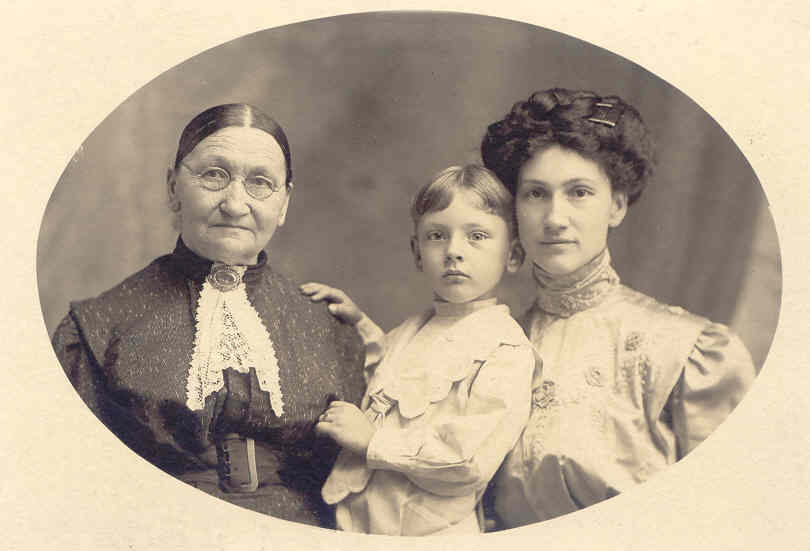
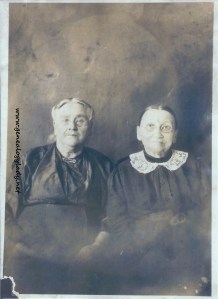
Today, let’s start with a typical photograph that anyone might have in their collection. In this case, the photograph is of my 2X great grandmother, Elizabeth (Schwartz) Yegerlehner, and one of her granddaughters. I have had this particular photograph in my collection for many years. When I received it from my uncle Mark (yes, that Mark from the letters!), he was in the process of photographing some of the family’s older photographs. He was generous in giving copies to all the relatives who wanted them. This was prior to scanning and high quality color photocopies. Over the years I was led to believe that the younger woman was Grace Wolfe, one of Elizabeth’s grandchildren. I have heard in the intervening years the woman might have been one of Grace’s older sisters.  This definitely put a spin on my original dating of the photograph! But it did clear up some of the inconsistencies that I could not rectify.

Grace Wolf & Elizabeth (Schwartz) Yegerlehner

The first step is to Identify and Describe the people in the picture:

During this step, write down everything you observe in the photograph. Even the smallest of details could be important. The background of this photograph does not provide any identification, such as buildings, cars, farm animals, etc. In this case, however, I am fairly certain that the photograph was taken on the Yegerlehner farm, or one of the farms owned by extended family members. However, this information is not relevant to dating the photograph at present. If the photograph had an identifiable background, listing the visible features would be another step in the  process.

Older Woman –

  • Elizabeth (Schwartz) Yegerlehner (I know this because I have seen other pictures of her so I am familiar with her appearance).
  • Lived 1843-1922
  • Wearing dark clothes, possibly black
  • Elizabeth was widowed in 1903
  • Her bodice has a yoke, with lace or other adornment
  • Sleeves caps are small
  • Sleeves are narrow, but not tight fitting, with cuffs at wrists
  • Bodice does not appear to close in front
  • Long skirt which ends 2-3 off the ground
  • Skirt is plain, with no adornment
  • Long narrow pin at base of neck
  • Bodice has a low or non-existent collar
  • Although her hands cover waist, there is possibly a belt which hits right under her bosom
  • Hair is pulled tight in a bun, with center part

Younger Woman –

  • Most likely one of the Wolfe girls (Emma, b. 1883; Mary, b. 1885; Bertha, b. 1886; Minnie, b. 1888; Pearl, b. 1895; and Grace, b. 1897)
  • Wears long skirt, a couple inches of the ground, striped material, possibly cotton
  • Bodice of same material as the skirt
  • Bodice has ¾ length sleeves, with cuffs below elbows
  • Sleeve caps are slightly puffy, as gathers are evident
  • Sleeves are narrower, but not tight fitting, for “ease of movement”
  • Bodice blouses out at waistline
  • No collar
  • Bodice does not close in front
  • No jewelry
  • No adornment on bodice or skirt
  • Skirt is smoother across hips, and wider at bottom
  • Age between 16-25, old enough to wear long skirts
  • Hair in bun at back, although there is fullness over the ears which mostly covers them; hair appears to be parted in the center but only at the front
  • Working clothes vs. high fashion “good occasion” clothes
  • Clothes likely homemade and not purchased from a catalogue

In the next installment, we will look at fashion trends at the end of the 19th and the beginning of the 20th centuries.

©2015 copyright by Deborah Sweeney
Post originally found: https://genealogylady.net/2015/05/02/identifying-everyday-clues-in-photographs-part-i/