-

- May 28, 1942 (8:30 post) Envelope
-

- May 28, 1942 (8:30 post), p. 1
-
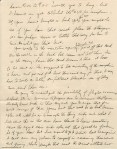
- May 28, 1942 (8:30 post), p. 2
-

- May 28, 1942 (8:30 post), p. 3
-
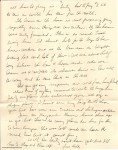
- May 28, 1942 (8:30 post), p. 4
One of the things that I find _____ (insert word: cool, fascinating, thrilling, etc.) about this project is seeing all the people that my grandparents interacted with in their daily lives. We spend so much time in genealogy research tracking down all the branches in the family tree. I think sometimes we forget that our ancestors also interacted with their neighbors intimately as well. The neighbors might not have been blood relations but they were best friends, mortal enemies, business partners, customers, patients, teachers, or students. As I come across names in the letters, I find myself wanting to know who these other people are. I also think (as a historian/genealogist) that maybe some of these people’s descendants might also be interested in hearing about their relations, even briefly. How often have we wondered at a witness’s signature on a will? Or thought about the other person in a land dispute? Who are these people that our ancestors knew?
Today’s letter mentions several people: Mrs. Nosker, Dr. Lentz, D. Ream, Mrs. Worrell, Larry Ried, Jim [Foster], Raymond Bower. Since Dr. Lentz is someone who served with my grandfather, he was one of the first people that I tried searching for. I didn’t know Dr. Lentz’s given name until I found a letter from Dr. Lentz to my grandfather. It was written in 1944 right after my grandfather had returned to the states. The return address was labeled E. T. Lentz, Comdr. (mc) NSNR. The letter was also signed Ed. Now, I had something to go on. Ed is short for several names: Edward, Edmund, Edwin. I did some searching through the Veterans databases on Ancestry and came up with Edmund T. Lentz. Then I searched the 1940 census and found Dr. Lentz living in Pennsylvania. The first letter in which my grandfather mentions Dr. Lentz, he says “I met a doctor from Pennsylvania”. They must have got on fairly well because they quickly became roommates.
Dr. Lentz was about 5 years older than my grandfather. Just older enough that he served briefly in World War I as a young man before he became a doctor. Dr. Lentz affectionately referred to my grandfather as “Junior”, either because of their age difference or perhaps due to a difference in rank. I was able to track down Dr. Lentz’s social security record and his marriage record. He married Margaret Broomhall in 1926 in Philadelphia. Finally, I found the Find A Grave memorials for Dr. Lentz & his wife. Sadly, I was able to determine that Dr. Lentz had not had children, so there are no descendants to share my grandfather’s letters with.
I’ve already started looking for Mrs. Nosker . . .
Letter transcription:
May 28 1530
Dear Mother,
I have the P.M. off since I was on duty all night and just got home. Bought two more shirts. I’ve worn this one since Sun. and I can hardly stay in the same room with it. I got two more today so I can clean up tomorrow. These shirts that I have are 31 sleeves but this is too short, but the ones I got this P.M. are 33 + 35, it’s the best I could do so I’ll have to sew a ruffle in them.
I didn’t ordered a prescription(?) for Mrs. Nosker but they didn’t have that type so I didn’t reorder. We owe the Blue line bill so write them a check. We also owe Schnible in Laf. [Lafayette] so pay that one when they send the bill. That bill to physicians supply just sent 5 on it now and then and don’t forget to send D. Ream his interest check. We get our first pay either Sat. or Mon. I still have with my travel money and the traveler checks about $92.00 but I don’t have a blue uniform, nor any white suits. The whites seem to be hard to get. I bought regulation white shoes + black ones both for 10.50. All total I think I still
(page 2) have $100 to $125 worth yet to buy – but I haven’t as yet collected the $250 for uniform. If you haven’t bought a bond yet this mo[nth] you might do so if you have that much plus the stamps. We can perhaps save a little that was from time to time. Do what you think best.
You write to the narcotic agency Indianapolis Ind. Get it off that card on the wall in the back Lab. Room and tell them I’m in the navy. Save that card because I think it has to be sent in. I’m supposed to take inventory of the morphine I have and get rid of it, but there isn’t any for that. I may have to write a letter or fill out blanks so if they come send them on.
I’m going to investigate the possibility of flight examiner’s school. It’s a course to prepare one to examine the flyers. The only drawback is that they ask you to sign that you won’t resign for three years but that won’t be so bad because after all we’ll be in 6 mo. after the thing ends and what I like about this is that one has a chance to learn something about the eyes + ears and after all that would be of value so if you hear that I’ve signed to go to school don’t be surprised. I can’t see any value to myself in examining these recruits and giving shots. Maybe that isn’t the correct attitude but
(page 3)They say the navy trains you for some job so why not. Two or three of the boys from here are being transferred to Fla. for that training.
We have a very nice room and our landlady is something like Mrs. Worell used to be – if you get what I mean.
I still would like for you to come down but give me time to get a place for you to stay. Without a car here it’s tough to get any place. There is a hotel ($2.50 per day) across the Bay for officers + wives. Used to be a summer resort but the navy took it over and that is generally a good place but at times it is filled. In order to get to town from there one must take a boat and then ride about 15 miles on street car. When one of the boys came to the base he got off the Boat down town and got a taxi to the base and it cost $5.00 so a round trip would be $10.00 plus bot boat fare.
This town is long and narrow – lies in a sort of horseshoe and there is no way only from the extreme south to get here but by water. Train cars buses etc.
(page 4) all have to ferry in. Lentz had to pay $3.50 to come in with his car from the north.
The lease on the house is not progressing very rapidly – since things are uncertain. If the houses were only furnished. There is so much trash living here I’d almost hate for the boys to be here. Workers out at the base are a tough looking lot and lots of them. We are about half way between the base + home and when we leave at 4:30 (1630) it’s almost drive in low all the way and the same think in the A.M.
Did you get any response or word from Larry Ried. I don’t know of anything unusual to write the boys. Seen lots of airplanes and anti air craft guns. All size + shape planes. I haven’t seen any large battle ships yet but have seen some cruisers and destroyers at a distance.
Jim or Raymond Bower haven’t shown up as yet, but there are so many places down here for them to be. Everyone that was tall made me look the second time but it wasn’t Jim.
Well, Dr. Lentz isn’t home yet but I’ll have to stop and clean up –
Love Daddy
©2012, copyrighted & written by Deborah Sweeney
 Genealogy Lady
I find it really fascinating and actually pretty mind-blowing to read the letters that my dad wrote before I was born. It’s a way to get to know him. And see their daily business and concerns. I’m so glad I saved those letters….and that YOU turned out to be such a sound historian. 🙂
Deborah, I know what you mean about wanting to know the stories–even of the friends and neighbors! When I was transcribing my father-in-law’s WWII letters (he was also in the Navy at that time), I couldn’t resist the temptation, and went looking to see if I could find anything on the names he mentioned. I did, sadly, run across information that usually indicated that they had already passed on–some in service, some after a long life. Sometimes, posting what was found helped a relative of the person connect, which was good if I happened to have a photo.
I guess the main thing, in all this interest in friends and neighbors, is to insure that, first of all, adequate research time is left for doing one’s own family–and then branching out.
I have found in many of the small farming communities that my family comes from that there are lots of intermarriages as well. At first look, on the surface, neighbors are just neighbors, but they later turn out to be cousins, or in laws. Part of the reasoning behind this project for me is that I want to reach out to the community that my grandparents belonged to. I consider myself to be an historian as well as a genealogist.
I am at the point in my own research where I either have to dig much deeper into records that are not readily available (and therefore not accessible as I am too far away) or I can enjoy discovering the communities my ancestors belonged to, in addition to, more in depth research when it does become available online.