Category Archives: Newspaper Clippings

W. B. Schwartz’s Circular

Schwartz, W. B. - 1902-02-13W. B. Schwartz’s Circular.

The following circular letter that was written by W. B. Schwartz, an attorney, and circulated among taxpayers has come to the attention of County Auditor Smith. “As you perhaps already know, the mortgage exception law has recently been declared unconstitutional by the Circuit Court in the case of Martha Lewis and Benjamin Lewis on the relation of the State of Indiana vs. the auditor of Marion county.

“Following this decision the probability is that you will receive no further exemption or deduction from your taxes on account of your mortgage indebtedness, and that within twelve months you will be required to pay back to the county the taxes from which the auditor has already exempted you under the mortgage exemption law.

“There is, however, one opportunity for you to keep from paying back the taxes from which you have already been exempted, and which may also entitled you to exemption on the taxes payable this year and next. If advantage is taken of this opportunity, however, it must be done not later than Jan. 31, 1902.

“If you will call at my office I can explain to you more fully the situation and instruct you what steps will be necessary for you to take in order to avail yourself of the deductions mentioned and avoid paying back any and all exemptions for which you have already received credit.”

County Auditor Smith said yesterday that no such attempt would be made, that the books in the office showed taxes paid in full, and that he could not go back and collect exemptions allowed. Schwartz says he will stand by his circular.

“W. B. Schwartz’s Circular,” The Indianapolis Journal (Indianapolis, Indiana), 13 February 1902, p. 12, col. 2-3; digital image, Chronicling America (http://chroniclingamerica.loc.gov/ : accessed 25 March 2014).

 

Claims Law Is Unconstitutional

Schwartz, W. B. - 1901-07-12

Claims Law Is Unconstitutional.

Attorney W. B. Schwartz yesterday attacked the constitutionality of the new divorce law before Judge Carter. He said there is no law that can compel a plaintiff to pay for the defense of his own suit. His client, William S. Moorman, refused to advance the $5 fee for defending the case, and the suit was dismissed by the court. Schwartz asks that his suit be reinstated.

“Claims Law Is Unconstitutional,” The Indianapolis Journal (Indianapolis, Indiana), 12 July 1901, p. 6, col. 5; digital image, Chronicling America (http://chroniclingamerica.loc.gov/ : accessed 24 March 2014).

The Court Record – 30 June 1901

Schwartz, W. B. - 1901-06-30 #2

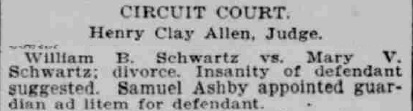
CIRCUIT COURT

Henry Clay Allen, Judge.

William B. Schwartz vs. Mary V. Schwartz; divorce. Insanity of defendant suggested. Samuel Ashby appointed guardian ad litem for defendant.

“Circuit Court,” The Indianapolis Journal (Indianapolis, Indiana), 30 June 1901, p. 7, col. 4; digital image, Chronicling America (http://chroniclingamerica.loc.gov/ : accessed 23 March 2014).

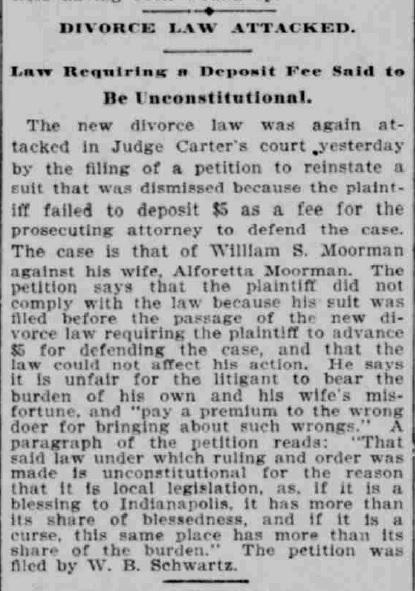
Divorce Law Attacked

Schwartz, W. B. - 1901-06-30 #1DIVORCE LAW ATTACKED

Law Requiring a Deposit Fee Said to Be Unconstitutional

The new divorce law was again attacked in Judge Carter’s court yesterday by the filing of a petition to reinstate a suit that was dismissed because the plaintiff failed to deposit $5 as a fee for the prosecuting attorney to defend the case. The case is that of William S. Moorman against his wife, Alforetta Moorman. The petition says that the plaintiff did not comply with the law because his suit was filed before the passage of the new divorce law requiring the plaintiff to advance $5 for defending the case, and that the law could not affect his action. He says it is unfair for the litigant to bear the burden of his own and his wife’s misfortune, and ‘pay a premium to the wrong doer from bringing about such wrongs.’ A paragraph of the petition reads: “That said law under which ruling and order was made in unconstitutional for the reason that it is local legislation, as, if it is a blessing to Indianapolis, it has more than its share of blessedness, and if it is a curse, this same place has more than its share of the burden.” The petition was filed by W. B. Schwartz.

“Divorce Law Attacked,” The Indianapolis Journal (Indianapolis, Indiana), 30 June 1901, p. 7, col. 3; digital image, Chronicling America (http://chroniclingamerica.loc.gov/ : accessed 23 March 2014).

New Suits Filed

Schwartz, W. B. - 1901-06-11

NEW SUITS FILED

Wallshier D. Bodenhamer vs. William B. Schwartz et al.: mortgage foreclosure. Superior court, Room 2.

“New Suits Filed,” The Indianapolis Journal (Indianapolis, Indiana), 11 June 1901, p. 6, col. 5; digital image, Chronicling America (http://chroniclingamerica.loc.gov/ : accessed 21 March 2014).

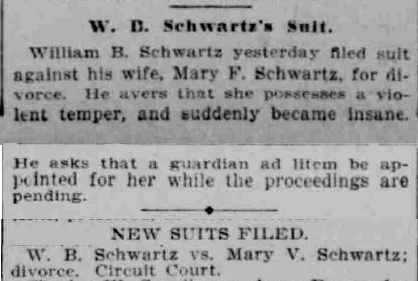
W. B. Schwartz’s Suit

Schwartz, W. B. - 1901-06-04W. B. Schwartz’s Suit.

William B. Schwartz yesterday filed suit against his wife, Mary F. Schwartz, for divorce. He avers that she possesses a violent tempter, and suddenly became insane. He asks that a guardian ad litem be appointed for her while the proceedings are pending.

NEW SUITS FILED.

W.  B. Schwartz vs. Mary V. Schwartz: divorce. Circuit Court.

“W. B. Schwartz’s Suit,” The Indianapolis Journal (Indianapolis, Indiana), 4 June 1901, p. 6, col. 5-6; digital image, Chronicling America (http://chroniclingamerica.loc.gov/  : accessed 20 March 2014).

“New Suits Filed,” The Indianapolis Journal (Indianapolis, Indiana), 4 June 1901, p. 6, col. 6; digital image, Chronicling America (http://chroniclingamerica.loc.gov/ : accessed 20 March 2014).

[Editor’s note: This is the second time W. B. Schwartz filed for a divorce. The first filing was in May 1900.]

Divorce Suit Blanks

Schwartz, W. B. - 1901-03-16Divorce Suit Blanks.

Divorces have become so common that attorneys are now using printed blank forms of complaints which are so constructed as to fit the average suit for separation. The first of this form of complaints was filed yesterday by W. B. Schwartz. The form is as complete as that used in the foreclosure of improvement liens and other matters of common litigation, having blanks in the body of the charges for dates, names and a short space left for the pronoun “he” or “she,” according to the sex of the plaintiff or defendant.

The suit that initiates this form of divorce complaint into the courts of Marion county is that of Mattie M. Travis against Charles F. Travis, basing the grounds for separation on alleged cruel treatment.

NEW SUITS FILED.

Emily W. Mills vs. Winifred B. Holton et al.: on note. Superior Court, Room 1.
Hiram H. Gibbs vs. Richard Ryse: damages. Superior Court, Room 2.
Mary Bogle vs. George Bogle: divorce. Superior Court, Room 1.
Sadie E. Leacock vs. Anna B. Knee et al.: partition. Circuit Court.
Mattie M. Travis vs. Charles F. Travis: divorce. Superior Court, Room 3.

“Divorce Suit Blanks,” and “New Suits Filed,” The Indianapolis Journal (Indianapolis, Indiana), 16 March 1901, p. 8, col. 4; digital image, Chronicling America (http://chroniclingamerica.loc.gov/ : accessed 18 arch 2014).

Sheriff’s Sale

Schwartz, W. B. - 1901-03-02SHERIFF’S SALE.

By virtue of a certified copy of a degree to me directed from the clerk of the Marion Circuit Court of Marion county, Indiana, in Cause No. 10042, wherein Thomas Johnson is plaintiff and Walter S. Oder is defendant, requiring me to make the sum of nineteen dollars and fifty centers ($19.50), as provided for in said decree, with interest and costs, I will expose at public sale to the highest bidder, on

SATURDAY, THE 9TH DAY OF MARCH, 1901,

between the hours of 10 o’clock a.m. and 4 o’clock p.m. of said day, at the door of the courthouse of Marion county, the rents and profits for a term not exceeding seven years, of the following real estate in Marion county, Indiana: Lot numbered two hundred and forty-six (246), in Dr. Martin’s second addition to the city of Indianapolis.

If such rents and profits will not sell for a sufficient sum to satisfy said decree, with interest and costs, I will, at the same time and place, expose to public sale the fee simple of said real estate, or so much thereof as may be sufficient to discharge said decree. Said sale will be made without relief from valuation or appraisement laws.

EUGENE SAULCY,
Sheriff of Marion County.

Feb. 16, 1901

W. B. Schwartz, Attorney for Plaintiff.

“Sheriff’s Sale,” The Indianapolis Journal (Indianapolis Indiana), 2 March 1901, p. 6, col. 2; digital image, Chronicling America (http://chroniclingamerica.loc.gov/ : accessed 18 March 2014).

The Court Record

Schwartz, W. B. - 1900-06-25THE COURT RECORD.

SUPERIOR COURT.

Hon. Martin Hugg, Special Judge.

William Schwartz vs. Mary Schwartz; divorce. Evidence partly heard. Continued.

“The Court Record,” The Indianapolis Journal (Indianapolis, Indiana), 25 June 1900, p. 3, col. 5; digital image, Chronicling America (http://chroniclingamerica.loc.gov/ : accessed 17 March 2014).

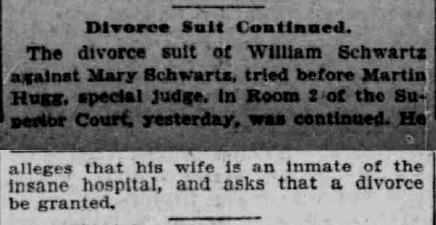
Divorce Suit Continued

Schwartz, W. B. - 1900-06-24Divorce Suit Continued.

The divorce suit of William Schwartz against Mary Schwartz, tried before Martin Hugg, special judge. In Room 2 of the Superior Court, yesterday, was continued. He alleges that his wife is an inmate of the insane hospital, and asks that a divorce be granted.

“Divorce Suit Continued,” The Indianapolis Journal (Indianapolis, Indiana), 24 June 1900, p. 6, col. 3-4; digital image, Chronicling America (http://chroniclingamerica.loc.gov/ : accessed 16 March 2014).