Tag Archives: Indianapolis

H. H. Symms Co.

Schwartz, W. B. - 1903-12-05

NEW SUITS FILED.

H. H. Symms Co. vs. William B. Schwartz et al.; suit on judgment. Superior Court, Room 2.

“The Court Record: New Suits Filed,” The Indianapolis Journal (Indianapolis, Indiana), 5 December 1903, p. 5, col. 3; digital image, Newspaper Archive (http://www.newspaperarchive.com : accessed 1 April 2014).

Not Ground For Divorce

Schwartz, W. B. - 1903-07-08 #2NOT GROUND FOR DIVORCE

Judge Carter Would Not Grant It Because Defendant Is Insane

William B. Schwartz, an attorney whose wife has been in the Central Insane Hospital since 1890, was refused a divorce by Judge Carter yesterday. The judge said that insanity is not a ground for divorce in Indiana; that it is one of the “risks of the partnership,” and he would not grant a decree on that ground.

Edgar A. Brown was appointed guardian to look after Mrs. Schwartz’s interest in the suit. Schwartz’s attorney made the plea that his client should not for the rest of his life have such a burden upon him, and claimed that in the insanity of his wife interfered with transfers of real estate he desired to make. Mrs. Schwartz’s brother was in favor of a divorce.

“Not Ground For Divorce,” The Indianapolis Journal (Indianapolis, Indiana), p. 9, col. 1; digital image, Chronicling America (http://chroniclingamerica.loc.gov/ : accessed 30 March 2014).

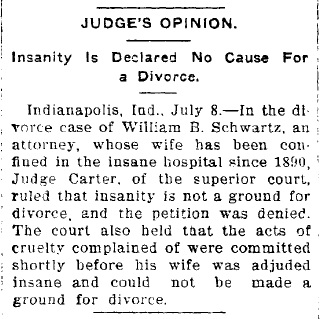
Judge’s Opinion

Schwartz, W. B. - 1903-07-08JUDGE’S OPINION

Insanity is Declared No Cause For a Divorce

Indianapolis, Ind., July 8. – In the divorce case of William B. Schwartz, an attorney, whose wife has been confined in the insane hospital since 1890, Judge Carter, of the superior court, ruled that insanity is not a ground for divorce, and the petition was denied. The court also held that the acts of cruelty complained of were committed shortly before his wife was adjuded insane and could not be made a ground for divorce.

“Judge’s Opinion,” Hartford City Telegram (Hartford, Indiana), 8 July 1903, p. 8, col. 2; digital image, Newspaper Archive (http://www.newspaperarchive.com : accessed 28 March 2014).

Schwartz Hit with a Club

Schwartz, W. B. - 1902-09-09

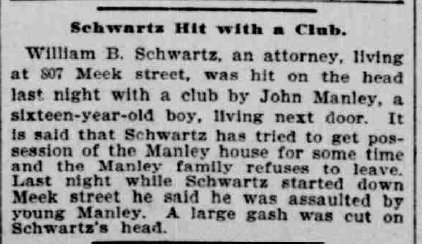
Schwartz Hit with a Club.

William B. Schwartz, an attorney, living at 807 Meek street, was hit on the head last night with a club by John Manley, a sixteen-year-old boy, living next door. It is said that Schwartz has tried o get possession of the Manley house for some time and the Manley family refuses to leave. Last night while Schwartz started down Meek street he said he was assaulted by young Manley. A large gash was cut on Schwartz’s head.

“Schwartz Hit with a Club,” The Indianapolis Journal (Indianapolis, Indiana), 9 September 1902, p. 3, col. 5; digital image, Chronicling America (http://chroniclingamerica.loc.gov/ : accessed 28 March 2014).

Cannot Give Away Money

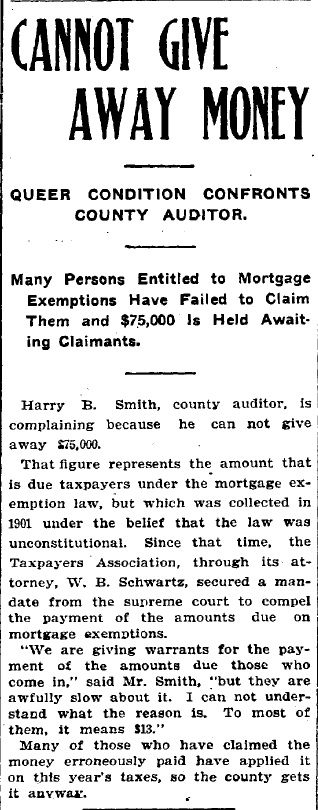
Schwartz, W. B. - 1902-08-20CANNOT GIVE AWAY MONEY

QUEER CONDITION CONFRONTS COUNTY AUDITOR

Many Persons Entitled to Mortgage Exemptions Have Failed to Claim Them and $75,000 is Held Awaiting Claimants

Harry B. Smith, county auditor, is complaining because he can not give away $75,000.

That figure represents the amount that is due taxpayers under the mortgage exemption law, but which was collected in 1901 under the belief that the law was unconstitutional. Since that time, the Taxpayers Association, through its attorney, W. B. Schwartz, secured a mandate from the supreme court to compel the payment of the amounts due on mortgage exemptions.

“We are giving warrants for the payment of the amounts due those who come in,” said Mr. Smith, “but they are awfully slow about it. I can not understand what the reason is. To most of them, it means $13.”

Many of those who have claimed the money erroneously paid have applied it on the year’s taxes, so the county gets it anyway.

“Cannot Give Away Money,” The Indianapolis Sun (Indianapolis, Indiana), 20 August 1902, p. 1, col. 5; digital image, Newspaper Archive (http://www.newspaperarchive.com : accessed 27 March 2014).

Rip-Roaring Platform Adopted By Democrats

Schwartz, W. B. - 1902-05-27A RIP-ROARING PLATFORM ADOPTED BY DEMOCRATS

In Their County Convention, Which Was Attended By A Small Crowd

Democratic County Convention Got Plenty of Candidates

[Editor’s note: The actual article was much longer but I have included only the section that mentions W. B.]

Clark for Prosecutor

Charles B. Clark was nominated for prosecutor on the first ballot by the following vote: Clark, 294 1/2; Cox, 245 1/2; Barrett, 24.

The convention was literally stampeded for Charles E. Cox for criminal judge. Someone in Lawrence township tried to nominate someone else, but the convention would not hear him. Cox was nominated with a roar.

Ex-Judge and ex-Mayor Thomas L. Sullivan was nominated with another roar for circuit judge.

After several had declined to run, Edgar A. Brown, W. B. Schwartz and John Kingsbury consented to allow themselves to be voted for for superior judge in room 1. Brown was nominated by acclamation after part of the vote had been taken.

A Rip-Roaring Platform Adopted By Democrats,” The Indianapolis Sun (Indianapolis, Indiana), 27 May 1902, p. 1, col. 1-3; digital image, Newspaper Archive (http://www.newspaperarchive.com : accessed 26 March 2014).

W. B. Schwartz’s Circular

Schwartz, W. B. - 1902-02-13W. B. Schwartz’s Circular.

The following circular letter that was written by W. B. Schwartz, an attorney, and circulated among taxpayers has come to the attention of County Auditor Smith. “As you perhaps already know, the mortgage exception law has recently been declared unconstitutional by the Circuit Court in the case of Martha Lewis and Benjamin Lewis on the relation of the State of Indiana vs. the auditor of Marion county.

“Following this decision the probability is that you will receive no further exemption or deduction from your taxes on account of your mortgage indebtedness, and that within twelve months you will be required to pay back to the county the taxes from which the auditor has already exempted you under the mortgage exemption law.

“There is, however, one opportunity for you to keep from paying back the taxes from which you have already been exempted, and which may also entitled you to exemption on the taxes payable this year and next. If advantage is taken of this opportunity, however, it must be done not later than Jan. 31, 1902.

“If you will call at my office I can explain to you more fully the situation and instruct you what steps will be necessary for you to take in order to avail yourself of the deductions mentioned and avoid paying back any and all exemptions for which you have already received credit.”

County Auditor Smith said yesterday that no such attempt would be made, that the books in the office showed taxes paid in full, and that he could not go back and collect exemptions allowed. Schwartz says he will stand by his circular.

“W. B. Schwartz’s Circular,” The Indianapolis Journal (Indianapolis, Indiana), 13 February 1902, p. 12, col. 2-3; digital image, Chronicling America (http://chroniclingamerica.loc.gov/ : accessed 25 March 2014).


 

Claims Law Is Unconstitutional

Schwartz, W. B. - 1901-07-12

Claims Law Is Unconstitutional.

Attorney W. B. Schwartz yesterday attacked the constitutionality of the new divorce law before Judge Carter. He said there is no law that can compel a plaintiff to pay for the defense of his own suit. His client, William S. Moorman, refused to advance the $5 fee for defending the case, and the suit was dismissed by the court. Schwartz asks that his suit be reinstated.

“Claims Law Is Unconstitutional,” The Indianapolis Journal (Indianapolis, Indiana), 12 July 1901, p. 6, col. 5; digital image, Chronicling America (http://chroniclingamerica.loc.gov/ : accessed 24 March 2014).

The Court Record – 30 June 1901

Schwartz, W. B. - 1901-06-30 #2

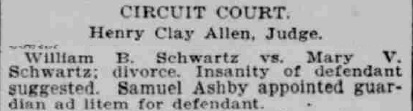
CIRCUIT COURT

Henry Clay Allen, Judge.

William B. Schwartz vs. Mary V. Schwartz; divorce. Insanity of defendant suggested. Samuel Ashby appointed guardian ad litem for defendant.

“Circuit Court,” The Indianapolis Journal (Indianapolis, Indiana), 30 June 1901, p. 7, col. 4; digital image, Chronicling America (http://chroniclingamerica.loc.gov/ : accessed 23 March 2014).

Divorce Law Attacked

Schwartz, W. B. - 1901-06-30 #1DIVORCE LAW ATTACKED

Law Requiring a Deposit Fee Said to Be Unconstitutional

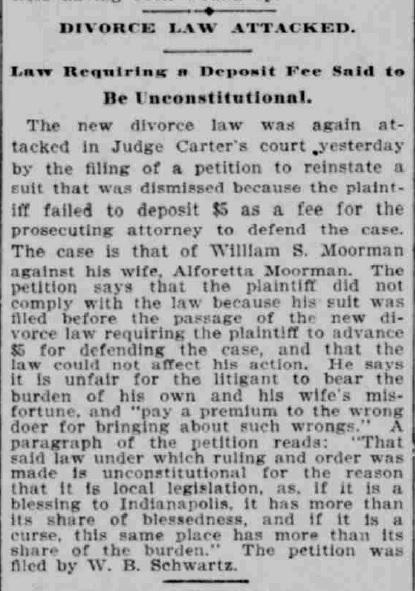
The new divorce law was again attacked in Judge Carter’s court yesterday by the filing of a petition to reinstate a suit that was dismissed because the plaintiff failed to deposit $5 as a fee for the prosecuting attorney to defend the case. The case is that of William S. Moorman against his wife, Alforetta Moorman. The petition says that the plaintiff did not comply with the law because his suit was filed before the passage of the new divorce law requiring the plaintiff to advance $5 for defending the case, and that the law could not affect his action. He says it is unfair for the litigant to bear the burden of his own and his wife’s misfortune, and ‘pay a premium to the wrong doer from bringing about such wrongs.’ A paragraph of the petition reads: “That said law under which ruling and order was made in unconstitutional for the reason that it is local legislation, as, if it is a blessing to Indianapolis, it has more than its share of blessedness, and if it is a curse, this same place has more than its share of the burden.” The petition was filed by W. B. Schwartz.

“Divorce Law Attacked,” The Indianapolis Journal (Indianapolis, Indiana), 30 June 1901, p. 7, col. 3; digital image, Chronicling America (http://chroniclingamerica.loc.gov/ : accessed 23 March 2014).