Tag Archives: Indianapolis

Mrs. Tillie Robinson’s Suit

Schwartz, W. B. - 1900-01-26MRS. TILLIE ROBINSON’S SUIT.

Wants a Divorce from the Man Who Tried to Kill Her

Mrs.Tillie Robinson who was shot and seriously wounded a few days ago by her husband, Paul Robinson, yesterday began an action against him for divorce. The shooting took place on Jan. 19, in the office of Attorney Schwartz on East Washington street, where Mrs. Robinson was employed as stenographer. Mrs. Robinson says she was married on Dec. 15, 1897. She avers that shortly after her marriage her husband began to show a trifling and quarrelsome disposition. She says he failed to support her properly and would go away and leave her destitute of means of support. She also charges that he was inclined to be fond of other woman. She avers that as soon as learned of his conduct she declined to live with him longer. Their trouble culminated on Jan. 19 when he walked into the office of Lawyer Schwartz and, finding his wife there at work, fired at her. The bullet took effect and she was painfully wounded.

“Mrs. Tillie Robinson’s Suit,” The Indianapolis Journel (Indianapolis, Indiana), 26 January 1900, p. 6, col. 4; digital image, Chronicling America (http://chroniclingamerica.loc.gov/ : accessed 11 March 2014).

Bullet Takes Effect

Schwartz, W. B. - 1900-01-20BULLET TAKES EFFECT

PAUL VALDO ROBINSON ATTEMPTS TO KILL HIS WIFE

The Murderous Attack Is Made in the Law Office of W. B. Schwartz – Robinson Arrested.

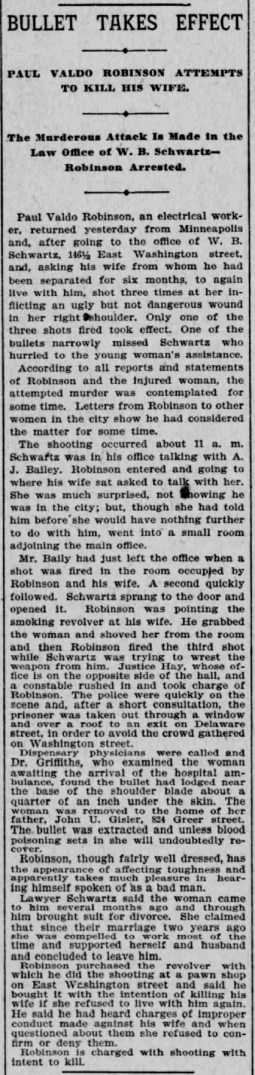
Paul Valdo Robinson, an electrical worker, returned yesterday from Minneapolis and, after going to the office of W. B. Schwartz, 146 ½ East Washington street, and, asking his wife from whom he had been separated for six months, to again live with him, shot three times at her inflicting an ugly but not dangerous wound in her right shoulder. Only one of the three shots fired took effect. One of the bullets narrowly missed Schwartz who hurried to the young woman’s assistance.

According to all reports and statements of Robinson and the injured woman, the attempted murder was contemplated for some time. Letters from Robinson to other women in the city show he had considered the matter for some time.

The shooting occurred about 11 a.m. Schwartz was in his office talking with A. J. Bailey. Robinson entered and going to where his wife sat asked to talk with her. She was much surprised, not knowing he was in the city; but, though she told him before she would have nothing further to do with him, went into a small room adjoining the main office.

Mr. Baily had just left the office when a shot was fired in the room occupied by Robinson and his wife. A second quickly followed. Schwartz sprang to the door and opened it. Robinson was pointing the smoking revolver at his wife. He grabbed the woman and shoved her from the room and then Robinson fired the third shot while Schwartz was trying to wrest the weapon from him. Justice Hay, whose office is on the opposite side of the hall, and a constable rushed in and took charge of Robinson. The police were quickly on the scene and, after a short consultation, the prisoner was taken out through a window and over a roof to an exit on Delaware street, in order to avoid the crowd gathering on Washington street.

Dispensary physicians were called and Dr. Griffiths, who examined the woman awaiting the arrival of the hospital ambulance, found the bullet had lodged near the base of the shoulder blade about a quarter of an inch under the skin. The woman was removed to the home of her father, John U. Gisler, 824 Greer street. The bullet was extracted and unless blood poisoning sets in she will undoubtedly recover.

Robinson, though fairly well dressed, has the appearance of affecting toughness and apparently takes much pleasure in hearing himself spoken of as a bad man.

Lawyer Schwartz said the woman came to him several months ago and through him brought suit for divorce. She claimed that since their marriage two years ago she was compelled to work most of the time and supported herself and husband and concluded to leave him.

Robinson purchased the revolver with which he did the shooting at a pawn shop on East Washington street and said he bought it with the intention of killing his wife if she refused to live with him again. He said he had heard charges of improper conduct made against his wife and when questioned about them she refused to confirm or deny them.

Robinson is charged with shooting with intent to kill.

“Bullet Takes Effect,” The Indianapolis Journal (Indianapolis, Indiana), 20 January 1900, p. 8, col. 3; digital image, Chronicling America (http://chroniclingamerica.loc.gov/ : accessed 10 March 2014).

[Editor’s note: Paul V. Robinson married Tillie Gisler on 15 December 1897, in Marion county, Indiana. Tillie was short for Matilda. On June 1, 1900, Matilda was living with her parents, and she was divorced.]

Robinson, Tillie (Gisler) - 1900 Census

1900 U. S. Census, Marion county, Indiana, population schedule, Centre Township, ED 162, p. 1-B, John U. Gisler

© Deborah Sweeney, 2014.
Post originally found at: https://genealogylady.net/2014/03/11/bullet-takes-effect/
Couldn’t Stand Prosperity

Schwartz, W. B. - 1899-10-17COULDN’T STAND PROSPERITY

An Inventor Too Nervous to Count His New Fortune

Though excuses for all sorts of doings have been made on account of a circus and the circus parade the latest in Indianapolis is something out of the ordinary, says the Philadelphia Inquirer. A story is told of W. B. Schwartz, a lawyer of Indianapolis, who has patented a typewriter having a number of vital and valuable points, going into Fletcher’s bank with a representative of the typewriter trust. The lawyer had a certified check or draft for something like $50,000, which had been given him for his interest in the patent. The check was presented and the cashier began piling out bundles of bills. When the full amount had been placed on the desk the teller asked Mr. Schwartz to count it and see if all was right. He counted awhile, but became so nervous that he could not “check out” the supposed amount in each pile of bills, and finally pushed all back and said: “Oh, I guess it’s all right. Give me a certificate of deposit.” It was done and Mr. Schwartz left. The incident was quite amusing to patrons of the bank who happened in at the time. When asked about it Mr. Schwartz denied being excited on account of the large sum which he had just received as a result of five years’ work. He said it was the circus parade that excited him. Mr. Schwartz is a practicing attorney, living at 1130 Brookside avenue, with an office at 146 ½ East Washington street. He was born in Berlin, Holmes county, Ohio, in 1859, and after attending school at that place and at Pittsburg, Pa., went to Brazil, Ind., where he was admitted to the bar and practiced there from 1889 to 1894. He went to Indianapolis in 1895, and shortly after, on account of frequent use of a typewriting machine, became imbued with the idea of inconvenience of the machines of the day and thought that a “visible” writing machine would be the proper thing. He worked out a plan in his head and finally put it into sketches. His plans were so perfected about a year later that he applied for a patent, which was granted in August, 1896. Not long after the patent was granted, representatives of the typewriter trust began negotiations with Mr. Schwartz for the purchase of the patent. He refused all offers, but kept the trust in tow, and several conferences during the last few weeks resulted in the sale of the patent to the trust. On account of business and personal reasons Mr. Schwartz declined to give the exact amount of the purchase money, and the details of the transaction, but it is understood that he received more than $50,000 in cash and is to receive $3,000 a year until 1901 to refrain from further action connected with the invention of typewriters.

“Couldn’t Stand Prosperity,” Mexia Evening News (Mexia, Texas), 17 October 1899, p. 4, col. 6; digital image, Newspaper Archive (http://www.newspaperarchive.com : accessed 7 March 2014).

Made Him Nervous

Schwartz, W. B. - 1899-07-22MADE HIM NERVOUS

INDIANAPOLIS, July 21. – After exhausting his means in perfecting a visible line typewriter, W. B. Schwartz, an attorney of this city, yesterday called at a bank with a representative of the eastern typewriting machine combination and received $50,000 for his patent. Mr. Schwartz was so nervous when this fortune was shoved at him that he counted but little of it, pushing the bunch back and taking a certificate of deposit. He worked on his patent for several years. The sale to the trust was made yesterday. He is also to be paid $3,000 a year royalty.

“Made Him Nervous,” Fort Wayne Daily Journal Gazette (Fort Wayne, Indiana), 22 July 1899, p. 3, col. 4; digital image, Newspaper Archive (http://www.newspaperarchive.com : accessed 7 March 2014).

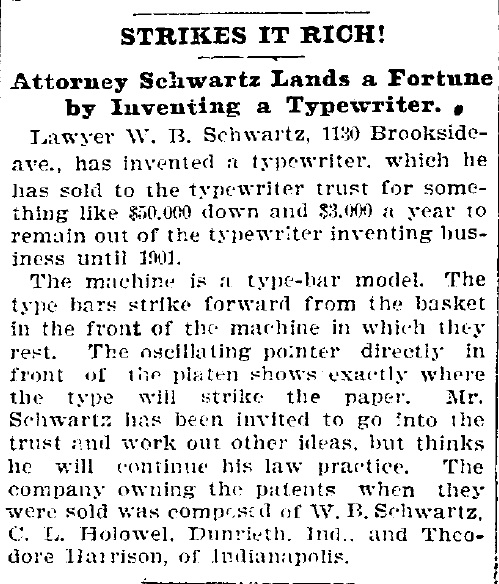
Strikes It Rich!

Schwartz, W. B. - 1899-07-21STRIKES IT RICH!

Attorney Schwartz Lands a Fortune by Inventing a Typewriter

Lawyer W. B. Schwartz, 1130 Brookside ave., has invented a typewriter, which he has sold to the typewriter trust for something like $50,000 down and $3,000 a year to remain out of the typewriter inventing business until 1901.

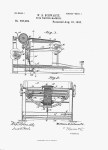
The machine is a type-bar model. The type bars strike forward from the basket in the front of the machine in which they rest. The oscillating pointer directly in front of the platen shows exactly where the type will strike the paper. Mr. Schwartz has been invited to go into the trust and work out other ideas, but thinks he will continue his law practice. The company owning the patents when they were sold was composed of W. B. Schwartz, C. L. Holowel, Dunrieth, Ind., and Theodore Harrison, of Indianapolis.

“Strikes It Rich!,” Indianapolis Sun (Indianapolis, Indiana), 21 July 1899, p. 3, col. 2; digital image, Newspaper Archive (http://www.newspaperarchive.com : accessed 7 March 2014).

$50,000

Schwartz, W. B. - 1899-07-06W B. Schwartz Gets $50,000

W. B. Schwartz, until a few years ago a well known attorney of this city, but now president of the Visible Typewriter company, of Indianapolis, has sold his patent and franchise to the typewriter trust, of New York, for the sum of $50,000 in cash. Mr. Schwartz has also been retained by the trust company as chief mechanical expert, at a handsome salary. He may have to go the New York city to reside, in order to properly discharge his duties in connection with the typewriter enterprise.

The machine which has proven to be such a winner was invented and the patent taken out while Mr. Schwartz was a resident of this city. He has many friends here who will be pleased to learn of his success. – Miner.

“W. B. Schwartz Gets $50,000,” Clay County Enterprise (Brazil, Indiana), 13 July 1899, p. 1, col. 5; digital image, Newspaper Archive (http://www.newspaperarchive.com : accessed 7 March 2014).

Wanted

Schwartz, W. B. - 1897-08-21

WANTED – Situation as housekeeper, by lady: references. Inquire W. B. Schwartz. 94 1/2 E. Washington

“To Late to Classify,” Indianapolis Sun (Indianapolis, Indiana), 21 August 1897, p. 2, col. 5; digital image, Newspaper Archive (http://www.newspaperarchive.com : accessed 6 March 2014).

Patents

Schwartz, W. B. - 1896-08-29Patents were issued to Indianians Tuesday as follows: M. T. Deck, Milton, wire fencing; J. M. Dodridge, Milton, harvesting machine; G. W. Grimes, Bluffton, pumping power; P. J. Harrah, Bloomfield, combined vise and drill; S. W. R. Mitchell, Burrows, nut lock; F. Norkus, Indianapolis, cabinet; L. Rostetter, Ft. Wayne, wood rim bending machine; W. B. Schwartz, Indianapolis, typewriting machine; E. J. Stansbury, Plymouth, guide loop for check reins; W. K. Thompson, Alexandria, manufacturing edged tool; T. L. Wallace, Indianapolis, saw filing machine.

“State News,” Logansport Times (Logansport, Indiana), 29 August 1896, p. 7, col. 3; digital image, Newspaper Archive (http://www.newspaperarchive.com : accessed 4 March 2014).

“U.S. Patent and Trademark Office Patents, 1790-1909,” database, Ancestry.com (http://www.ancestry.com : 4 March 2014), W. B. Schwartz, Type Writing Machine, patented 18 August 1896.

Relocated

During 1895, William B. Schwartz appears to have relocated to Indianapolis. I have not found any newspaper articles announcing his departure from Brazil. By 1896, he appears in the Indianapolis City Directory.

Schwartz, W. B. - Indianapolis directory, 1896

W. B. Schwartz, Indianapolis, 1896

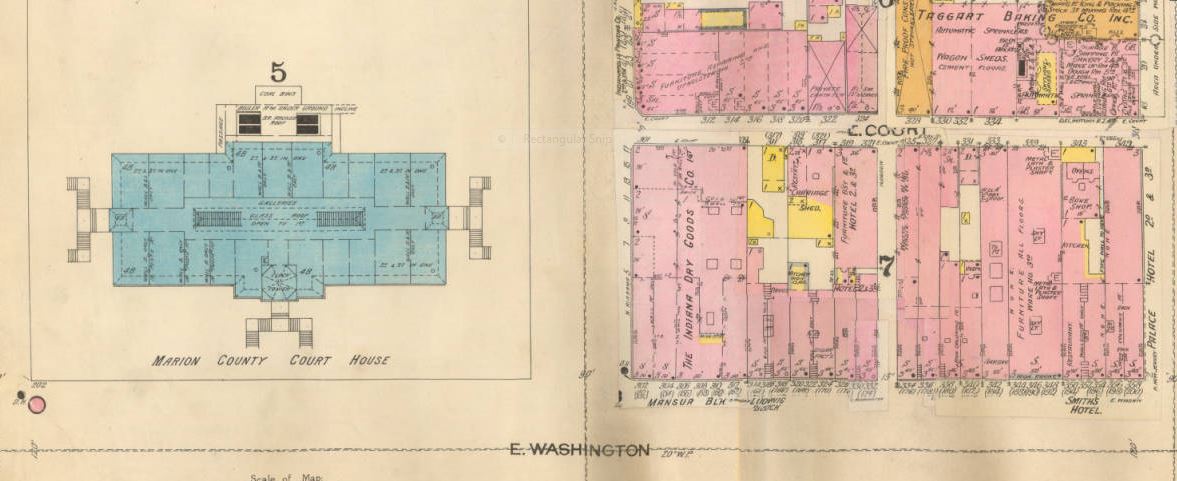
E. Washington Street is one of the major boulevards through the city of Indianapolis. The Marion County court house is located on E. Washington. William’s office would have been located down the street.

E. Washington Street, 1898 (plate 153)

Sanborn map of Indianapolis (1898) showing the Marion County Courthouse

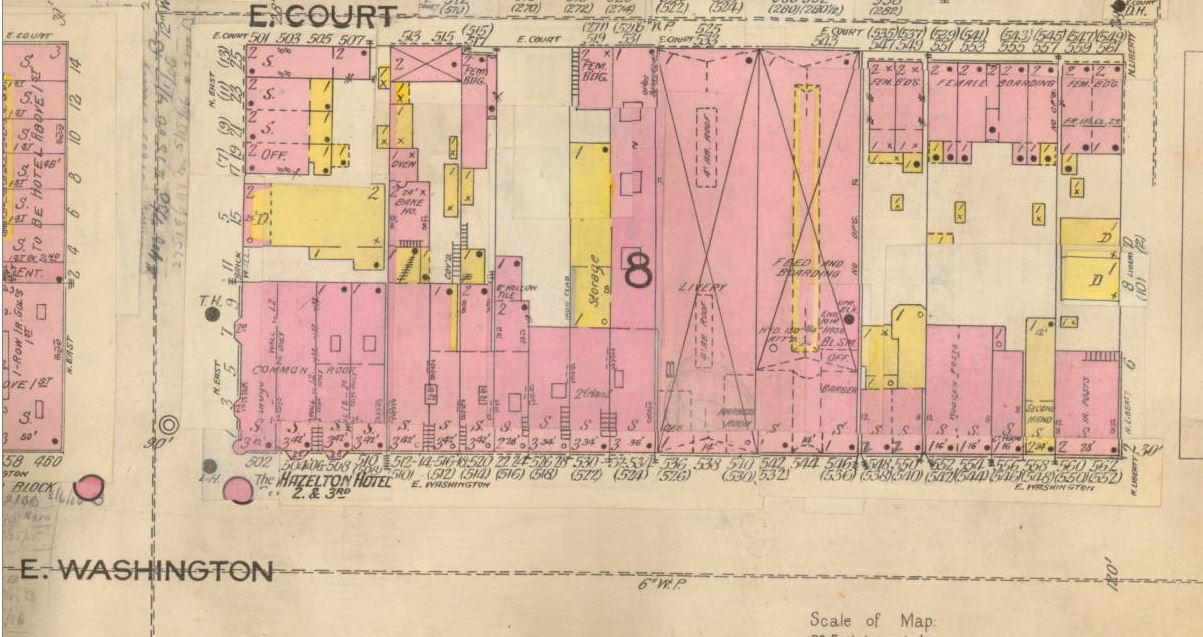
E. Washington Street, 1898 (plate 154)

Block with W. B. Schwartz’s house

W. B. Schwartz’s house would have been one of the long skinny homes to the west (or to the left) of the livery. The modern map at Google shows that these buildings no longer exist.

Sources Used:

“U.S. City Directories, 1821-1989,” database and images, Ancestry.com (http://www.ancestry.com : accessed 3 March 2014), Indianapolis, 1896.

“Indianapolis Sanborn Map and Baist Atlas Collection,” database and images, Indiana Memory Project (http://www.in.gov/memories : 4 March 2014), Indianapolis, 1898.

Legal Business

Schwartz, W. B. - 1890-03-13

W. B. Schwartz went to Indianapolis on legal business Wednesday.

“Individualities,” The Democrat (Brazil, Indiana), 13 March 1890, p. 1, col. 5; digital image, Newspaper Archive (http://www.newspaperarchive.com : accessed 27 January 2014).