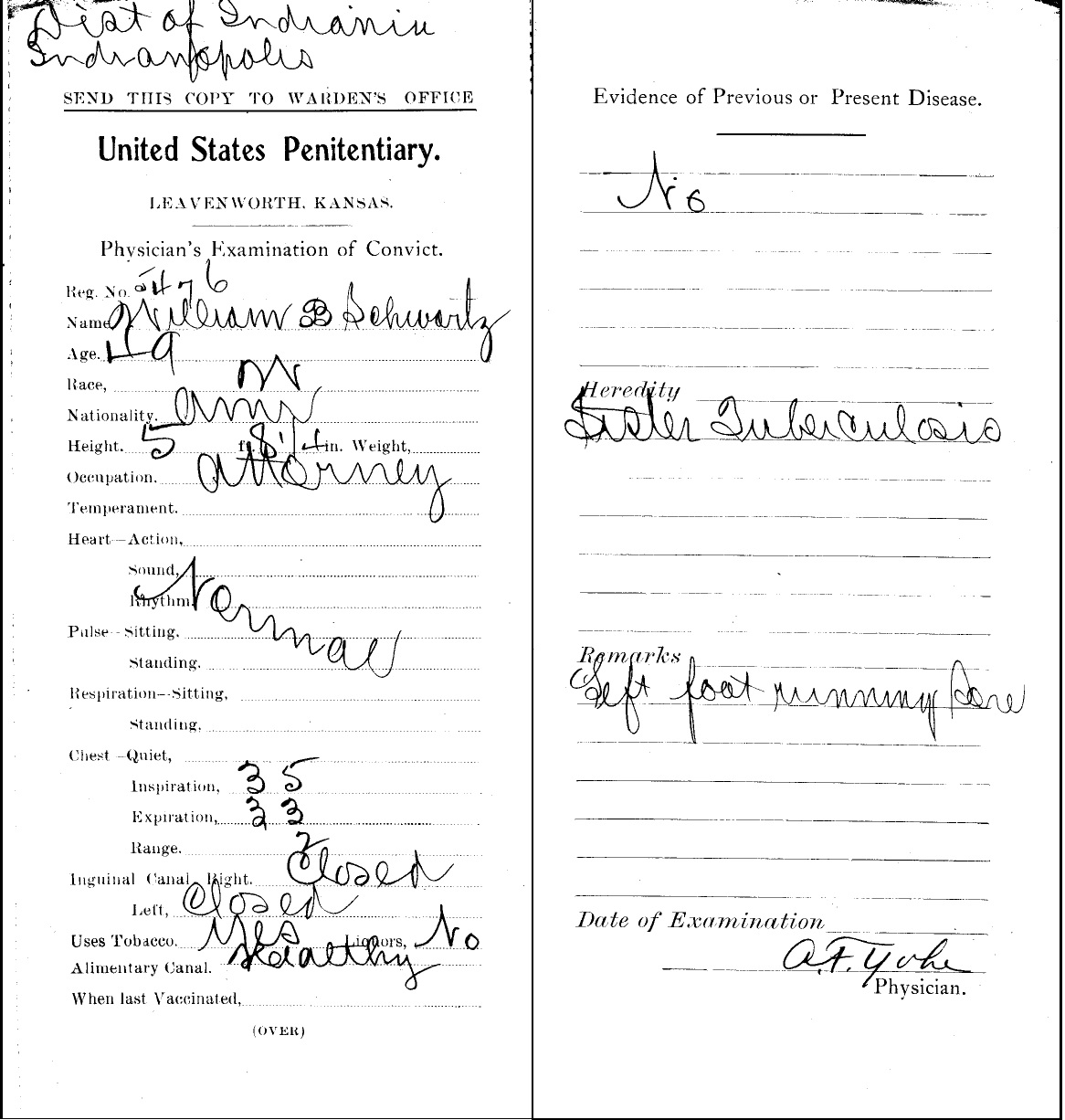
Source:
Physician’s Examination of Convict, William B. Schwartz, Prisoner no. 5476; Inmate Case Files, U. S. Penitentiary, Leavenworth, Kansas, 1895-1931, Record Group 129; National Archives at Kansas City, Missouri.
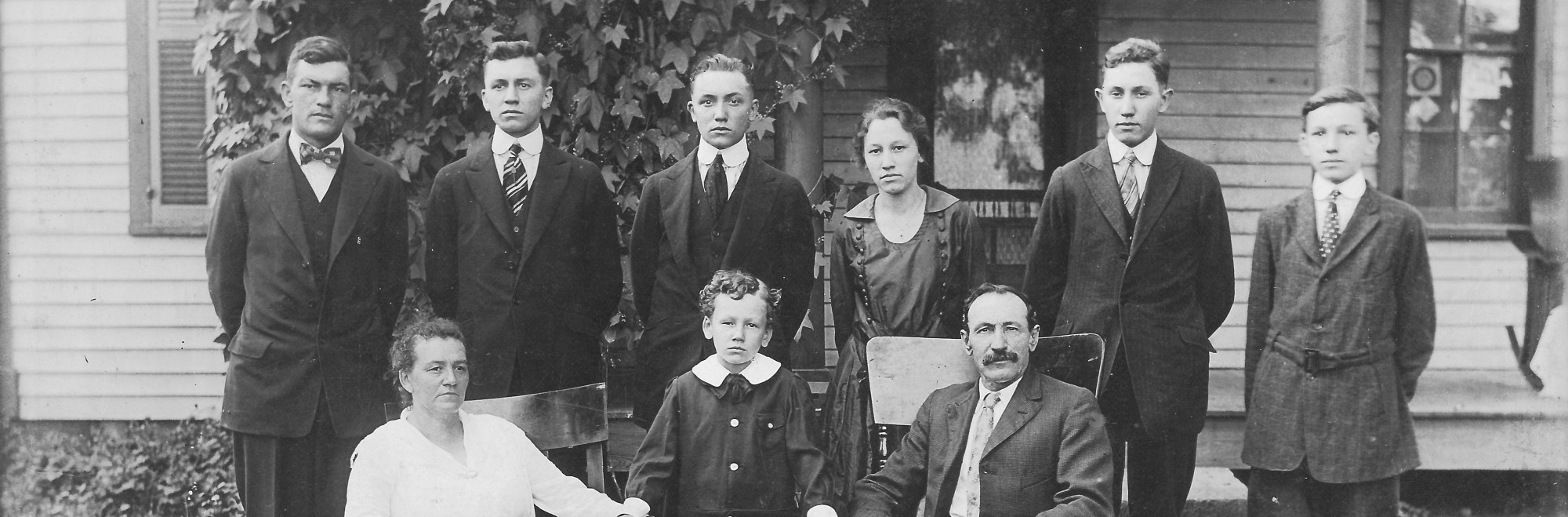
Source:
Physician’s Examination of Convict, William B. Schwartz, Prisoner no. 5476; Inmate Case Files, U. S. Penitentiary, Leavenworth, Kansas, 1895-1931, Record Group 129; National Archives at Kansas City, Missouri.
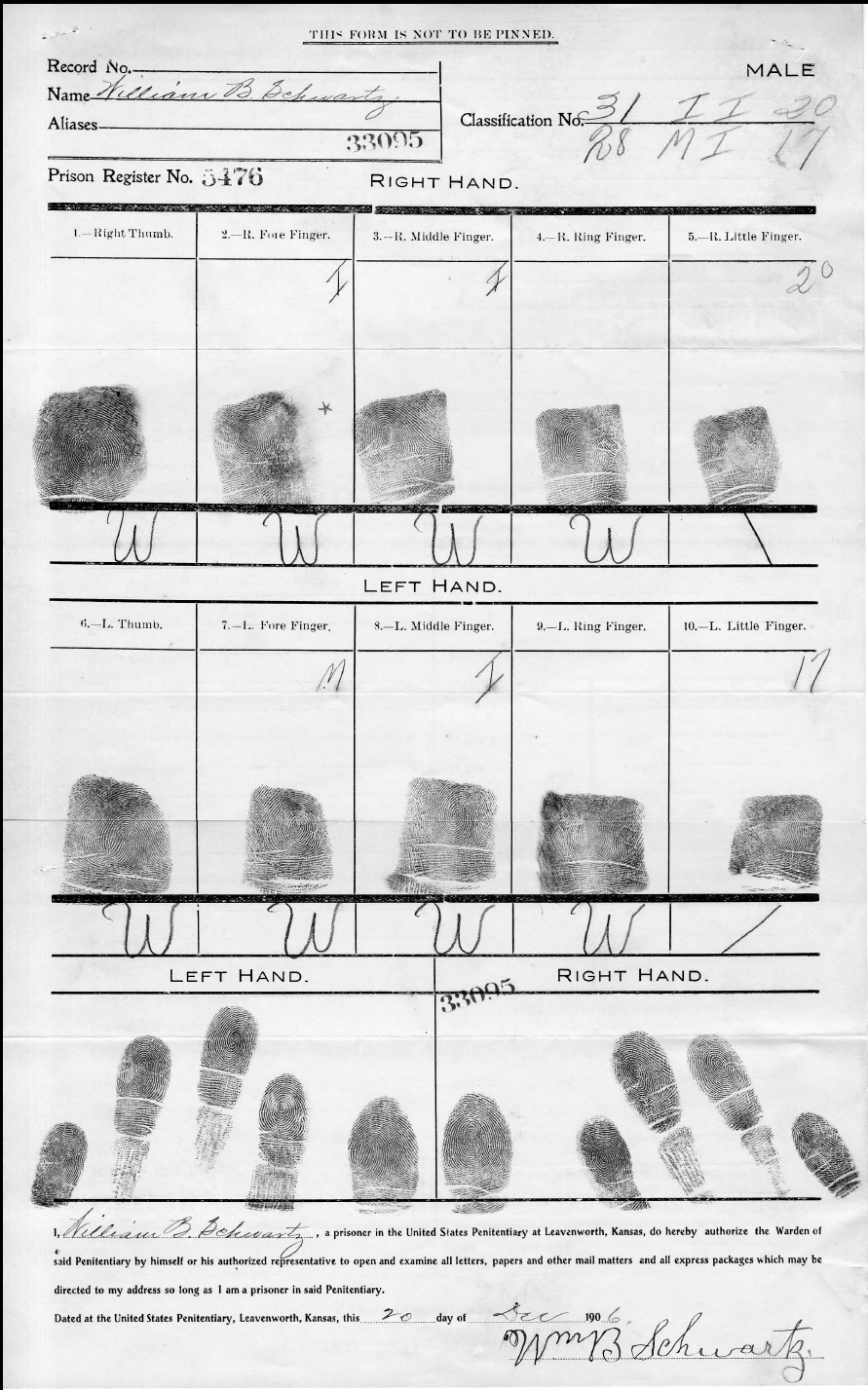
Fingerprints of William B. Schwartz, taken at Fort Leavenworth, Kansas, 1906.
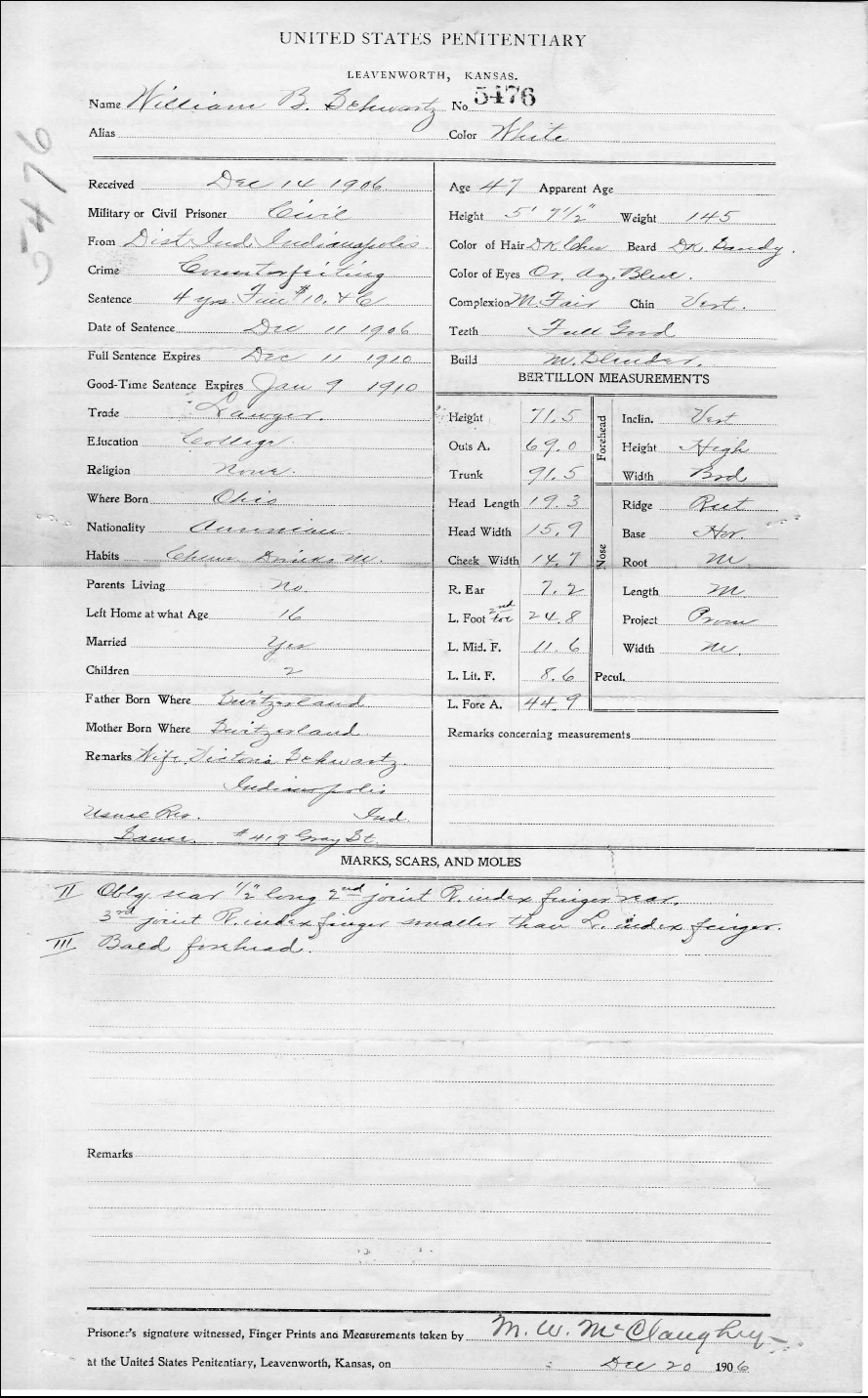
Body measurements and biographical information of William B. Schwartz, taken at Fort Leavenworth, Kansas, 1906.
Source:
Fingerprints and measurements, William B. Schwartz, Prisoner no. 5476; Inmate Case Files, U. S. Penitentiary, Leavenworth, Kansas, 1895-1931, Record Group 129; National Archives at Kansas City, Missouri.
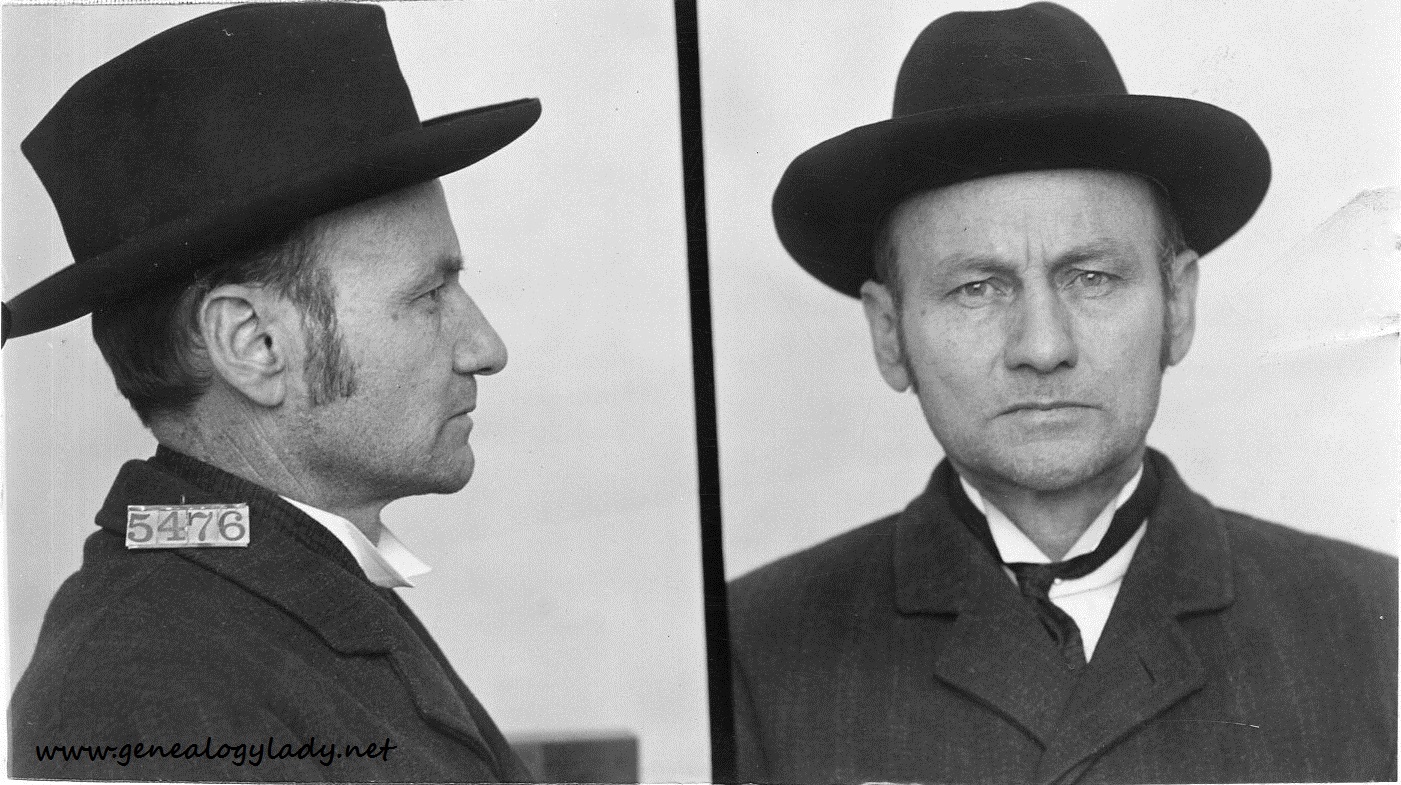
Before Shot – Photograph presumably taken when William B. Schwartz arrived at Fort Leavenworth, Kansas, 1906.

After shot – Photograph of William B. Schwartz after he had been processed at Fort Leavenworth, Kansas, 1906.
Source:
Mugshots, William B. Schwartz, Prisoner no. 5476; Inmate Case Files, U. S. Penitentiary, Leavenworth, Kansas, 1895-1931, Record Group 129; National Archives at Kansas City, Missouri.
 Marshal’s Criminal Docket No. 4193
No. 6742
DISTRICT COURT U.S.
DISTRICT OF INDIANA
THE UNITED STATES
William B. Schwartz
Warrant to Marshal to Deliver Convict to
United States Penitentiary
At Fort Leavenworth, Kansas
Filed Dec 26, 1906
Noble C. Butler, Clerk
Kealing
U.S. Attorney
EXECUTED BY DELIVERING THE
BODY OF THE WITH-IN NAMED DE-
FENDANT TO THE WARDEN OF THE
UNITED STATES PENITENTIARY AT
FORT LEAVENWORTH KANSAS, THIS
14th DAY OF December 1906,
Henry C. Pettit
MARSHAL
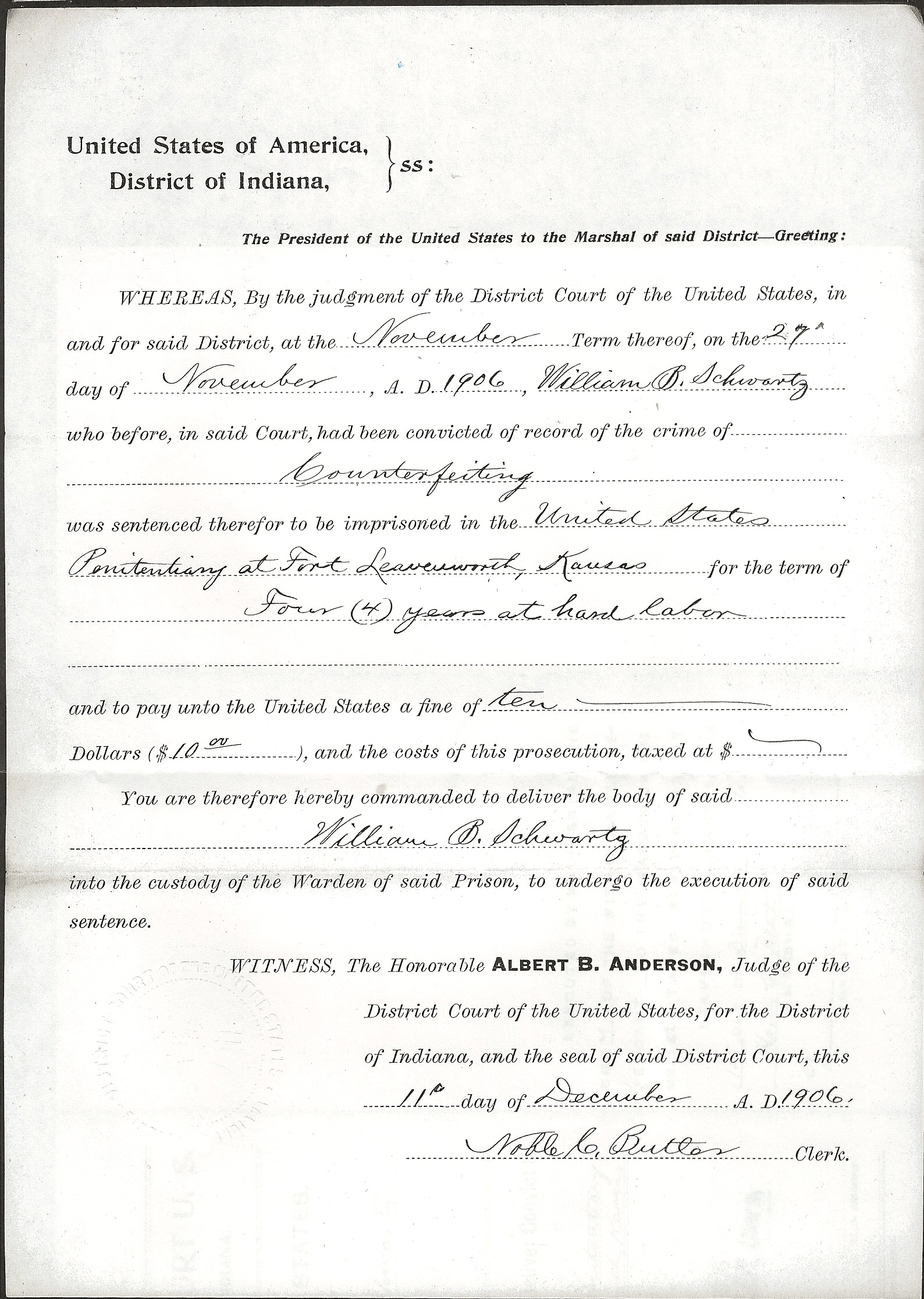
United States of America }
District of Indiana } SS:
The President of the United States to the Marshal of said District – Greeting:
WHEREAS, By the judgment of the District court of the United States, in and for said District, at the November Term thereof, on the 27th day of November, A. D. 1906, William B. Schwartz who before, in said Court, had been convicted of record of the crime of Counterfeiting was sentenced therefor to be imprisoned in the United States Penitentiary at Fort Leavenworth, Kansas for the term of Four (4) years at hard labor and to pay unto the United States a fine of ten Dollars ($10⁰⁰), and the costs of this prosecution, taxes at $ – .
You are therefore hereby commanded to deliver the body of said William B. Schwartz into the custody of the Warden of said Prison, to undergo the execution of said sentence.
WITNESS, the Honorable Albert B. Anderson, Judge of the District Court of the United States, for the District of Indiana, and the seal of said District Court, this 11th day of December A. D. 1906.
Noble C. Butler Clerk.
Source:
Warrant to Marshal to Deliver Convict, 26 December 1906; United States vs. William B. Schwartz, case no. 6742; Criminal Case Files, U. S. District Court, Southern District of Indiana, 1854-1981; Records of the District Courts of the United States, Record Group 21; National Archives, Chicago, Illinois.

ON WAY TO PRISON
GROUP OF CONVICTED MEN STARTED WESTWARD IN MARSHAL’S CHARGE
Eight men sentenced to terms in the United States prison at the last term of the federal court started for that institution at Fort Leavenworth, Kas., Thursday, in charge of United States Marshal H. C. Pettit and Duputies Dave Rankin and Tom Martin, leaving the city at 11:45. The prisoners are William Schwartz, the Indianapolis attorney, sentenced for four years for counterfeiting; John row, one year for making false affidavit as to pension papers; Theodore Linninger, three years, for passing counterfeit coins; Theodore Englebert, of Richmond, one year for taking money from a letter, as an employee of the postoffice; Judson Sturtevant, three years for robbing a postoffice; Alexander Rusilla, one year for counterfeiting; Napoleon B. Livingston, one year for impersonating a government pension officer; Clarence Robertson, one year for forging a money order.
Mrs. Gustave A. Consman, of Terre Haute, true to her husband, who is serving a term in prison for embezzlement, called at the marshal’s office before the officers departed with the prisoners, and entrusted to them a package intended to make her husband’s Christmas brighter.
“On Way to Prison,” Indianapolis Sun (Indianapolis, Indiana), p. 2, col. 6; digital image, Newspaper Archive (http://www.newspaperarchive.com : accessed 16 April 2014).

No. 6742
U. S. DISTRICT COURT
November Term, 1906
At Indianapolis
UNITED STATES
vs.
William B. Schwartz,
Indianapolis
INDICTMENT
Counterfeiting
Sec. 5457 & 5458
A TRUE BILL:
Mark Hillsarne
Foreman
Filed Nov 22 1906
Noble C. Butler, Clerk
Joseph B. Kealing
U.S. DISTRICT ATTORNEY
U.S. WITNESSES
T. E. Halls, S.S.O. – Indianapolis
Chauncey A. Manning – ”
Merrill Wilson – “

UNITED STATES OF AMERICA }
DISTRICT OF INDIANA } SS:
IN THE DISTRICT COURT OF THE UNITED STATES FOR THE DISTRICT OF INDIANA.
November Term, A.D. 1906, at Indianapolis.
THE GRAND JURORS OF THE UNITED STATES, Within and for the District of Indiana, impaneled, sworn and charged in said Court, at the term aforesaid, to inquire for the United States, within and for the District of Indiana aforesaid, upon their oath present that William B. Schwartz late of said District, at the District aforesaid, on sixth day of June in the year of our Lord one thousand, nine hundred and six, unlawfully, knowingly and feloniously did then and there have in his possession, at the same time, with intent then and there to pass, utter and publish the same as true and genuine, to some person or persons, to the Grand Jurors aforesaid unknown, two similar pieces of falsely made, forged and counterfeited coin, in the likeness and similitude of the silver coin of the United States, which has been coined at the mints of the United States, commonly called a —; and also thirty-eight similar pieces of falsely made, forged and counterfeited coin, in the likeness and similitude of the silver coin of the United States, which has been coined at the mints of the United States, commonly called a half dollar (crossed out) with intent then and there to defraud the said person, or persons, unknown, as aforesaid, to the said Grand Jurors, he, the said William B. Schwartz then and there well knowing the same to be falsely made, forged and counterfeited, contrary to the form of the statute of the United States in such case made and provided, and against the peace and dignity of the United States of America.

Second COUNT
And the Grand Jurors aforesaid, upon their oath aforesaid, do further charge and present that William B. Schwartz late of the said District, at the District aforesaid, on the first day of May in the year of our Lord one thousand, nine hundred and six unlawfully and feloniously did then and there falsely make, forge and counterfeit, and did cause and procure to be falsely made, forged and counterfeited, and did willingly aid and assist in falsely making, forging and counterfeiting ten similar pieces of falsely made, forged and counterfeited coin in the resemblance and similitude of the silver coin of the United States, which has been coined at the mints of the United States, commonly called a — dollar; and also fifty similar pieces of falsely made, forged and counterfeited coin in the resemblance and similitude of the silver coin of the United States, which has been coined at the mints of the United States, commonly called a half dollar, with intent then and there and therewith to defraud some person, or persons, to the Grand Jurors aforesaid unknown, contrary to the form of the statute of the United States in such case made and provided, and against the peace and dignity of the United States of America.
Joseph B. Keating
U.S. Attorney
SOURCE:
Indictment Counterfeiting, 22 November 1906; United States vs. William B. Schwartz, case no. 6742; Criminal Case Files, U. S. District Court, Southern District of Indiana, 1854-1981; Records of the District Courts of the United States, Record Group 21; National Archives, Chicago, Illinois.
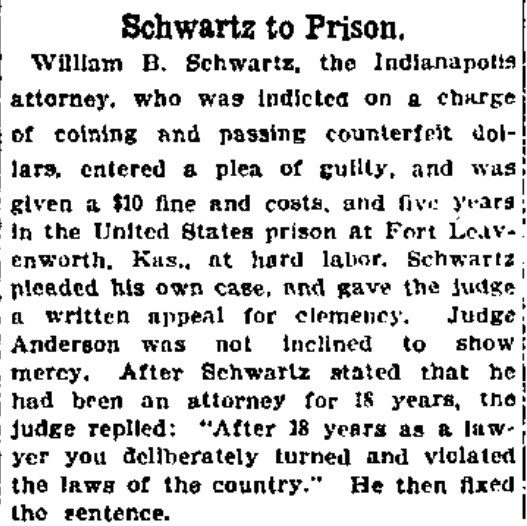 Schwartz to Prison.
William B. Schwartz, the Indianapolis attorney, who was indicted on a charge of coining and passing counterfeit dollars, entered a plea of guilty, and was given a $10 fine and costs, and five years in the United States prison at Fort Leavenworth, Kas., at hard labor. Schwartz pleased his own case, and gave the judge a written appeal for clemency. Judge Anderson was not inclined to show mercy. After Schwartz stated that he had been an attorney for 18 years, the judge replied: “After 19 years as a lawyer you deliberately turned and violated the laws of the country.” He then fixed the sentence.
“Schwartz to Prison,” Indianapolis Sun (Indianapolis, Indiana), 27 November 1906, p. 1, col. 5; digital image, Newspaper Archive (http://www.newspaperarchive.com : accessed 7 April 2014).

“The men are well treated,” he said. “Their food is good. It is utterly false that Edward Franklin, the night turnkey, has been intoxicated. I know he has not touched a drop in ten years. As to the complaint about the filth, they are expected to clean their own quarters. I announced to them in criminal court, where some of them were arraigned, that none would get a bite to eat until the cells were thoroughly cleaned.
“Yes, Judge Alford asked me about the complaint, and I showed him the evidences of the plot to escape. They made the complaint in order to escape punishment.”
Inspection of Ward.
County Commissioner McGregor and a representative of The Sun visited the jail Thursday, inspected the United States ward, and talked to the prisoners, who were house-cleaning very industriously, by applying streams of water from the hose to the cell floors. They said they were required to mop the floors every morning, but complained that there was a thorough cleaning ordered only once in about three weeks.
“Everything in that letter was true,” said Attorney William B. Schwartz, the counterfeiter, looking through the bars “Our bed-clothing is full of vermin, which is the worst things we have to bear.”
Prisoners Were Beaten
“Is it true that Jack Blake and L. Knauss were seriously beaten because they did not wish to sign the letter” he was asked.
“They were not hurt,” Schwartz replied, smiling, but he admitted they had been punished by the “Kangaroo court.”
Knauss cried when asked about his experience. “The ‘Kangaroo court’ said that I could not have a cot unless I paid for it,” he said, “and after the first night I had to sleep on the floor. They beat me up when I refused to sign the letter of complaint. I was whipped with a strap. Boys, it wasn’t right.”
Court Must Be Stopped.
Sheriff Sourbler is taking strenuous measures to break up the sessions of the court. John Smith and a prisoner named Greeley, two officers of the court, have been confined with the negro prisoners as a punishment, but the men in the dungeon are thought to have been the ringleaders.
Commissioner McGregor suggested to the sheriff that a garbage can be provided for the prisoners and that the cells be washed out oftener. Otherwise, he thought the prisoners had no right to complain, and will so report to Judge Alford.
“Jail Plot Exposed,” Indianapolis Sun (Indianapolis, Indiana), 20 September 1906, p. 8, col. 3-4; digital image, Newspaper Archive (http://www.newspaperarchive.com : accessed 7 April 2014).
 Meals for Sunday.
“At this meal the sirup is not diluted. The dinner meal is served at 2 o’clock in the afternoon and is the same as any other day, with the addition of boiled potatoes. No supper is served Sundays. The condition of the table and cutlery used by the prisoners, so far as filth is concerned, is in keeping with the other surroundings. Apparently no attempt is made to removed the corrosive and rusty substance from the cutlery, which time and inattention allow to accumulate.
Men Lost Their Breakfast.
“The occasion of this complaint is the outcome of a long series of the abuses embodied in this letter, and brought to a climax by the further unbearable treatment of the night turnkey in depriving all men in the United States ward of their breakfast, without the slightest provocation, and after he had repeatedly, and without cause, threatened to make life unbearable for all men in this ward. There are men here who are actually starving, unreasonable as it may seem, and unless something is done for the relief of these men the outcome will be serious, in some cases where the men are fit subjects for the hospital.
Ready to Make Affidavits.
“We, therefore, beseech your honor to cause such investigation as you may deem necessary and proper to verify the truth of these statements and to effect a long needed reform.
“Respectfully submitted by the prisoners of the United States ward who stand ready to make affidavit to these and more serious abuses.”
After reading this letter in commissioners court, Thursday, Sheriff Sourbler declared it to be a tissue of lies from beginning to end.
“Jail Plot Exposed,” Indianapolis Sun (Indianapolis, Indiana), 20 September 1906, p. 8, col. 3; digital image, Newspaper Archive (http://www.newspaperarchive.com : accessed 7 April 2014).
 Accused a Negro Jailer.
“There are men confined here who have enjoyed every social and home environment which tends to elevate, and who know and can fully appreciate the rank injustice and demoralizing abuse heaped upon them in a most deplorable way. The writer has reference to the conduct of a deputy sheriff, a negro, whose delight seems to be the application of language which can not be even hinted at here, so vile and foul it is. This is not an exaggeration, but a true recital of facts made in a very conservative way. Men are called names which, anywhere else, would be resented in a very forcible way. When men such as are here have to listen to the blasphemous abuse of a negro which reflects upon the honor and virtue of their mothers, it seems it is high time to call the attention of those who strive for the honest administration of law to correct and prohibit such abuses.
Called It Public Disgrace.
“These are but a few of the true facts, and an investigation would show a state of affairs, a disgrace to any civilized community, and more especially so in a city like Indianapolis, noted for its educational and religious influences.
“It is a notorious fact that the night turnkey, on several occasions, has been so disgracefully under the influence of liquor that he fell prostrate on the floor in the effect to discharge his duties. This occurred once to our knowledge. This man’s language in addressing the prisoners is one continual string of profanity and abuse, and his delight seems to be just how much suffering he can cause the men in every possible way.
Appeals Were Not Heeded.
“We have previous to this appealed to the sheriff with no noticeable change for the better. Refusal has been made of a common garbage can, in which to deposit the natural accumulations of dirt, which, in a place like this, borders on filth. A visit to this ward a 9 o’clock at night will show a condition of affairs worse than has been described.
“The bill of fare of the jail will, no doubt, be interesting to the taxpayers of Marion county, who pay 40 centers per day for the keeping of each inmate. Six mornings a week, sirup, diluted with water; three slices of small loaves of bakers’ bread, with a small cup of coffee, which is invariably cold, compose the breakfast meal. For dinner, either hominy or beans, with meat in a small quantity, and three slices of bread, and water compose the meal. Supper consists of either soup, which, in most cases, is not touched, or diluted sirup and bread with coffee. On Sunday the men eat their breakfast at 8 o’clock.
“Jail Plot Exposed,” Indianapolis Sun (Indianapolis, Indiana), 20 September 1906, p. 8, col. 3; digital image, Newspaper Archive (http://www.newspaperarchive.com : accessed 7 April 2014).
 Genealogy Lady