Category Archives: Newspaper Clippings

Cline Gives Bond

Schwartz, W. B. - 1906-05-23CLINE GIVES BOND

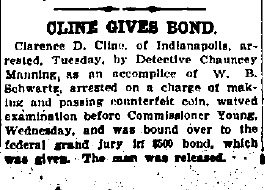
Clarence D. Cline, of Indianapolis, arrested, Tuesday, by Detective Chauncey Manning, as an accomplice of W. B. Schwartz, arrested on a charge of making and passing counterfeit coin, waived examination before Commissioner Young, Wednesday, and was bound over to the federal grand jury in $500 bond, which was given. The man was released.

“Cline Gives Bond,” The Indianapolis Sun (Indianapolis, Indiana), 23 May 1906, p. 1, col. 3; digital image, Newspaper Archive (http://www.newspaperarchive.com : accessed 4 April 2014).

Driven By Misfortune

Schwartz, W. B. - 1906-05-22 #3DRIVEN BY MISFORTUNE

Indianapolis Lawyer Takes to Making Bogus Coins

Counterfeiter Arrested and Confesses He Did it Because of Poverty.

William B. Schwartz Was Unable to Support HIs Family From His Practice and Started Counterfeiting – – – Carried on the Work for Several Years.

INDIANAPOLIS, Ind., Mary 21 – Unable to support two grown daughters and an insane wife by his profession as a lawyer, William B. Schwartz, a member of the Indianapolis bar, admitted to secret service officials this afternoon that he had been forced to make counterfeit half dollars to add to his income.

Schwartz was arrested in his office by Captain Thomas E. Hails, chief of the secret service department, and Merrill E. Wilson, chief deputy United States marshal. Some of the most perfect imitations of half dollars ever found in Indianapolis were discovered in Schwartz’s office, where he finished his output after making the preliminary molds at his home, 419 Grace street.

There was little difficulty in getting Schwartz to admit his guilt. He has been under surveillance almost a year and it is believed he has been making coin nearly two years. Brass molds were used in manufacturing the rough coins, which were composed generally of babbitt metal. These molds or dies were used in Schwartz’s home and after the rough coins were prepared they were taken to his office and finished in an electric battery. One half dollar being “finished” was found in the battery after Schwartz’s arrest by Detective Manning, acting captain of the city detective department, who had been the first to suspect Schwartz.

Officers who made the arrest do not believe that Schwartz passed any great amount of the “queer” in Indianapolis Ind, that he sold his output to an organized gang.

When arrested Schwartz told a tale of poverty and the struggle for existence he has had for the last few years. He is scarcely forty years old and until a few years ago earned a fair compensation from his practice. His wife’s mind became affected, however, and after spending large sums for medical attention, it was necessary to place her in an asylum.

Left with two daughters to support and his practice rapidly decreasing, Schwartz said he knew not from one day’s end to the other where the next day’s meals were coming from.

“Then it was that I got into this business,” he said in conclusion.

“Driven By Misfortune,” The Fort Wayne Journal (Fort Wayne, Indiana), 22 May 1906, p. 1, col. 1; digital image, Newspaper Archive (http://www.newspaper archive.com : accessed 3 April 2014).
Makes Coin Molds

Schwartz, W. B. - 1906-05-22MAKES COIN MOLDS

CLEVER MECHANIC PLEADS HIS POVERTY

Schwartz Put Under $1,000 Bail on Charge of Making Spurious Half Dollars.

William B. Schwartz, the Indianapolis lawyer under arrest for counterfeiting, was given a hearing before United States Commissioner Young, Tuesday, and was committed, in default of $1,000 bail. Schwartz made a complete confession at the hearing and wept as he told how he had been tempted to take to counterfeiting as an easy way of getting money. He said he had made and passed about 100 pieces. About half this number has been taken up by the detectives. He said that when he was absolutely in need of a little money he would get rid of a few of the half dollars and then would not attempt it for some time. He has never had a large law practice and his Income from his business was small. Developments of an interesting nature are looked for. The man was finishing one of the coins by an electric process when arrested. He says he has no confederate outside the city.

The prisoner is strong and healthy. The brass molds with which he made the coins molds he made himself, indicate his mechanical ability. He has two daughters who are said to be supporting themselves. His wife is in an insane asylum. The molds were said to be perfect pieces of workmanship. The authorities regard this one of the best catches made recently.

“Makes Coin Molds,” The Indianapolis Sun (Indianapolis, Indiana), 22 May 1906, p. 8, col. 4; digital image, Newspaper Archive (http://www.newspaperarchive.com : accessed 2 April 2014).

H. H. Symms Co.

Schwartz, W. B. - 1903-12-05

NEW SUITS FILED.

H. H. Symms Co. vs. William B. Schwartz et al.; suit on judgment. Superior Court, Room 2.

“The Court Record: New Suits Filed,” The Indianapolis Journal (Indianapolis, Indiana), 5 December 1903, p. 5, col. 3; digital image, Newspaper Archive (http://www.newspaperarchive.com : accessed 1 April 2014).

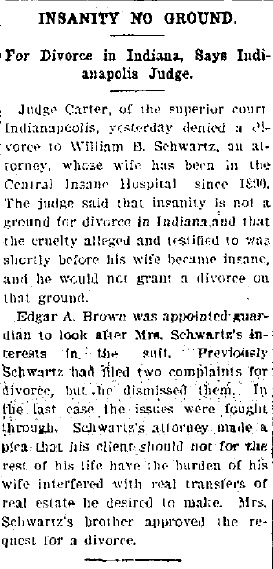
Insanity No Ground

Schwartz, W. B. - 1903-07-09INSANITY NO GROUND

For Divorce in Indiana, Says Indianapolis Judge.

Judge Carter, of the superior court Indianapolis, yesterday denied a divorce to William B. Schwartz, an attorney, whose wife has been in the Central Indiana Insane Hospital since 1890. The judge said that insanity is not a ground for divorce in Indiana and the cruelty alleged and testified to was shortly before his wife became insane, and he would not grant a divorce on that ground.

Edgar A. Brown was appointed guardian to look after Mrs. Schwartz’s interests in the suit. Previously Schwartz had filed two complaints for divorce, but he dismissed them. In the last case the issues were fought through. Schwartz’s attorney made a plea that his client should not for the rest of his life have the burden of his wife interfered with real transfers of real estate he desired to make. Mr. Schwartz’s brother approved the request for a divorce.

“Insanity No Ground,” Logansport Reporter (Logansport, Indiana), 9 July 1903, p. 3, col. 6; digital image, Newspaper Archive (http://www.newspaperarchive.com : accessed 31 March 2014).

Not Ground For Divorce

Schwartz, W. B. - 1903-07-08 #2NOT GROUND FOR DIVORCE

Judge Carter Would Not Grant It Because Defendant Is Insane

William B. Schwartz, an attorney whose wife has been in the Central Insane Hospital since 1890, was refused a divorce by Judge Carter yesterday. The judge said that insanity is not a ground for divorce in Indiana; that it is one of the “risks of the partnership,” and he would not grant a decree on that ground.

Edgar A. Brown was appointed guardian to look after Mrs. Schwartz’s interest in the suit. Schwartz’s attorney made the plea that his client should not for the rest of his life have such a burden upon him, and claimed that in the insanity of his wife interfered with transfers of real estate he desired to make. Mrs. Schwartz’s brother was in favor of a divorce.

“Not Ground For Divorce,” The Indianapolis Journal (Indianapolis, Indiana), p. 9, col. 1; digital image, Chronicling America (http://chroniclingamerica.loc.gov/ : accessed 30 March 2014).

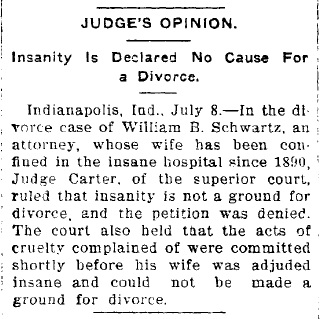
Judge’s Opinion

Schwartz, W. B. - 1903-07-08JUDGE’S OPINION

Insanity is Declared No Cause For a Divorce

Indianapolis, Ind., July 8. – In the divorce case of William B. Schwartz, an attorney, whose wife has been confined in the insane hospital since 1890, Judge Carter, of the superior court, ruled that insanity is not a ground for divorce, and the petition was denied. The court also held that the acts of cruelty complained of were committed shortly before his wife was adjuded insane and could not be made a ground for divorce.

“Judge’s Opinion,” Hartford City Telegram (Hartford, Indiana), 8 July 1903, p. 8, col. 2; digital image, Newspaper Archive (http://www.newspaperarchive.com : accessed 28 March 2014).

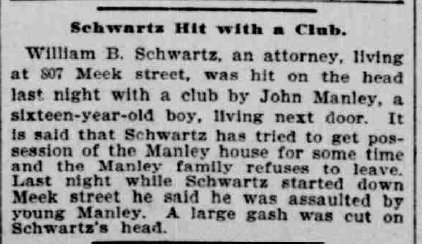
Schwartz Hit with a Club

Schwartz, W. B. - 1902-09-09

Schwartz Hit with a Club.

William B. Schwartz, an attorney, living at 807 Meek street, was hit on the head last night with a club by John Manley, a sixteen-year-old boy, living next door. It is said that Schwartz has tried o get possession of the Manley house for some time and the Manley family refuses to leave. Last night while Schwartz started down Meek street he said he was assaulted by young Manley. A large gash was cut on Schwartz’s head.

“Schwartz Hit with a Club,” The Indianapolis Journal (Indianapolis, Indiana), 9 September 1902, p. 3, col. 5; digital image, Chronicling America (http://chroniclingamerica.loc.gov/ : accessed 28 March 2014).

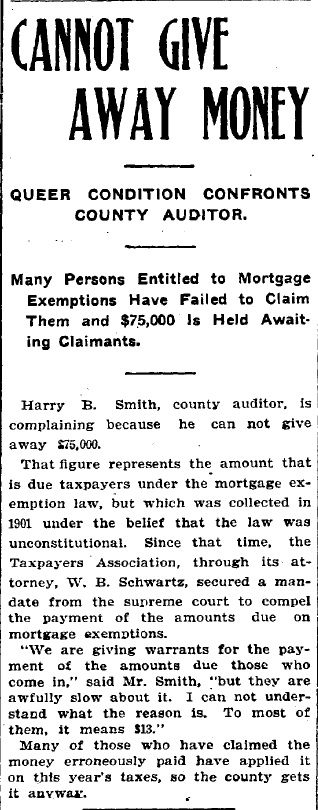
Cannot Give Away Money

Schwartz, W. B. - 1902-08-20CANNOT GIVE AWAY MONEY

QUEER CONDITION CONFRONTS COUNTY AUDITOR

Many Persons Entitled to Mortgage Exemptions Have Failed to Claim Them and $75,000 is Held Awaiting Claimants

Harry B. Smith, county auditor, is complaining because he can not give away $75,000.

That figure represents the amount that is due taxpayers under the mortgage exemption law, but which was collected in 1901 under the belief that the law was unconstitutional. Since that time, the Taxpayers Association, through its attorney, W. B. Schwartz, secured a mandate from the supreme court to compel the payment of the amounts due on mortgage exemptions.

“We are giving warrants for the payment of the amounts due those who come in,” said Mr. Smith, “but they are awfully slow about it. I can not understand what the reason is. To most of them, it means $13.”

Many of those who have claimed the money erroneously paid have applied it on the year’s taxes, so the county gets it anyway.

“Cannot Give Away Money,” The Indianapolis Sun (Indianapolis, Indiana), 20 August 1902, p. 1, col. 5; digital image, Newspaper Archive (http://www.newspaperarchive.com : accessed 27 March 2014).

Rip-Roaring Platform Adopted By Democrats

Schwartz, W. B. - 1902-05-27A RIP-ROARING PLATFORM ADOPTED BY DEMOCRATS

In Their County Convention, Which Was Attended By A Small Crowd

Democratic County Convention Got Plenty of Candidates

[Editor’s note: The actual article was much longer but I have included only the section that mentions W. B.]

Clark for Prosecutor

Charles B. Clark was nominated for prosecutor on the first ballot by the following vote: Clark, 294 1/2; Cox, 245 1/2; Barrett, 24.

The convention was literally stampeded for Charles E. Cox for criminal judge. Someone in Lawrence township tried to nominate someone else, but the convention would not hear him. Cox was nominated with a roar.

Ex-Judge and ex-Mayor Thomas L. Sullivan was nominated with another roar for circuit judge.

After several had declined to run, Edgar A. Brown, W. B. Schwartz and John Kingsbury consented to allow themselves to be voted for for superior judge in room 1. Brown was nominated by acclamation after part of the vote had been taken.

A Rip-Roaring Platform Adopted By Democrats,” The Indianapolis Sun (Indianapolis, Indiana), 27 May 1902, p. 1, col. 1-3; digital image, Newspaper Archive (http://www.newspaperarchive.com : accessed 26 March 2014).