Category Archives: Newspaper Clippings

Smallpox Epidemic, Part XXIII

Indianapolis Journal - 1900-02-06 (Smallpox epidemic)BOARD IS HELPLESS

Nothing to Prevent Spread of Disease
in Washington County.

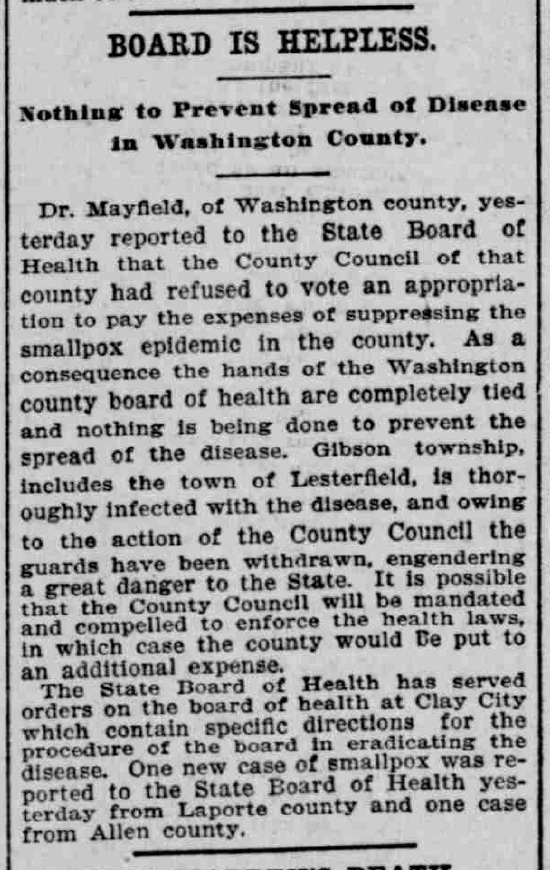
Dr. Mayfield, of Washington county, yesterday reported to the State Board of Health that the County Council of that county had refused to vote an appropriation to pay the expenses of suppressing the smallpox epidemic in the county. As a consequence the hands of the Washington county board of health are completely tied and nothing is being done to prevent the spread of the disease. Gibson township, includes the town of Lesterfield, is thoroughly infected with the disease, and owing to the action of the County Council the guards have been withdrawn, engendering a great danger to the State. It is possible that the County Council will be mandated and compelled to enforce the health laws, in which case the county would be put to an additional expense.

The State Board of Health has served orders on the board of health at Clay City which contain specific directions for the procedure of the board in eradicating the disease. One new case of smallpox was reported to the State Board of Health yesterday from Laporte county and one case from Allen County.

“Board is Helpless,” The Indianapolis Journal (Indianapolis, Indiana), 6 February 1900, p. 8, col. 4; digital image, Chronicling America (http://chroniclingamerica.loc.gov/ : accessed 6 December 2014).
Smallpox Epidemic, Part XXII

Indianapolis Journal - 1900-02-06 (Smallpox epidemic), p. 5SPREAD OF THE PEST.

Rigorous Measure Taken Against
Smallpox in Clay County.

Special to the Indianapolis Journal.
BRAZIL, Ind., Feb. 5. – Dr. Hurty, secretary of the State Board of Health, was here to-day and served the notice issued by the State Board of Health on the County Commissioners to at once take action to stop the spread of smallpox in Clay county. In compliance the commissioners appointed the deputies to meet and act with the local health boards. Several new cases have developed and County Commissioner David Keller is confined to his bed with the malady. Auditor Stigler issued a call for the County Council to meet and appropriate funds to cover the expenses attendant on this action.

“Spread of the Pest,” The Indianapolis Journal (Indianapolis, Indiana), 6 February 1900, p. 5, col. 4; digital image, Chronicling America (http://chroniclingamerica.loc.gov/ : accessed 6 December 2014).

Smallpox Epidemic, Part XXI

Indianapolis Journal - 1900-02-04 (Smallpox epidemic)DEATH FROM SMALLPOX.

One More Fatality Reported from Clay City.

Another death resulting from smallpox was reported to the State Board of Health yesterday from Clay City. The patient was an infant, and contracted the disease from its mother.

Dr. Richards, health officer of Owen county, reported two new cases of smallpox from that county, one of which was of the confluent form and very serious. He said that 90 per cent, of the population had been vaccinated, and he expected the disease would soon subside.

Dr. Ferguson, who, at the solicitation of the State Board of Health, went to Campbellsburg to investigate the suspected cases of smallpox there, returned yesterday morning and said he found several cases of chickenpox and three well-developed cases of smallpox.

“Death From Smallpox,” The Indianapolis Journal (Indianapolis, Indiana), 4 February 1900, p. 6, col. 4; digital image, Chronicling America (http://chroniclingamerica.loc.gov/ : accessed 6 December 2014).

Smallpox Epidemic, Part XX

Indianapolis Journal - 1900-02-03 (Smallpox epidemic)REPORT FROM CLAY CITY
“Special Deputy” Discouraged
Over Smallpox Situation.

Dr. Wolfe Making Stump Speeches –
Dr. A. W. Brayton’s Visit to
Terre Haute

Secretary Hurty, of the State Board of Health, yesterday received a rather discouraging report from his special deputy, who he sent to Clay City to investigate the smallpox situation there. As a result of the report from the deputy, Secretary Hurty says he will go to Brazil, Clay county, to-day.

The report says that while the disease is probably under control at Clay City, Dr. Wolfe, who diagnosed the disease as chicken pox in the first place, is making stump-speeches on the street, declaring that the malady is still an infection of chicken pox. The report says that Dr. Wolfe is joined in giving these “lectures” by William E. Smith. There has been one death at Clay City. This was little Effie Smith, who died on the fifth day after falling ill. Dr. Hurty’s deputy says that in Lewis township, Clay county, there is a great deal of the disease and seeming nothing is being done to prevent its spread. In commenting on the situation the special deputy says: “I fear there will be many fatalities here yet.”

Dr. A. W. Brayton says he was not called to Terre Haute to diagnose smallpox as was sated in an evening paper. He had no seen a case of smallpox since he was at Clay City, on Jan. 19. His object was to arrange with the City Health Board of Terre Haute in regard to some matters of quarantine.

Dr. Brayton says there had been but three or four cases in Terre Haute and that the Health Board, Drs. Willian, Rice and Gerstmeyer, are perfectly familiar with smallpox and chicken pox, and have recognized every case on sight. The first case is recovering in the detention house. A Normal student, well broken out, has been quarantined in his mother’s house and is doing well. Dr. Willian has one suspicious case under quarantine. Allison Peck, who left the city while fully broken out Wednesday night, went at once to his home in Canton, Ill., two hundred miles from Terre Haute. His case was at once recognized and he was promptly quarantined by the Canton Health Board, and this board conferred with Dr. Willian by telephone.

Dr. Brayton says there is little to fear from smallpox in Terre Haute as the people are vaccinating, and the Health Board is active, kind and considerate, and has the esteem and confidence of the people. There is little danger from smallpox, the doctor says, in college towns, as the influence of all the higher schools, both professors and the student body, is in favor of vaccination. He does not expect a wide spread of the disease in the State as the physicians through reading, study of cases, and continued agitation, are quickly recognizing even the mild smallpox, and the people are aiding them more and more, and abiding by their decisions. Dr. Brayton says there has been very general approval of the decision of the Supreme Court, giving boards the right to vaccinate in times of epidemic.

The school authorities of Terre Haute are considering the subject. Probably nine-tenths of the students in the higher schools and colleges are now vaccinated. The boarding house room where Allison Peck lived for four days has been purified and the house will go on as before, as Peck did not mix with the boarders.

FIRST DEATH FROM SMALLPOX
Effie Smith, a Thirteen-Year-Old Clay
City Girl, the Victim.

CLAY CITY, Ind., Feb. 2. – Effie Smith, the thirteen-year-old daughter of Frank Smith, is death’s first victim of smallpox at this place. The premonitory symptoms began last Sunday. The eruption appeared and the fever subsided Tuesday, but the secondary fever made its appearance Thursday, and speedily developed unusual virulence. The victim died shortly after 5 o’clock yesterday afternoon. Severe hemorrhages were a feature of the later course of the disease. Dr. Fred and Dr. Vandivier, who attended the case, have reported other recent instances of hemorrhages in connection with smallpox, but no deaths have occurred.

“Report From Clay City,” The Indianapolis Journal (Indianapolis, Indiana), 3 February 1900, p. 8, col. 6; digital image, Chronicling America (http://chroniclingamerica.loc.gov/ : accessed 6 December 2014).

Smallpox Epidemic, Part XIX

Indianapolis Journal - 1900-02-02 (Smallpox epidemic), p. 8ALL CASES NOT REPORTED

State Health Board Report
Give Interesting Statistics.

Claims More Cases of Smallpox Exist
Than Have Been Reported-High
Death Rate in Central Part.

The State Board of Health has prepared the following report of deaths, contagious diseases, births and marriages for the quarter ending Dec. 31, 1899:

“For the purposes of this report and in order to make comparisons between geographical sections the State is divided into three sections – namely, northern, central and southern. The northern division is bounded on the south by Warren, Tippecanoe, Clinton, Tipton, Madison, Delaware and Randolph counties. These counties comprise the northern tier of the central section. The central section is bounded on the south by Sullivan, Greene, Lawrence, Jackson, Jennings, Ripley and Dearborn counties, and these comprise the northern tier of the southern section. The population of these sections is as follows: Northern, 892,448; central, 1,022,694; southern, 729,838. The total number of deaths for the several sections for the quarter was: Northern, 2,422; central, 3,367; southern, 2,336. The total number of births reported was: Northern, 2,533; central, 4,166; southern, 2,754. Total number of contagious and infectious diseases reported was: Northern, 1,129; central, 1,892; southern, 1,144. The annual rates, calculated on the above quarterly figures, are as follows: Deaths – Northern, 12.8; central, 15.6; southern, 14, per 1,000 of population. Births – The annual rates per 1,000 were as follows: Northern, 13.3; central 16.2; southern, 15. Contagious diseases – The annual rates per 1,000 were as follows: Northern, 50.4; central, 74; southern, 62.

“Of the total number of contagious diseases during the quarter in the whole State there were: Of diphtheria, 1,202, with 347 deaths; scarlet fever, 1,503, with 46 deaths; measles, 181, with 2 deaths; smallpox, 132, no deaths; cerebro-spinal meningitis, 133, with 120 deaths; whooping cough 55, with 28 deaths; typhoid fever, 1,076, with 646 deaths. Total births reported in the whole State, 9,453. Of this number 4,984 were males and 4,469 were females. Of this total 181 were colored, of which 93 were males and 88 females. Still births were 219, plural births 99, illegitimate 154. The total marriages were 7,061. From these figures it appears that the central section of the State for this quarter had the highest death, birth and contagious-disease rate, and in this regard the southern section stands second and the northern third. The number of cases of smallpox reported is far below the truth, because so many cases were mistaken for chicken-pox. There was one death from smallpox in Posey county, but it was not reported, and was discovered by accident, after all reports were tabulated.”

January’s Death Rate.

The records of the City Board of Health show eight more deaths during January than during December, the total for the month being 224. The death rate was heavier during the first of the month than during the latter portion. The largest increase came from pneumonia, twenty-three being recorded during January as against eighteen for December.

BROKE THE QUARANTINE.
Smallpox Suspect Left Terre Haute for Canton, Ill.

Special to the Indianapolis Journal.
TERRE HAUTE, Ind., Feb. 1. –The City Board of Health learned to-day that a smallpox suspect named Peck, whose conditional quarantine was continued for a few hours at the request of his physician, has slipped away from town. This afternoon the Board of Health was asked over the long distance telephone by Canton, Ill., authorities as to the nature of Peck’s disease, saying that he had arrived at his home in that town. There are two other suspects who had been in contact with Peck, and Richard McCloskey, the normal student who has a mild case, was a boarder at the same boarding house.

The city school board will meet to-morrow, and now that the Supreme Court has upheld compulsory vaccination of the pupils of the public schools, an order for vaccination will be issued.

Fifteen Instead of 2,500 Cases.

Special to the Indianapolis Journal.
LINTON, Ind., Feb. 1. – Citizens of Linton and vicinity are greatly wrought up over the report in the Indianapolis Press that 2,500 cases of smallpox existed in Greene county. The report is without foundation, and so far no cases have been reported except in Stockton township, where Linton is situated, and in the vicinity of Jasonville. In Linton there are only three cases, instead of ten, as reported, and these are quarantined with the strictest care. In Wright township, where there is the greatest number of cases, sentries are stationed on each road leading to town to prevent people from the infected parts coming to Linton. A strict quarantine is being enforced by the health officers, and so far no new cases have developed. The postmaster of Linton has never written anything in regard to the disease spreading, and great injustice has been done him and the town by those false reports. The local health officers are doing all they can to prevent the disease from spreading, and so far have it under perfect control. It appears that the number of cases reported includes cases from neighboring counties, but, as to 2,500 cases in Greene county, no such number exists. Not over fifteen are reported in the county.

“All Cases Not Reported,” The Indianapolis Journal (Indianapolis, Indiana), 2 February 1900, p. 8, col. 5; digital image, Chronicling America (http://chroniclingamerica.loc.gov/ : accessed 6 December 2014).

Smallpox Epidemic, Part XVIII

Indianapolis Journal - 1900-02-02 (Smallpox epidemic), p. 6HIGHER COURT DECISIONS.

Important Ruling on Question of Vaccination

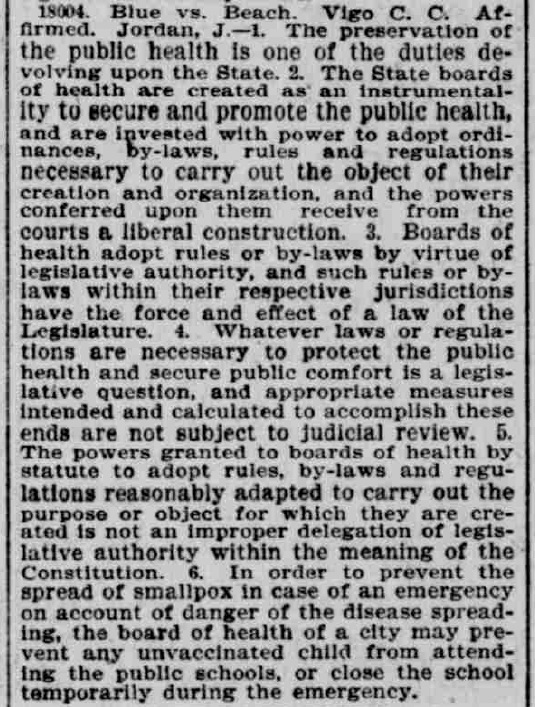
The Supreme Court, in a decision affirming the judgment in the case of Frank D. Blue against Fannie D. Beach and Orville E. Conner, given yesterday, held that the children of parents who refuse to have them vaccinated may be excluded from the public schools during an epidemic of smallpox. In the fall of 1893, during the smallpox scare at Terre Haute, the local Board of Health and the school authorities ordered that no person should attend the public schools unless vaccinated. Blue, who had refused to have his boy vaccinated brought suit to restrain the teacher and principal from excluding his boy from school. The case dragged along in the Circuit Court for nearly three years and a decision was finally rendered in favor of the defendants. Bloom appealed to the Supreme Court in 1896 and the decision was not handed down until yesterday.

“Higher Court Decisions,” The Indianapolis Journal (Indianapolis, Indiana), 2 February 1900, p. 6, col. 4; digital image, Chronicling America (http://chroniclingamerica.loc.gov/ : accessed 6 December 2014).

Indianapolis Journal - 1900-02-02 (Smallpox epidemic), p. 6 (Blue vs. Beach)THE COURT RECORD

SUPREME COURT

18004. Blue vs. Beach. Vigo C.C. Affirmed. Jordan, J. – 1. The preservation of the public health is one of the duties devolving upon the State. 2. The State boards of health are created as an instrumentality to secure and promote the public health, and are invested with power to adopt ordinances, by-laws, rules and regulations necessary to carry out the object of their creation and organization, and the powers conferred upon them receive from the courts a liberal construction. 3. Boards of health adopt rules or by-laws by virtue of legislative authority, and such rules or by-laws within their respective jurisdictions have the force and effect of a law of the Legislature. 4. Whatever laws or regulations are necessary to protect the public health and secure public comfort is a legislative question, and appropriate measures intended and calculated to accomplish these ends are not subject to judicial review. 5. The powers granted to boards of health by statute to adopt rules, by-laws and regulations reasonably adapted to carry out the purpose or object for which they are created is not an improper delegation of legislative authority within the meaning of the Constitution. 6. In order to prevent the spread of smallpox in case of an emergency on account of danger of the disease spreading, the board of health of a city may prevent any unvaccinated child from attending the public school, or close the school temporarily during the emergency.

“The Court Record,” The Indianapolis Journal (Indianapolis, Indiana), 2 Feburary 1900, p. 6, col. 5; digital image, Chronicling America (http://chroniclingamerica.loc.gov/ : accessed 6 December 2014).

Smallpox Epidemic, Part XVII

Indianapolis Journal - 1900-02-01 (Smallpox epidemic)RUMORS OF SMALLPOX
Reports To State Board Of
Health From Over State.

Disease Said to Be Spreading in
Greene County-Chicken Pox
In This City.

Dr. Hurty, secretary of the State Board of Health, received a letter yesterday from H. M. Aspy, the health officer of Geneva, Allen county, which stated that a letter had been received by one of the citizens of the town from Elmer Myers, who lives at 3610 East Twenty-eighth street, Indianapolis, saying that three of Meyer’s children were broken out with smallpox.

Mr. Hurty immediately turned the letter over to City Health Board, and Dr. Ferguson was sent to visit the place. After a careful examination Dr. Ferguson diagnosed, the disease as chickenpox, and when interrogated last night said there was no cause for alarm.

Dr. E. D. Laughlin, the vice president of the State Board of Health, wrote Dr. Hurty yesterday that he had made a second visit to Campbellsburg, and had found a number of cases of smallpox.

A report was also received that the disease was rapidly spreading at Linton, Green county. It is reported that 2,500 new cases of smallpox have developed in Greene county. When Dr. Hurty was apprised of the report last night he said the State board had received no information in regard to it, and added that it was probably untrue.

“Rumors of Smallpox,” The Indianapolis Journal (Indianapolis, Indiana), 1 February 1900, p. 3, col. 3; digital image, Chronicling America (http://chroniclingamerica.loc.gov/ : accessed 6 December 2014).

Smallpox Epidemic, Part XVI

Indianapolis Journal - 1900-01-31 (Smallpox epidemic)CRY FROM FORT BRANCH
Clerk of That Place Wants
Mount Vernon Quarantined.

Says There Are Over Two Hundred
Cases of Smallpox in Po-
sey County.

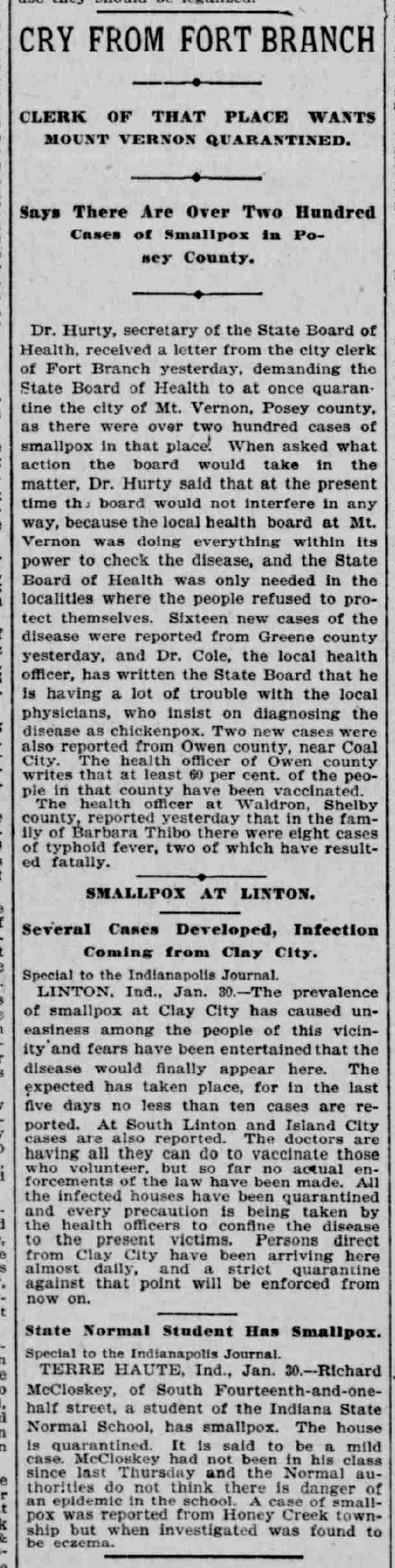
Dr. Hurty, secretary of the State Board of Health, received a letter from the city clerk of Fort Branch yesterday, demanding the State Board of Health to at once quarantine the city of Mr. Vernon, Posey county, as there were over two hundred cases of smallpox in that place. When asked what action the board would take in the matter, Dr. Hurty said that at the present time the board would not interfere in any way, because the local health board at Mr. Vernon was doing everything within its power to check the disease, and the State Board of Health was only needed in the localities where the people refused to protect themselves. Sixteen new cases of the disease were reported from Greene county yesterday, and Dr. Cole, the local health officer, has written the State Board that he is having a lot of trouble with the local physicians, who insist on diagnosing the disease as chickenpox. Two new cases were also reported from Owen county, near Coal City. The health officer of Owen county writes that at least 60 per cent of the people in the county have been vaccinated.

The health officer at Waldron, Shelby county, reported yesterday that in the family of Barbara Thibo there were eight cases of typhoid fever, two of which have resulted fatally.

SMALLPOX AT LINTON.

Several Cases Developed, Infection
Coming from Clay City

Special to the Indianapolis Journal.
LINTON, Ind., Jan. 30. – The prevalence of smallpox at Clay City has caused uneasiness among the people of this vicinity and fears have been entertained that the disease would finally appear here. The expected has taken place, for in the last five days no less than ten cases are reported. At South Linton and Island City cases are also reported. The doctors are having all they can do to vaccinate those who volunteer, but so far no actual enforcements of the law have been made. All the infected houses have been quarantined and every precaution is being taken by the health officers to confine the disease to the present victims. Persons direct from Clay City have been arriving here almost daily, and a strict quarantine against that point will be enforced from now on.

State Normal Student Has Smallpox.

Special to the Indianapolis Journal.
TERRE HAUTE, Ind., Jan. 30. – Richard McCloskey, of South Fourteenth-and-one half street, a student of the Indiana State Normal School, has smallpox. The house is quarantined. It is said to be a mild case. McCloskey had not been in his class since last Thursday and the Normal authorities do not think there is danger of an epidemic in the school. A case of smallpox was reported from Honey Creek township but when investigated was found to be eczema.

“Cry From Fort Branch,” The Indianapolis Journal (Indianapolis, Indiana), 31 January 1900, p. 6, col. 3; digital image, Chronicling America (http://chroniclingamerica.loc.gov/ : accessed 6 December 2014).

Smallpox Epidemic, Part XV

Indianapolis Journal - 1900-01-30 (Smallpox epidemic)STILL CAUSE FOR ALARM

Dr. Hurty Continues Apprehen-
Sive of Smallpox Spreading.

New Cases Reported from Clay City,
Where the Authorities Have Be-
come Aroused Over Situation.

Dr. Hurty said yesterday that his smallpox mail was just as heavy as ever and he was still very apprehensive of the disease spreading. E. B. Laughlin, he member of the State Board of Health who went to Campbellsburg Saturday to investigate reported cases of chicken pox, supposed by the State board to be smallpox, sent word to Dr. Hurty yesterday that the disease was really chicken pox, and chiefly attacked the children.

Four more new cases of smallpox were reported from Clay City, but the health officer says they are not to be attributed to any negligence on the part of the authorities, as everyone in Clay City is working hard to abate the plague, there being absolutely no opposition to the orders given by the health board. There were also four new cases reported from Jackson and Benton counties, two cases from each county. Dr. Beckes, of Vincennes, write Dr. Hurty that in Illinois, directly across the Wabash river from Know county, there is an awful epidemic of smallpox raging, and that the Know county health board is quarantining against it.

CLAY CITY EPIDEMIC.

Everything Possible Is Being Done to
Stamp It Out.

Special to the Indianapolis Journal.
CLAY CITY, Ind., Jan 29. – Now that Clay county is aroused to her needs in connection with the smallpox situation, no effort is being spared to stamp out the disease. Hundreds of persons have been vaccinated, and the quarantine is rigidly enforced. A place of detention has been secured for those refusing to submit to quarantine and this has operated to deter violations of the rules. Fourteen deputies patrol the streets, and care for persons under quarantine, besides guarding the approaches to the town. At Middleberg, a mile away, there are twelve or fifteen cases, and all through the neighboring country the disease is widespread, but everything possible is being done to stamp it out.

No Smallpox in Daviess County.

Special to the Indianapolis Journal.
WASHINGTON, Ind., Jan. 29. – The report that there is smallpox in Daviess county is absolutely without foundation. County Health Officer McConn says there is no smallpox and no sign or immediate danger of any.

Why Not Test the Case?

To the Editor of the Indianapolis Journal:
At the present time there is a wide-spread opposition to vaccination, all over this country. A large majority of intelligent physicians believe that the ills of vaccination are not as bad as the smallpox itself. A large number of people seem to believe the reverse. Now, suppose we stop trying to compel persons to be vaccinated, and let smallpox have a chance for a year or two? “How long halt ye between two opinions? if the Lord be God, follow Him; but if Baal, then follow him.” In the eighteenth century smallpox in France carried off annually 30,000, and in Prussia, 26,000. What if it did? Well, the people in those countries introduced vaccination and stopped completely the spread of that dread disease. They believe in the efficacy of vaccination now. Let us try the disease, pure, simple and unfettered, and see how we come out. A good many people will die, of course, but then we have lots of people this year. It may paralyze business for a time, but we can recover that by patience. When it is tried there will be fewer of the persons living who did not believe in vaccination, and those who survive will not be so handsome after the experiment.
G. W. H. KEMPER, M.D.
Muncie, Ind., Jan. 29.

“Still Cause For Alarm,” The Indianapolis Journal (Indianapolis, Indiana), 30 January 1900, p. 8, col. 5; digital image, Chronicling America (http://chroniclingamerica.loc.gov/ : accessed 6 December 2014).

Smallpox Epidemic, Part XIV

Indianapolis Journal - 1900-01-29 (Smallpox epidemic)JOHN LANE’S TROUBLES

A Smallpox “Suspect” On His Way
To Cincinnati To Get Married.

He Created Consternation at the
Police Station and Was Prompt-
ly Ordered Out.

Commanding officers of the police force, with one exception, are anticipating much amusement this winter from smallpox scares, and the fun began last night. It resulted in a serious discussion whether or not there should be a large sign over the walk in front of the City Dispensary for the guidance of persons afflicted with smallpox, who invariably inquire in the police department for the dispensary. John Lane, colored, entered the office of the police desk sergeant about roll call time. All the sergeants were present, including Sergeant Lowe, who, on one occasion last winter, jumped from a window to get away from a smallpox “suspect.” Lane’s face was disfigured, and he no more than got inside of the room when someone said “smallpox.” Captain Dawson was holding a consultation behind closed doors, but Sergeant Lowe disturbed the conference to get away. Lane did not have a chance to make explanations, but was required at once to leave the room. He had before been in the dispensary and by the doctors there sent to the police department.

Lane said he had been working for a dental company in Chicago and on Monday last, while taking a bottle of sulphuric acid from a shelf, let it fall, turning the contents of the bottle on his face, badly burning it. He was unable to work and was given a pass, he claims, to Cincinnati. At Champaign, Ill., he lost the pass and was put off the train. His face was broken out and all to whom he applied for assistance turned him away, thinking he had smallpox. Finally the city authorities gave him a pass to get rid of him. The transportation furnished did not take him much beyond the county line and there again he was put off. He again applied for transportation and had no difficulty in securing it, and got a little farther on his way. He finally landed in Crawfordsville, where it was thought he had smallpox, and he was furnished with a ticket to Indianapolis. Physicians in Crawfordsville telegraphed the Board of Health here, and Dr. Ferguson was sent to the City Dispensary, where Lane had been instructed to go, to investigate. He found no trace of smallpox, and gave the man a letter to that effect. Lane had no money and as his only means of securing transportation had been spoiled, he knew not how he was going to get to Cincinnati. He was also much worried over the reception he would receive on his arrival there, saying he was going there to get married, but was afraid his affianced would go back on him because of the disfigurement.

Dr. Ferguson, while talking with Sergeant Lowe, told a story of the tendency to discredit a physician’s diagnosis of a case as smallpox, saying that when he was in a small town about a week ago he found every house in the village contained victims of the disease. He was standing in the hotel talking to a local doctor, who contended the afflicted did not have smallpox. Finally, after a number of men said they believed the diagnosis of their local physician, one of them asked Dr. Ferguson if he had examined the patients. He said he had and then the question came, “Have you been with them to-day?” “Yes,” said the doctor. “Well, did you change your clothes or disinfect them afterward?”

“No,” said Dr. Ferguson, “I forgot all about that. I believe I’ll have to do that now – “ but before he had finished the room was clear. His hearers evidently wished to take no chances.

No Cases at Salem.

Special to the Indianapolis Journal.
SALEM, Ind., Jan. 28 – There are no cases of smallpox in Salem nor nearer than several miles. The disease is confined to Gibson township, where it originated, with three new cases across the line in Monroe township, but no deaths. The report that Dr. Mayfield, health officer, has been threatened by Salem citizens is denied by him. The doctors of Salem are having all they can do to vaccinate all who come voluntarily. There are a few cases of violation of the quarantine, but all such offenders may have to answer for these violations as their names are taken and prosecutions will follow.

“John Lane’s Troubles,” The Indianapolis Journal (Indianapolis, Indiana), 29 January 1900, p. 8, col. 6; digital image, Chronicling America (http://chroniclingamerica.loc.gov/ : accessed 6 December 2014).