Tag Archives: Indianapolis

Smallpox Epidemic, Part LIV

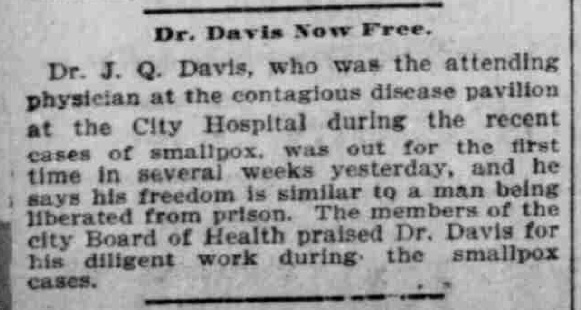
Indianapolis Journal - 1900-04-01 (Smallpox epidemic)Dr. Davis Now Free

Dr. J. Q. Davis, who was the attending physician at the contagious disease pavilion at the City Hospital during the recent cases of smallpox, was out for the first time in several weeks yesterday, and he says his freedom is similar to a man being liberated from prison. The members of the city Board of Health praised Dr. Davis for his diligent work during the smallpox cases.

“Dr. Davis Now Free,” The Indianapolis Journal (Indianapolis, Indiana), 1 April 1900, p. 3, col. 1; digital image, Chronicling America (http://chroniclingamerica.loc.gov/ : accessed 31 January 2015).


Smallpox Epidemic, Part XLV

Indianapolis Journal - 1900-03-08 (Smallpox epidemic)Health Board Wants $2,000.

The Board of Health held a meeting yesterday morning and after allowing monthly bills, decided to ask the City council to appropriate $2,000 for a contagious disease fund. The members of the board say that department is allowed but a few hundred dollars for contagious diseases, which is all used in the general run of business and in the event of a smallpox epidemic or even a case or two of smallpox the board is embarrassed financially. The members believe the board should have the money in case it is needed at any time.

“Health Board Wants $2,000,” The Indianapolis Journal (Indianapolis, Indiana), 8 March 1900, p. 3, col. 4; digital image, Chronicling America (http://chroniclingamerica.loc.gov/ : accessed 6 December 2014).
Smallpox Epidemic, Part XXXII

Indianapolis Journal - 1900-02-20 (Smallpox epidemic), p. 6CASE IN THIS CITY
The Cold Weather Causes Smallpox to
Break Out Afresh.

A well-developed case of smallpox was discovered yesterday afternoon at the home of John Brigham, 806 Bates street. The patient is Mrs. Maggie Sperling, who came here on a visit from Monticello, Ill., about two weeks ago. A physician was called Sunday morning to see the little daughter of Mrs. Sperling, who was supposed to be suffering with convulsions. While examining the child he noticed that the mother was broken out with eruptive sores.

Yesterday morning the city Health Board was notified and immediately sent Dr. Ferguson to investigate the report. He reported that the woman had a well-developed case of smallpox, and while the little daughter was not broken out with the disease, Dr. Ferguson was under the impression that she was suffering from the first stages of it. The Health Board at once had the patients removed to the smallpox ward of the City Hospital, and the Brigham family was quarantined. There have been few exposures, and little danger of the disease spreading is apprehended.

Ever since the cold weather the State Board of Health has been receiving reports from the districts infected with smallpox, which indicate that the number of cases is increasing. Reports were received from various parts of the State yesterday stating that smallpox had broken out again. Dr. Mayfield reported that several families had smallpox at Saltillo, and the Town Board of Health had refused to do anything to prevent the spread of the disease. The State Board will demand that the Town Board act at once. A number of cases were reported from Campbellsburg and vicinity. Dr. Hurty also received a telegram from Scottsburg asking him to visit that city, and it is thought there are new cases there.

“Case In This City,” The Indianapolis Journal (Indianapolis, Indiana), 20 February 1900, p. 6, col. 6; digital image, Chronicling America (http://chroniclingamerica.loc.gov/ : accessed 6 December 2014).

Smallpox Epidemic, Part XXXI

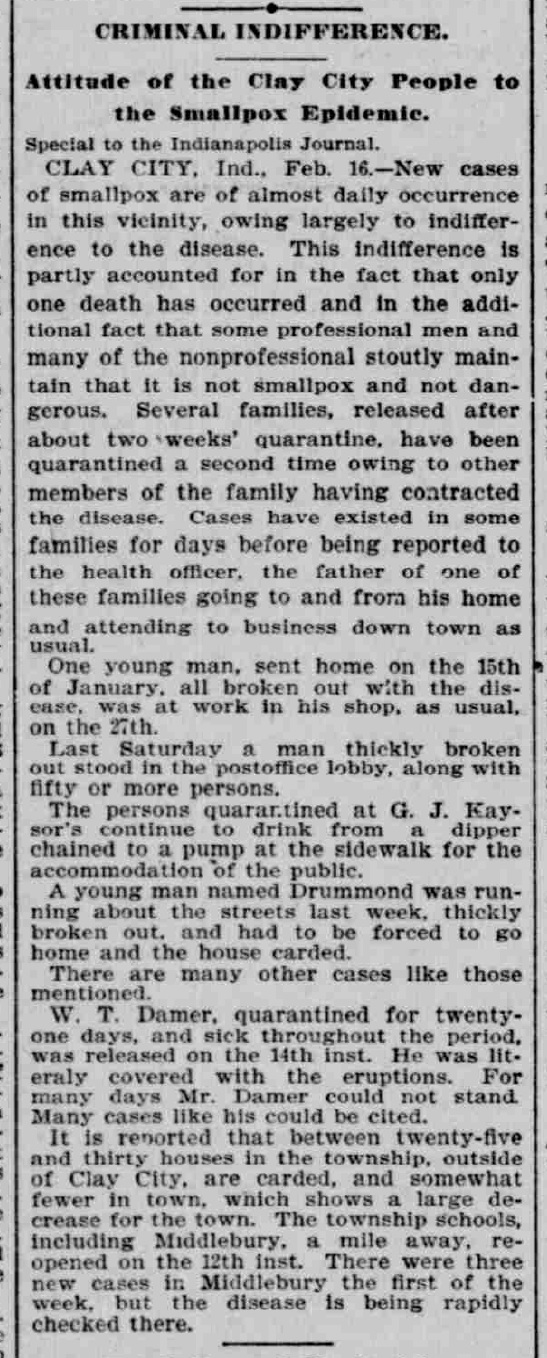
Indianapolis Journal - 1900-02-17 (Smallpox epidemic)CRIMINAL INDIFFERENCE.
Attitude of the Clay City People to
the Smallpox Epidemic.

Special to the Indianapolis Journal.
CLAY CITY, Ind., Feb. 16. – New cases of smallpox are of almost daily occurrence in this vicinity, owing largely to indifference to the disease. This indifference is partly accounted for in the fact that only one death has occurred and in the additional fact that some professional men and many of the nonprofessional stoutly maintain that it is not smallpox and not dangerous. Several family, released after about two weeks’ quarantine, have been quarantined a second time owing to other members of the family having contracted the disease. Cases have existed in some families for days before being reported to the health officer, the father of one of these families going to and from his home and attending to business down town as usual.
One young man, sent home on the 15th of January, all broken out with the disease, was at work in his shop, as usual, on the 27th.
Last Saturday a man thickly broken out stood in the postoffice lobby, along with fifty or more persons.
The persons quarantined at G. J. Kaysor’s continue to drink from a dipper chained to a pump at the sidewalk for the accommodation of the public.
A young man named Drummond was running about the streets last week, thickly broken out, and had to be forced to go home and the house carded.
There are many other cases like those mentioned.
W. T. Damer, quarantined for twenty-one days, and sick throughout the period, was released on the 14th inst. He was literally covered with the eruptions. For many days Mr. Damer could not stand. Many cases like his could be cited.
It is reported that between twenty-five and thirty houses in the township, outside of Clay City, are carded, and somewhat fewer in town, which shows a large decrease for the town. The township schools, including Middlebury, a mile away, reopened on the 12th inst. There were three new cases in Middlebury the first of the week, but the disease is being rapidly checked there.

“Criminal Indifference,” The Indianapolis Journal (Indianapolis, Indiana), 17 February 1900, p. 2, col. 3; digital image, Chronicling America (http://chroniclingamerica.loc.gov/ : accessed 6 December 2014).

Smallpox Epidemic, Part XXX

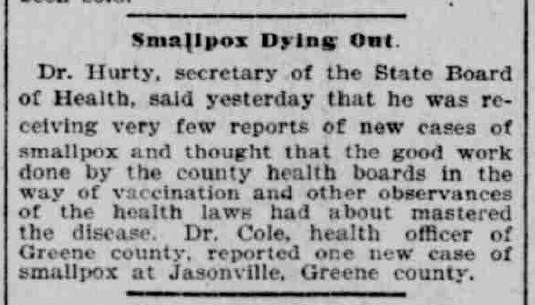
Indianapolis Journal - 1900-02-16 (Smallpox epidemic)Smallpox Dying Out.

Dr. Hurty, secretary of the State Board of Health, said yesterday that he was receiving very few reports of new cases of smallpox and thought that the good work done by the county health boards in the way of vaccination and other observances of the health laws had about mastered the disease. Dr. Cole, health officer of Greene county, reported one new case of smallpox at Jasonville, Greene county.

“Smallpox Dying Out,” The Indianapolis Journal (Indianapolis, Indiana), 16 February 1900, p. 3, col. 4; digital image, Chronicling America (http://chroniclingamerica.loc.gov/ : accessed 6 December 2014).

Smallpox Epidemic, Part XXVIII

Indianapolis Journal - 1900-02-10 (Smallpox epidemic)CLAY CITY SCHOOLS
Will Probably Open Again Monday –
Calls for Virus.

The Clay City schools, which have been closed for weeks on account of the smallpox epidemic which has been raging in that city, will probably be opened next Monday. The State Board of Health has forwarded instructions to that effect, with the proviso that no child shall be admitted unless vaccinated, and further that none shall be admitted from infected families.

The Portland Board of Health has asked the State Board of Health for vaccine virus and will order the vaccination of school children.

Smallpox Patient Released.

The Board of Public Health Thursday ordered the removal of N. C. Burnham from the pesthouse to his home, No. 330 North Beville avenue. He was the smallpox patient confined at the City Hospital contagious disease pavilion and was declared to be cured of the disease. His wife, who was with him and helped to nurse him, was also allowed to go home with her husband.

“Clay City Schools,” The Indianapolis Journal (Indianapolis, Indiana), 10 February 1900, p. 8, col. 3; digital image, Chronicling America (http://chroniclingamerica.loc.gov/ : accessed 6 December 2014).

Smallpox Epidemic, Part XVII

Indianapolis Journal - 1900-02-01 (Smallpox epidemic)RUMORS OF SMALLPOX
Reports To State Board Of
Health From Over State.

Disease Said to Be Spreading in
Greene County-Chicken Pox
In This City.

Dr. Hurty, secretary of the State Board of Health, received a letter yesterday from H. M. Aspy, the health officer of Geneva, Allen county, which stated that a letter had been received by one of the citizens of the town from Elmer Myers, who lives at 3610 East Twenty-eighth street, Indianapolis, saying that three of Meyer’s children were broken out with smallpox.

Mr. Hurty immediately turned the letter over to City Health Board, and Dr. Ferguson was sent to visit the place. After a careful examination Dr. Ferguson diagnosed, the disease as chickenpox, and when interrogated last night said there was no cause for alarm.

Dr. E. D. Laughlin, the vice president of the State Board of Health, wrote Dr. Hurty yesterday that he had made a second visit to Campbellsburg, and had found a number of cases of smallpox.

A report was also received that the disease was rapidly spreading at Linton, Green county. It is reported that 2,500 new cases of smallpox have developed in Greene county. When Dr. Hurty was apprised of the report last night he said the State board had received no information in regard to it, and added that it was probably untrue.

“Rumors of Smallpox,” The Indianapolis Journal (Indianapolis, Indiana), 1 February 1900, p. 3, col. 3; digital image, Chronicling America (http://chroniclingamerica.loc.gov/ : accessed 6 December 2014).

Smallpox Epidemic, Part XV

Indianapolis Journal - 1900-01-30 (Smallpox epidemic)STILL CAUSE FOR ALARM

Dr. Hurty Continues Apprehen-
Sive of Smallpox Spreading.

New Cases Reported from Clay City,
Where the Authorities Have Be-
come Aroused Over Situation.

Dr. Hurty said yesterday that his smallpox mail was just as heavy as ever and he was still very apprehensive of the disease spreading. E. B. Laughlin, he member of the State Board of Health who went to Campbellsburg Saturday to investigate reported cases of chicken pox, supposed by the State board to be smallpox, sent word to Dr. Hurty yesterday that the disease was really chicken pox, and chiefly attacked the children.

Four more new cases of smallpox were reported from Clay City, but the health officer says they are not to be attributed to any negligence on the part of the authorities, as everyone in Clay City is working hard to abate the plague, there being absolutely no opposition to the orders given by the health board. There were also four new cases reported from Jackson and Benton counties, two cases from each county. Dr. Beckes, of Vincennes, write Dr. Hurty that in Illinois, directly across the Wabash river from Know county, there is an awful epidemic of smallpox raging, and that the Know county health board is quarantining against it.

CLAY CITY EPIDEMIC.

Everything Possible Is Being Done to
Stamp It Out.

Special to the Indianapolis Journal.
CLAY CITY, Ind., Jan 29. – Now that Clay county is aroused to her needs in connection with the smallpox situation, no effort is being spared to stamp out the disease. Hundreds of persons have been vaccinated, and the quarantine is rigidly enforced. A place of detention has been secured for those refusing to submit to quarantine and this has operated to deter violations of the rules. Fourteen deputies patrol the streets, and care for persons under quarantine, besides guarding the approaches to the town. At Middleberg, a mile away, there are twelve or fifteen cases, and all through the neighboring country the disease is widespread, but everything possible is being done to stamp it out.

No Smallpox in Daviess County.

Special to the Indianapolis Journal.
WASHINGTON, Ind., Jan. 29. – The report that there is smallpox in Daviess county is absolutely without foundation. County Health Officer McConn says there is no smallpox and no sign or immediate danger of any.

Why Not Test the Case?

To the Editor of the Indianapolis Journal:
At the present time there is a wide-spread opposition to vaccination, all over this country. A large majority of intelligent physicians believe that the ills of vaccination are not as bad as the smallpox itself. A large number of people seem to believe the reverse. Now, suppose we stop trying to compel persons to be vaccinated, and let smallpox have a chance for a year or two? “How long halt ye between two opinions? if the Lord be God, follow Him; but if Baal, then follow him.” In the eighteenth century smallpox in France carried off annually 30,000, and in Prussia, 26,000. What if it did? Well, the people in those countries introduced vaccination and stopped completely the spread of that dread disease. They believe in the efficacy of vaccination now. Let us try the disease, pure, simple and unfettered, and see how we come out. A good many people will die, of course, but then we have lots of people this year. It may paralyze business for a time, but we can recover that by patience. When it is tried there will be fewer of the persons living who did not believe in vaccination, and those who survive will not be so handsome after the experiment.
G. W. H. KEMPER, M.D.
Muncie, Ind., Jan. 29.

“Still Cause For Alarm,” The Indianapolis Journal (Indianapolis, Indiana), 30 January 1900, p. 8, col. 5; digital image, Chronicling America (http://chroniclingamerica.loc.gov/ : accessed 6 December 2014).

Smallpox Epidemic, Part XIV

Indianapolis Journal - 1900-01-29 (Smallpox epidemic)JOHN LANE’S TROUBLES

A Smallpox “Suspect” On His Way
To Cincinnati To Get Married.

He Created Consternation at the
Police Station and Was Prompt-
ly Ordered Out.

Commanding officers of the police force, with one exception, are anticipating much amusement this winter from smallpox scares, and the fun began last night. It resulted in a serious discussion whether or not there should be a large sign over the walk in front of the City Dispensary for the guidance of persons afflicted with smallpox, who invariably inquire in the police department for the dispensary. John Lane, colored, entered the office of the police desk sergeant about roll call time. All the sergeants were present, including Sergeant Lowe, who, on one occasion last winter, jumped from a window to get away from a smallpox “suspect.” Lane’s face was disfigured, and he no more than got inside of the room when someone said “smallpox.” Captain Dawson was holding a consultation behind closed doors, but Sergeant Lowe disturbed the conference to get away. Lane did not have a chance to make explanations, but was required at once to leave the room. He had before been in the dispensary and by the doctors there sent to the police department.

Lane said he had been working for a dental company in Chicago and on Monday last, while taking a bottle of sulphuric acid from a shelf, let it fall, turning the contents of the bottle on his face, badly burning it. He was unable to work and was given a pass, he claims, to Cincinnati. At Champaign, Ill., he lost the pass and was put off the train. His face was broken out and all to whom he applied for assistance turned him away, thinking he had smallpox. Finally the city authorities gave him a pass to get rid of him. The transportation furnished did not take him much beyond the county line and there again he was put off. He again applied for transportation and had no difficulty in securing it, and got a little farther on his way. He finally landed in Crawfordsville, where it was thought he had smallpox, and he was furnished with a ticket to Indianapolis. Physicians in Crawfordsville telegraphed the Board of Health here, and Dr. Ferguson was sent to the City Dispensary, where Lane had been instructed to go, to investigate. He found no trace of smallpox, and gave the man a letter to that effect. Lane had no money and as his only means of securing transportation had been spoiled, he knew not how he was going to get to Cincinnati. He was also much worried over the reception he would receive on his arrival there, saying he was going there to get married, but was afraid his affianced would go back on him because of the disfigurement.

Dr. Ferguson, while talking with Sergeant Lowe, told a story of the tendency to discredit a physician’s diagnosis of a case as smallpox, saying that when he was in a small town about a week ago he found every house in the village contained victims of the disease. He was standing in the hotel talking to a local doctor, who contended the afflicted did not have smallpox. Finally, after a number of men said they believed the diagnosis of their local physician, one of them asked Dr. Ferguson if he had examined the patients. He said he had and then the question came, “Have you been with them to-day?” “Yes,” said the doctor. “Well, did you change your clothes or disinfect them afterward?”

“No,” said Dr. Ferguson, “I forgot all about that. I believe I’ll have to do that now – “ but before he had finished the room was clear. His hearers evidently wished to take no chances.

No Cases at Salem.

Special to the Indianapolis Journal.
SALEM, Ind., Jan. 28 – There are no cases of smallpox in Salem nor nearer than several miles. The disease is confined to Gibson township, where it originated, with three new cases across the line in Monroe township, but no deaths. The report that Dr. Mayfield, health officer, has been threatened by Salem citizens is denied by him. The doctors of Salem are having all they can do to vaccinate all who come voluntarily. There are a few cases of violation of the quarantine, but all such offenders may have to answer for these violations as their names are taken and prosecutions will follow.

“John Lane’s Troubles,” The Indianapolis Journal (Indianapolis, Indiana), 29 January 1900, p. 8, col. 6; digital image, Chronicling America (http://chroniclingamerica.loc.gov/ : accessed 6 December 2014).

Smallpox Epidemic, Part XII

Indianapolis Journal - 1900-01-27 (Smallpox epidemic)WORKS BOARD SESSION
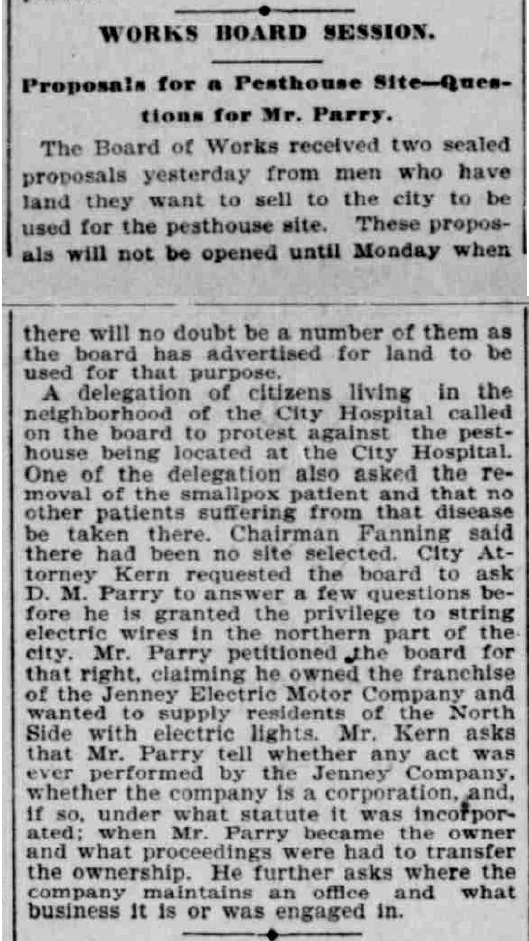
Proposals for a Pesthouse Site-Ques-
tions for Mr. Parry.

The Board of Works received two sealed proposals yesterday from men who have land they want to sell to the city to be used for the pesthouse site. These proposals will not be opened until Monday when there will no doubt be a number of them as the board has advertised for land to be used for that purpose.

A delegation of citizens living in the neighborhood of the City Hospital called on the board to protest against the pesthouse being located at the City Hospital. One of the delegation also asked the removal of the smallpox patient and that no other patients suffering from that disease be taken there. Chairman Fanning said there had been no site selected. City Attorney Kern requested the board to ask D. M. Parry to answer a few questions before he is granted the privilege to string electric wires in the northern part of the city. Mr. Parry petitioned the board for that right, claiming he owned the franchise of the Jenney Electric Motor Company and wanted to supply residents of the North Side with electric lights. Mr. Kern asks that Mr. Parry tell whether any act was ever performed by the Jenney Company, whether the company is a corporation, and, if so, under what statute it was incorporated; when Mr. Parry became the owner and what proceedings were had to transfer the ownership. He further asks where the company maintains an office and what business it is or was engaged in.

“Works Board Session,” The Indianapolis Journal (Indianapolis, Indiana), 27 January 1900, p. 3, col. 3-4; digital image, Chronicling America (http://chroniclingamerica.loc.gov/ : accessed 6 December 2014).