Tag Archives: Indianapolis

Indianapolis Resident 1912

Schwartz, W. B. - Indianapolis directory, 1912

In 1912, William still advertised himself as a lawyer. A few lines above, William’s youngest daughter, Roberta V., was listed as a cashier for H. P. Wasson & Co.

Source:

“U.S. City Directories, 1821-1989,” digital image, Ancestry.com (http://www.ancestry.com : accessed 5 May 2014), Indianapolis (1912), Wm B. Schwartz and Roberta V. Schwartz.

Letter from the Warden

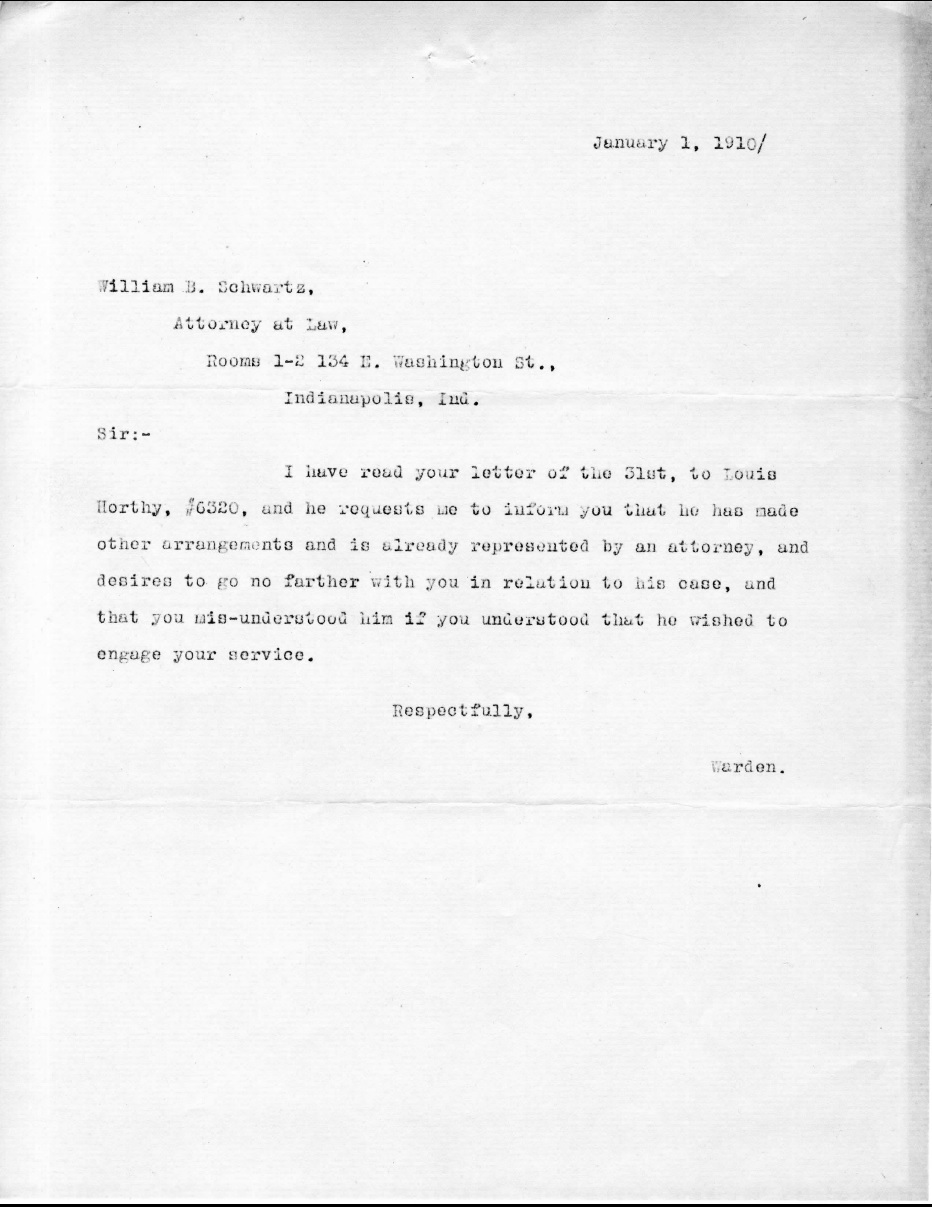
Schwartz, W. B. - 1910-01-01 LetterLetter transcription:

January 1, 1910/
William B. Schwartz,
Attorney at Law,
Rooms 1-2 143 E. Washington St.,
Indianapolis, Ind.

Sir: –
I have read your letter of the 31st, to Louis Horthy, #6320, and he requests me to inform you that he has made other arrangements and is already represented by an attorney, and desires to go no farther with you in relation to his case, and that you mis-understood him if you understood that he wished to engage your service.

Respectfully,
Warden.

Source:
Letter from the Warden on behalf of Louis Horthy, 1 January 1910, William B. Schwartz, Prisoner no. 5476; Inmate Case Files, U. S. Penitentiary, Leavenworth, Kansas, 1895-1931, Record Group 129; National Archives at Kansas City, Missouri.

Letter to Mr. Louis Horthy

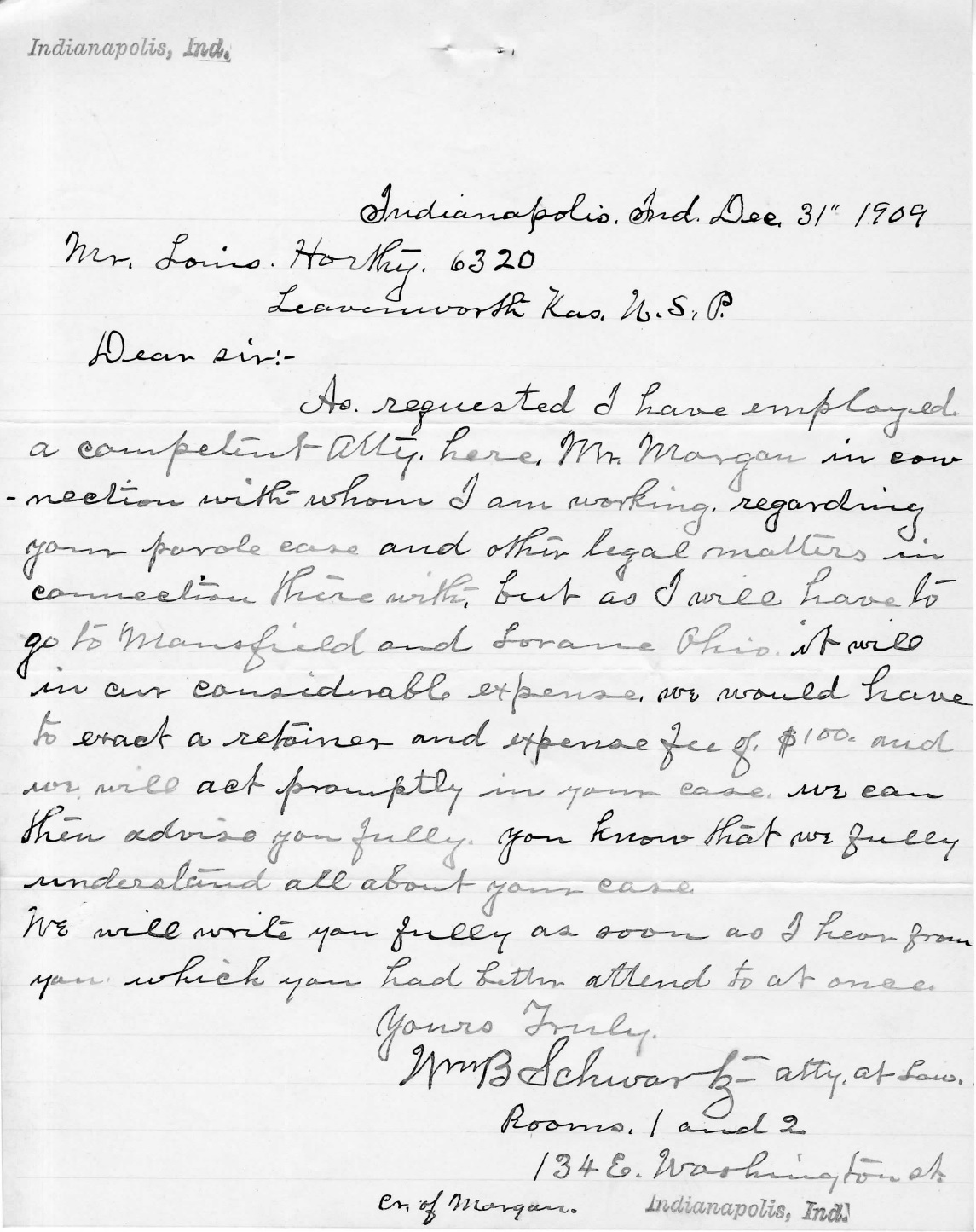
Schwartz, W. B. - 1909-12-31 Letter

Letter transcription:

Indianapolis. Ind. Dec. 31, 1909
Mr. Louis Horthy 6320
Leavenworth Kas. U.S.P

Dear sir:

As requested I have employed a competent Atty. here, Mr. Morgan in connection with whom I am working, regarding your parole case and other legal matters in connection there with but as I will have to go to Mansfield and Loraine Ohio it will incur considerable expense. We would have to exact a retainer and expense fee of $100 and we will act promptly in your case. We can then advise you fully. You know that we fully understand all about your case.

We will write you fully as soon as I hear from you which you had better attend to at once

Yours Truly,
Wᵐ B Schwartz – Atty. at Law
Rooms, 1 and 2
1346 E. Washington St.
cr.of Morgan
Indianapolis, Ind.

Source:

Letter to Mr. Louis Horthy, 31 December 1909, William B. Schwartz, Prisoner no. 5476; Inmate Case Files, U. S. Penitentiary, Leavenworth, Kansas, 1895-1931, Record Group 129; National Archives at Kansas City, Missouri.

Schwartz is Released

Schwartz, W. B. - 1909-12-28 (cropped)

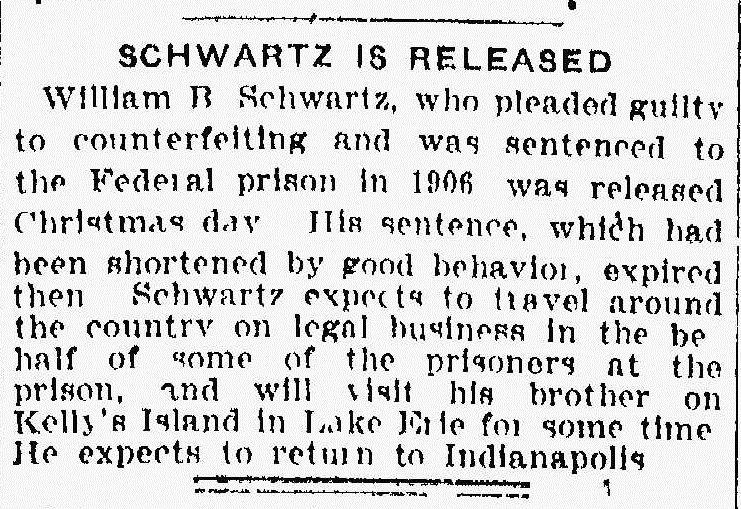
SCHWARTZ IS RELEASED

William B. Schwartz, who pleaded guilty to counterfeiting and was sentenced to the Federal prison in 1906 was released Christmas day. His sentence, which had been shortened by good behavior, expired then. Schwartz expects to travel around the country on legal business in the behalf of some of the prisoners at the prison, and will visit his brother on Kelly’s Island in Lake Erie for some time. He expects to return to Indianapolis.

Source:

“Schwartz is Released,” Indianapolis Star (Indianapolis, Indiana), 28 December 1909, p. 14, col. 4; “Historical Newspaper Collection,” digital image, Ancestry.com (http://www.ancestry.com : accessed 25 April 2014).

Lawyer Became Counterfeiter

LAWYER BECAME COUNTERFEITER; IN UNITED STATES PRISON
W. B. Schwartz of Indianapolis, Inventor of Visible Typewriter

His fortune dissipated in an effect to perfect a typewriter which he had invented, and driven to desperation by the need of money to support an insane wife and two grown daughters, William B. Schwartz, a prominent attorney of Indianapolis, Ind., resorted to counterfeiting when his practice failed to bring in a sufficient revenue and now he is in the United States penitentiary to serve four years for counterfeiting. He is 47 years old. He arrived Friday morning with a bunch of convicts from Indianapolis, Ind. Schwartz was arrested last May and put up a pitiful pleas to obtain his freedom, but failed.

The product of Schwartz’s mold consisted chiefly of 50-cent pieces and they were the nearest perfect of any that ever came under the notice of the secret service men in Indiana. For over a year the spurious coins had worried the United States officers, both on account of their being difficult of detection and the trouble in ascertaining their source.

It was by mere chance that suspicion was directed toward Schwartz, bue [but] even then it was a year before the officers were able to obtain convicting evidence against the lawyer. In the meantime, while he had not grown reckless in putting the coins into circulation, the fear of detection had grown less and less, so that, when the officers arrested him in his office as he was bending over his desk engrossed in some legal work, the surprise was so great he gave a shriek, like a wild animal at bay.

His arrest was the culmination of all his woes, and for a moment Schwartz seemed on the verge of losing his reason. When told quietly that indisputable evidence had been obtained against him, there was little difficulty in getting the man to admit his guilt.

Coins in His Office.

A search of his office revealed a number of counterfeit coins, which it was almost impossible to distinguish from genuine. Schwartz had a method of taking away the “newness” by the aid of an electric battery. This he had fitted up at his office and he had just “finished” a run a short time before he was arrested. It was found later that he kept his molds, which were of his own workmanship, at his home where he cast the coins to be finished up at his office.

It is believed that Schwartz did not market his product in Indianapolis, but that he had dealings with large gangs of counterfeiters in other parts of the country.

At one time Schwartz was well-to-do, owned considerable property, had a good law practice and was well known in a wide circle of acquaintances. Then he became interested in typewriters. He conceived the idea of a “visible” machine and, after long labor and much expense, took out a patent and made an effort to market the product. He then found that the machine had many imperfections and drawbacks and he set about removing them. He was of a mechanical turn of mind and spent much time in his workshop. It was while thus engaged that the foundation was laid for his counterfeiting. In making patents for his typewriter he learned the art of making molds and one day one of his workmen jokingly remarked how easy it would be to make molds for counterfeiting coins. The workman showed him just how it could be done and they talked about it for a few minutes and then returned to the work in hand.

His Troubles Grew.

The typewriter business did not prosper, and about this time Schwartz’s wife became mentally deranged. He employed the best physicians he could find and sent her to sanitariums in an endeavor to cure her, and this expense, together with the losses he had sustained on his typewriter and the failure of his practice through inattention, made it necessary for him to give up his home. Still further pressed, he was forced to sell his patent, and it was not long until he did not know from one day’s end to another where the next day’s meals were coming from. It was then he turned to counterfeiting.

Schwartz’s wife is in an asylum and his daughters are crushed by the disgrace and shock of their father’s exposure. One of them said that had they known of his dire need for money they would have helped him in some way, but that he had always provided for them without complaint and that though they knew he had lost heavily in investments, they were not acquainted with his real need. – Leavenworth (Kan.) Times

Source:

“Lawyer Became Counterfeiter; In United States Prison,” Commercial Stamp Trade Journal 16 (January 1907): 7-8; digital images, Google (http://www.google.com : accessed 23 April 2014).


On Way To Prison

Schwartz, W. B. - 1906-12-13
ON WAY TO PRISON

GROUP OF CONVICTED MEN STARTED WESTWARD IN MARSHAL’S CHARGE

Eight men sentenced to terms in the United States prison at the last term of the federal court started for that institution at Fort Leavenworth, Kas., Thursday, in charge of United States Marshal H. C. Pettit and Duputies Dave Rankin and Tom Martin, leaving the city at 11:45. The prisoners are William Schwartz, the Indianapolis attorney, sentenced for four years for counterfeiting; John row, one year for making false affidavit as to pension papers; Theodore Linninger, three years, for passing counterfeit coins; Theodore Englebert, of Richmond, one year for taking money from a letter, as an employee of the postoffice; Judson Sturtevant, three years for robbing a postoffice; Alexander Rusilla, one year for counterfeiting; Napoleon B. Livingston, one year for impersonating a government pension officer; Clarence Robertson, one year for forging a money order.

Mrs. Gustave A. Consman, of Terre Haute, true to her husband, who is serving a term in prison for embezzlement, called at the marshal’s office before the officers departed with the prisoners, and entrusted to them a package intended to make her husband’s Christmas brighter.

“On Way to Prison,” Indianapolis Sun (Indianapolis, Indiana), p. 2, col. 6; digital image, Newspaper Archive (http://www.newspaperarchive.com : accessed 16 April 2014).

United States vs. William B. Schwartz

United States vs. William B. Schwartz Cover

No. 6742
U. S. DISTRICT COURT
November Term, 1906
At Indianapolis
UNITED STATES
vs.
William B. Schwartz,
Indianapolis
INDICTMENT
Counterfeiting
Sec. 5457 & 5458
A TRUE BILL:
Mark Hillsarne
Foreman
Filed Nov 22 1906
Noble C. Butler, Clerk
Joseph B. Kealing
U.S. DISTRICT ATTORNEY
U.S. WITNESSES
T. E. Halls, S.S.O. – Indianapolis
Chauncey A. Manning – ”
Merrill Wilson – “
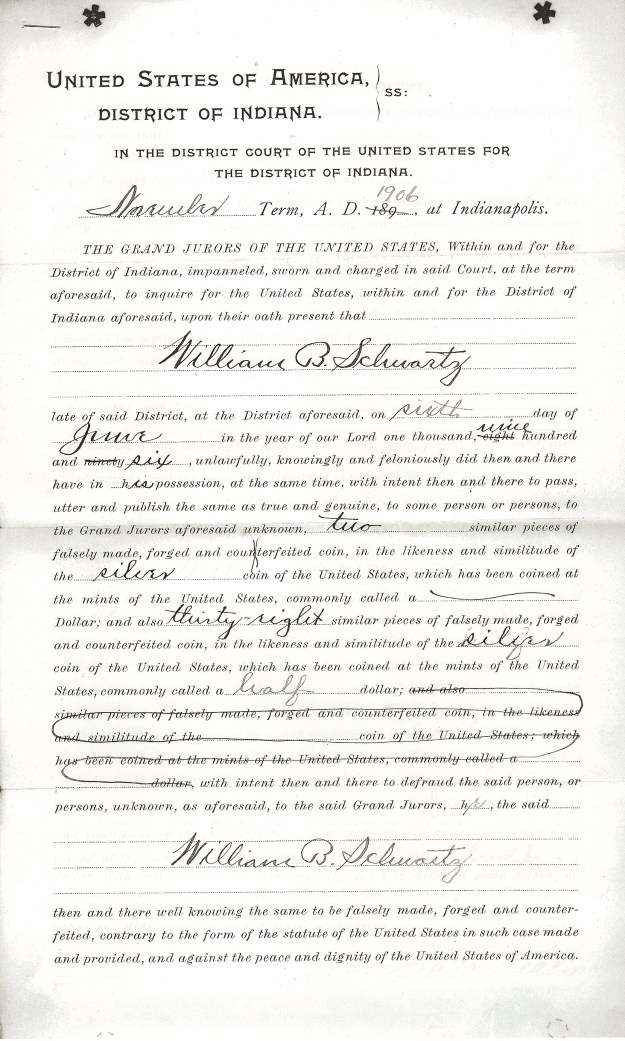
United States vs. William B. Schwartz, p. 1

UNITED STATES OF AMERICA }
DISTRICT OF INDIANA      } SS:

IN THE DISTRICT COURT OF THE UNITED STATES FOR THE DISTRICT OF INDIANA.
November Term, A.D. 1906, at Indianapolis.

THE GRAND JURORS OF THE UNITED STATES, Within and for the District of Indiana, impaneled, sworn and charged in said Court, at the term aforesaid, to inquire for the United States, within and for the District of Indiana aforesaid, upon their oath present that William B. Schwartz late of said District, at the District aforesaid, on sixth day of June in the year of our Lord one thousand, nine hundred and six, unlawfully, knowingly and feloniously did then and there have in his possession, at the same time, with intent then and there to pass, utter and publish the same as true and genuine, to some person or persons, to the Grand Jurors aforesaid unknown, two similar pieces of falsely made, forged and counterfeited coin, in the likeness and similitude of the silver coin of the United States, which has been coined at the mints of the United States, commonly called a —; and also thirty-eight similar pieces of falsely made, forged and counterfeited coin, in the likeness and similitude of the silver coin of the United States, which has been coined at the mints of the United States, commonly called a half dollar (crossed out) with intent then and there to defraud the said person, or persons, unknown, as aforesaid, to the said Grand Jurors, he, the said William B. Schwartz then and there well knowing the same to be falsely made, forged and counterfeited, contrary to the form of the statute of the United States in such case made and provided, and against the peace and dignity of the United States of America.
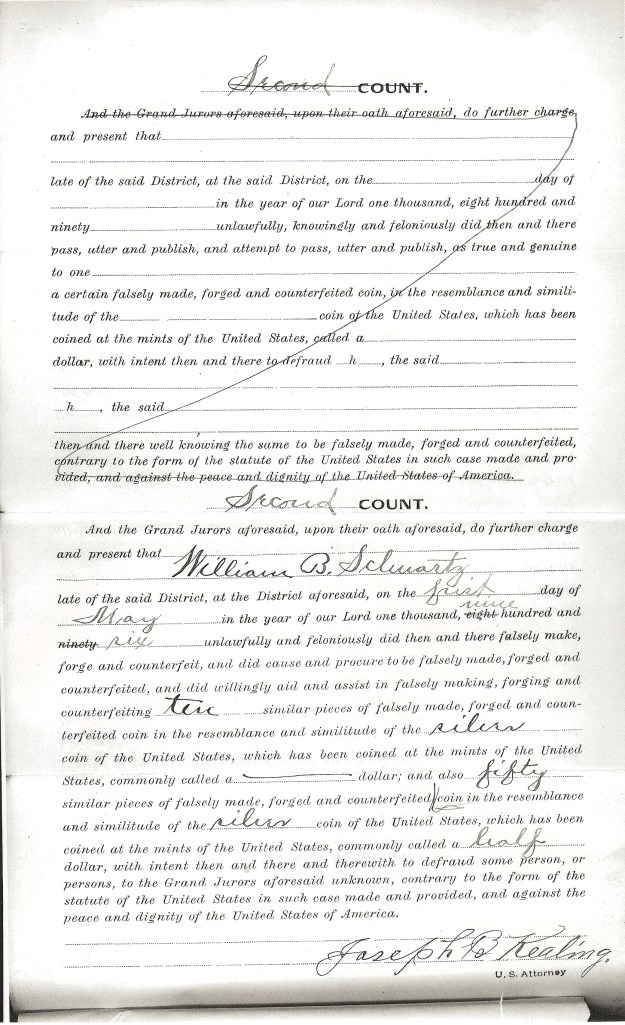
United States vs. William B. Schwartz, p. 2

Second COUNT

And the Grand Jurors aforesaid, upon their oath aforesaid, do further charge and present that William B. Schwartz late of the said District, at the District aforesaid, on the first day of May in the year of our Lord one thousand, nine hundred and six unlawfully and feloniously did then and there falsely make, forge and counterfeit, and did cause and procure to be falsely made, forged and counterfeited, and did willingly aid and assist in falsely making, forging and counterfeiting ten similar pieces of falsely made, forged and counterfeited coin in the resemblance and similitude of the silver coin of the United States, which has been coined at the mints of the United States, commonly called a — dollar; and also fifty similar pieces of falsely made, forged and counterfeited coin in the resemblance and similitude of the silver coin of the United States, which has been coined at the mints of the United States, commonly called a half dollar, with intent then and there and therewith to defraud some person, or persons, to the Grand Jurors aforesaid unknown, contrary to the form of the statute of the United States in such case made and provided, and against the peace and dignity of the United States of America.

Joseph B. Keating
U.S. Attorney

SOURCE:

Indictment Counterfeiting, 22 November 1906; United States vs. William B. Schwartz, case no. 6742; Criminal Case Files, U. S. District Court, Southern District of Indiana, 1854-1981; Records of the District Courts of the United States, Record Group 21; National Archives, Chicago, Illinois.
Schwartz To Prison

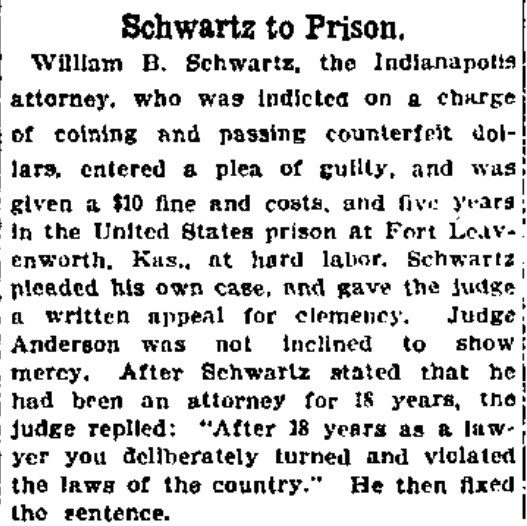
Schwartz, W. B. - 1906-11-27Schwartz to Prison.

William B. Schwartz, the Indianapolis attorney, who was indicted on a charge of coining and passing counterfeit dollars, entered a plea of guilty, and was given a $10 fine and costs, and five years in the United States prison at Fort Leavenworth, Kas., at hard labor. Schwartz pleased his own case, and gave the judge a written appeal for clemency. Judge Anderson was not inclined to show mercy. After Schwartz stated that he had been an attorney for 18 years, the judge replied: “After 19 years as a lawyer you deliberately turned and violated the laws of the country.” He then fixed the sentence.

“Schwartz to Prison,” Indianapolis Sun (Indianapolis, Indiana), 27 November 1906, p. 1, col. 5; digital image, Newspaper Archive (http://www.newspaperarchive.com : accessed 7 April 2014).

Jail Plot Exposed (Part 7)

Schwartz, W. B. - 1906-09-20, p. 8 (4)

“The men are well treated,” he said. “Their food is good. It is utterly false that Edward Franklin, the night turnkey, has been intoxicated. I know he has not touched a drop in ten years. As to the complaint about the filth, they are expected to clean their own quarters. I announced to them in criminal court, where some of them were arraigned, that none would get a bite to eat until the cells were thoroughly cleaned.

“Yes, Judge Alford asked me about the complaint, and I showed him the evidences of the plot to escape. They made the complaint in order to escape punishment.”

Inspection of Ward.

County Commissioner McGregor and a representative of The Sun visited the jail Thursday, inspected the United States ward, and talked to the prisoners, who were house-cleaning very industriously, by applying streams of water from the hose to the cell floors. They said they were required to mop the floors every morning, but complained that there was a thorough cleaning ordered only once in about three weeks.

“Everything in that letter was true,” said Attorney William B. Schwartz, the counterfeiter, looking through the bars “Our bed-clothing is full of vermin, which is the worst things we have to bear.”

Prisoners Were Beaten

“Is it true that Jack Blake and L. Knauss were seriously beaten because they did not wish to sign the letter” he was asked.

“They were not hurt,” Schwartz replied, smiling, but he admitted they had been punished by the “Kangaroo court.”

Knauss cried when asked about his experience. “The ‘Kangaroo court’ said that I could not have a cot unless I paid for it,” he said, “and after the first night I had to sleep on the floor. They beat me up when I refused to sign the letter of complaint. I was whipped with a strap. Boys, it wasn’t right.”

Court Must Be Stopped.

Sheriff Sourbler is taking strenuous measures to break up the sessions of the court. John Smith and a prisoner named Greeley, two officers of the court, have been confined with the negro prisoners as a punishment, but the men in the dungeon are thought to have been the ringleaders.

Commissioner McGregor suggested to the sheriff that a garbage can be provided for the prisoners and that the cells be washed out oftener. Otherwise, he thought the prisoners had no right to complain, and will so report to Judge Alford.

“Jail Plot Exposed,” Indianapolis Sun (Indianapolis, Indiana), 20 September 1906, p. 8, col. 3-4; digital image, Newspaper Archive (http://www.newspaperarchive.com : accessed 7 April 2014).

Jail Plot Exposed (Part 6)

Schwartz, W. B. - 1906-09-20, p. 8 (3)Meals for Sunday.

“At this meal the sirup is not diluted. The dinner meal is served at 2 o’clock in the afternoon and is the same as any other day, with the addition of boiled potatoes. No supper is served Sundays. The condition of the table and cutlery used by the prisoners, so far as filth is concerned, is in keeping with the other surroundings. Apparently no attempt is made to removed the corrosive and rusty substance from the cutlery, which time and inattention allow to accumulate.

Men Lost Their Breakfast.

“The occasion of this complaint is the outcome of a long series of the abuses embodied in this letter, and brought to a climax by the further unbearable treatment of the night turnkey in depriving all men in the United States ward of their breakfast, without the slightest provocation, and after he had repeatedly, and without cause, threatened to make life unbearable for all men in this ward. There are men here who are actually starving, unreasonable as it may seem, and unless something is done for the relief of these men the outcome will be serious, in some cases where the men are fit subjects for the hospital.

Ready to Make Affidavits.

“We, therefore, beseech your honor to cause such investigation as you may deem necessary and proper to verify the truth of these statements and to effect a long needed reform.

“Respectfully submitted by the prisoners of the United States ward who stand ready to make affidavit to these and more serious abuses.”

After reading this letter in commissioners court, Thursday, Sheriff Sourbler declared it to be a tissue of lies from beginning to end.

“Jail Plot Exposed,” Indianapolis Sun (Indianapolis, Indiana), 20 September 1906, p. 8, col. 3; digital image, Newspaper Archive (http://www.newspaperarchive.com : accessed 7 April 2014).