Tag Archives: Indianapolis

Jail Plot Exposed (Part 5)

Schwartz, W. B. - 1906-09-20, p. 8 (2)Accused a Negro Jailer.

“There are men confined here who have enjoyed every social and home environment which tends to elevate, and who know and can fully appreciate the rank injustice and demoralizing abuse heaped upon them in a most deplorable way. The writer has reference to the conduct of a deputy sheriff, a negro, whose delight seems to be the application of language which can not be even hinted at here, so vile and foul it is. This is not an exaggeration, but a true recital of facts made in a very conservative way. Men are called names which, anywhere else, would be resented in a very forcible way. When men such as are here have to listen to the blasphemous abuse of a negro which reflects upon the honor and virtue of their mothers, it seems it is high time to call the attention of those who strive for the honest administration of law to correct and prohibit such abuses.

Called It Public Disgrace.

“These are but a few of the true facts, and an investigation would show a state of affairs, a disgrace to any civilized community, and more especially so in a city like Indianapolis, noted for its educational and religious influences.

“It is a notorious fact that the night turnkey, on several occasions, has been so disgracefully under the influence of liquor that he fell prostrate on the floor in the effect to discharge his duties. This occurred once to our knowledge. This man’s language in addressing the prisoners is one continual string of profanity and abuse, and his delight seems to be just how much suffering he can cause the men in every possible way.

Appeals Were Not Heeded.

“We have previous to this appealed to the sheriff with no noticeable change for the better. Refusal has been made of a common garbage can, in which to deposit the natural accumulations of dirt, which, in a place like this, borders on filth. A visit to this ward a 9 o’clock at night will show a condition of affairs worse than has been described.

“The bill of fare of the jail will, no doubt, be interesting to the taxpayers of Marion county, who pay 40 centers per day for the keeping of each inmate. Six mornings a week, sirup, diluted with water; three slices of small loaves of bakers’ bread, with a small cup of coffee, which is invariably cold, compose the breakfast meal. For dinner, either hominy or beans, with meat in a small quantity, and three slices of bread, and water compose the meal. Supper consists of either soup, which, in most cases, is not touched, or diluted sirup and bread with coffee. On Sunday the men eat their breakfast at 8 o’clock.

“Jail Plot Exposed,” Indianapolis Sun (Indianapolis, Indiana), 20 September 1906, p. 8, col. 3; digital image, Newspaper Archive (http://www.newspaperarchive.com : accessed 7 April 2014).

Jail Plot Exposed (Part 4)

Schwartz, W. B. - 1906-09-20, p. 8 (1)JAIL PLOT EXPOSED

(Continued from Page One.)

“Honorable Sir: We, the undersigned beg to submit for your consideration, the following grievances of mistreatment as prisoners confined in the United States war of the Marion county jail, to-wit: First, we wish to call your attention to the fact that the prisoners are refused the proper means of maintaining personal bodily cleanliness, owing to the nonprovision of soap, towels and hot water.

Complained of Vermin.

“Many are compelled to sleep on the bare, damp concrete floor without bedding of any description. Those of the prisoners who are provided with bedding are without one exception reeking with vermin. The blankets furnished are not only filled with vermin, but are positively filthy. The men must use these to protect themselves from the cold, from which they suffer not a little because of lack of sufficient covering. The officials as a whole are indifferent to the requests of the prisoners for the chemicals furnished with which to spray their bedding themselves. The bedbugs, together with the vermin make sleep next to impossible.

Demanded Medical Aid.

“One of the most inhuman acts of injustice which the prisoners are forced to bear and suffer is being compelled to use the bedding of men afflicted with unmentionable diseases, which one is liable to contract at any time. These same men and others suffering from various complaints brought on by lack of food and long confinement have had to wait for days before medical aid could be obtained. This applies not only to the county prisoners, but to the United States prisoners as well. Men who have money to purchase articles of food necessary to regain and maintain their health are refused the same when there is a man who is kept purposely to purchase such articles as the prisoners may be able to pay for, and as the statues provide for under section 6, 118 R. S. of 1881, which is still in force. Even food brought here by wives, mothers and friends has been refused the prisoners for which it was intended.

“Jail Plot Exposed,” Indianapolis Sun (Indianapolis, Indiana), 20 September 1906, p. 8, col. 3; digital image, Newspaper Archive (http://www.newspaperarchive.com : accessed 7 April 2014).
Jail Plot Exposed (Part 3)

Schwartz, W. B. - 1906-09-20, p. 1 (3)Ringleaders in Dungeon.

After the sheriff discovered the kangaroo court, Monday, he sent Thomas McDermott and J. A. Hardin, well known as robbers, to join De Vall in the dungeon. He had reason to believe that these three men had come into possession of weapons and tools with which to manage an escape, but they denied this charge.

Fearing that a serious plot was on foot, Sheriff Sourbler secured a Winchester rifle and patrolled the United States war Tuesday night. Wednesday night, the sheriff, with a force of deputies, made a thorough search of the ward, and learned that their fears were well founded.

In the cells of the three dungeon prisoners were found two revolvers, saws and other tools sewed in the mattresses on the cots. The prisoners had manufactured clubs from the broken, wooden parts of cell cots, and had hidden the bludgeons under the bedclothing. A large numbers of these clubs were found.

May Be Other Weapons.

The sheriff believes there are other tools and weapons yet concealed and he will discipline the three suspected men until they confess. A careful inspection is now being made of the bars in the various cells, as it is feared some sawing already has been done.

The communication sent by the prisoners to Judge Alford is a most remarkable document to emanate from the jail. It was written by William B. Schwartz, attorney, who has been acting as “prosecutor” in the “Kangaroo court” conducted by the prisoners. Sheriff Sourbler suspects that the letter was carried form the jail by some attorney who interviewed his clients at the jail. In fact, the sheriff believes it is possible that the weapons and tools might have been carried to the prisoners by a visiting attorney. The “round robin” is as follows:

Piece of Jail Literature.

“Indianapolis, Ind., Sept. 17, 1906 –
“To the Hon. Fremont Alford, Judge of the Criminal Court, Indianapolis, Ind.

(Continued on Page 8, Col. 3)

“Jail Plot Exposed,” Indianapolis Sun (Indianapolis, Indiana), 20 September 1906, p. 1, col. 1; digital image, Newspaper Archive (http://www.newspaperarchive.com : accessed 7 April 2014).

Jail Plot Exposed (part 2)

Schwartz, W. B. - 1906-09-20, p. 1 (2)Judge Alford Prompt.

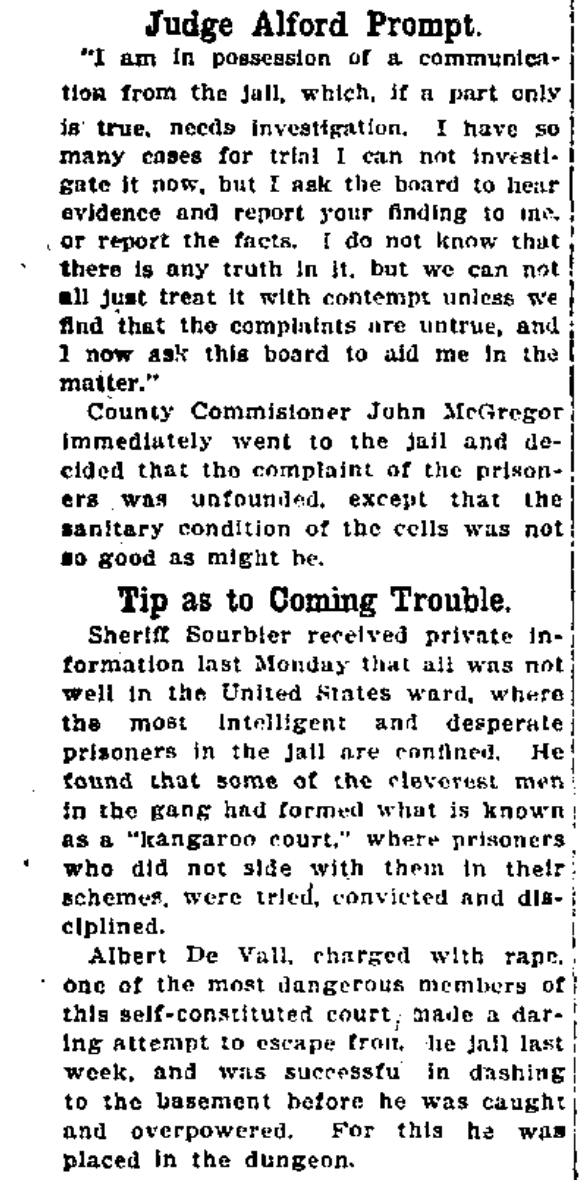
“I am in possession of a communication from the jail, which, if a part only is true, needs investigation. I have so many cases for trial I cannot investigate it now, but I ask the board to hear evidence and report your finding to me, or report the facts. I do not know that there is any truth in it, but we can not all just treat it with contempt unless we find that the complaints are untrue, and I now ask this board to aid me in the matter.”

County Commissioner John McGregor immediately went to the jail and decided that the complaint of the prisoners was unfounded, except that the sanitary condition of the cells was not as good as might be.

Tip as to Coming Trouble

Sheriff Sourbler received private information last Monday that all was not well in the United States ward, where the most intelligent and desperate prisoners in the jail are confined. He found that some of the cleverest men in the gang had formed what is known as a “kangaroo court,” where prisoners who did not side with them in their schemes, were tried, convicted and disciplined.

Albert De Vall, charged with rape, one of the most dangerous members of this self-constituted court, made a daring attempt to escape from the jail last week, and was successful in dashing to the basement before he was caught and overpowered. For this he was placed in the dungeon.

“Jail Plot Exposed,” Indianapolis Sun (Indianapolis, Indiana), 20 September 1906, p. 1, col. 1; digital image, Newspaper Archive (http://www.newspaperarchive.com : accessed 7 April 2014).
Jail Plot Exposed (Part 1)

Schwartz, W. B. - 1906-09-20, p. 1 (1)

JAIL PLOT EXPOSED

Bludgeons, Revolvers and Saws Found By Sheriff.

“ROUND ROBIN” WAS SENT TO JUDGE ALFORD BY THE U.S. PRISONERS.

DEMAND MADE FOR RELIEF FROM ABUSES

Investigation Disclosed Serious State of Affairs, Said to involve Many Clever Criminals, Who Were Placed in Dungeon.

A most desperate, carefully prepared and widespread attempt at jail delivery by a gang of the smartest prisoners ever held in the United States prison ward of the Marion county jail, has been discovered by Sheriff Edward Sourbler, who now has a set of ugly saws and files, two revolvers and innumerable clubs, the latter made from dismantled cell cots, to show for the seriousness of the plot.

In order to escape the penalties of discovery, the sheriff believes, the ring-leaders of the plot, who are horse-thieves, safe-blowers and other criminals of the worst type, induced Attorney William B. Schwartz, who is being held on a charge of counterfeiting, to draw up a ‘round-robin” complaining of alleged scandalous management of the jail. The leaders secured the signatures of 58 prisoners, addressed the ‘round-robin’ to Judge Fremont Alford, of criminal court, and it was smuggled to the postoffice. Judge Alford received the letter, Thursday, and sent the following notice to the county commissioners:

[to be continued] 

“Jail Plot Exposed,” Indianapolis Sun (Indianapolis, Indiana), 20 September 1906, p. 1, col. 1; digital image, Newspaper Archive (http://www.newspaperarchive.com : accessed 7 April 2014).
Lawyer A Counterfeiter

Schwartz, W. B. - 1906-06-20LAWYER A COUNTERFEITER

Says He Made Spurious Coin to Support His Sick Wife.

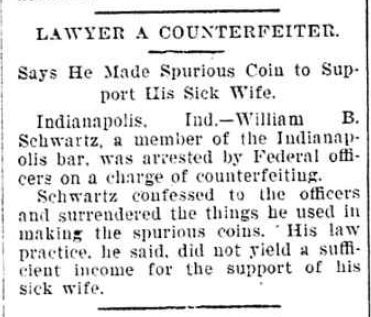
Indianapolis, Ind. – William B. Schwartz, a member of the Indianapolis bar, was arrested by Federal officers on charge of counterfeiting.

Schwartz confessed to the officers and surrendered the things he used in making the spurious coins. His law practice, he said, did not yield a sufficient income for the support of his sick wife.

“Lawyer A Counterfeiter,” The Abbeville Press and Banner (Abbeville, South Carolina), 20 June 1906, p. 2, col. 2; digital image, Chronicling America (http://chroniclingamerica.loc.gov/ : accessed 4 April 2014).

Minor State News

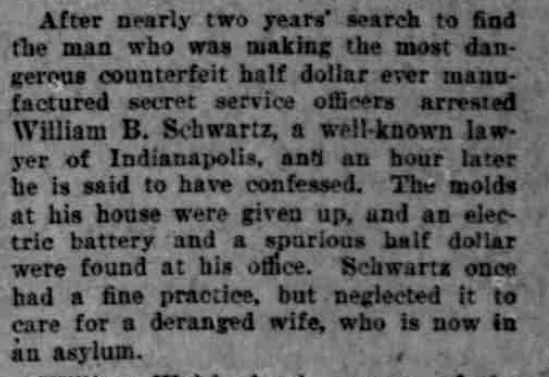
Schwartz, W. B. - 1906-06-07After nearly two years’ search to find the man who was making the most dangerous counterfeit half dollar ever manufactured secret service officers arrested William B. Schwartz, a well-known lawyer of Indianapolis, and an hour later he is said to have confessed. The molds at his house were given up, and an electric battery and a spurious half dollar were found at his office. Schwartz once had a fine practice, but neglected it to care for a deranged wife, who is now in an asylum.

“Minor State News,” The Plymouth Tribune (Plymouth, Indiana), 7 June 1906, p. 3, col. 8; digital image, Chronicling America (http://chroniclingamerica.loc.gov/ : accessed 4 April 2014).

Cline Gives Bond

Schwartz, W. B. - 1906-05-23CLINE GIVES BOND

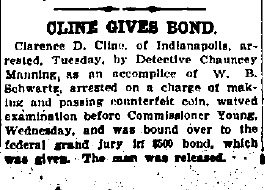
Clarence D. Cline, of Indianapolis, arrested, Tuesday, by Detective Chauncey Manning, as an accomplice of W. B. Schwartz, arrested on a charge of making and passing counterfeit coin, waived examination before Commissioner Young, Wednesday, and was bound over to the federal grand jury in $500 bond, which was given. The man was released.

“Cline Gives Bond,” The Indianapolis Sun (Indianapolis, Indiana), 23 May 1906, p. 1, col. 3; digital image, Newspaper Archive (http://www.newspaperarchive.com : accessed 4 April 2014).

Driven By Misfortune

Schwartz, W. B. - 1906-05-22 #3DRIVEN BY MISFORTUNE

Indianapolis Lawyer Takes to Making Bogus Coins

Counterfeiter Arrested and Confesses He Did it Because of Poverty.

William B. Schwartz Was Unable to Support HIs Family From His Practice and Started Counterfeiting – – – Carried on the Work for Several Years.

INDIANAPOLIS, Ind., Mary 21 – Unable to support two grown daughters and an insane wife by his profession as a lawyer, William B. Schwartz, a member of the Indianapolis bar, admitted to secret service officials this afternoon that he had been forced to make counterfeit half dollars to add to his income.

Schwartz was arrested in his office by Captain Thomas E. Hails, chief of the secret service department, and Merrill E. Wilson, chief deputy United States marshal. Some of the most perfect imitations of half dollars ever found in Indianapolis were discovered in Schwartz’s office, where he finished his output after making the preliminary molds at his home, 419 Grace street.

There was little difficulty in getting Schwartz to admit his guilt. He has been under surveillance almost a year and it is believed he has been making coin nearly two years. Brass molds were used in manufacturing the rough coins, which were composed generally of babbitt metal. These molds or dies were used in Schwartz’s home and after the rough coins were prepared they were taken to his office and finished in an electric battery. One half dollar being “finished” was found in the battery after Schwartz’s arrest by Detective Manning, acting captain of the city detective department, who had been the first to suspect Schwartz.

Officers who made the arrest do not believe that Schwartz passed any great amount of the “queer” in Indianapolis Ind, that he sold his output to an organized gang.

When arrested Schwartz told a tale of poverty and the struggle for existence he has had for the last few years. He is scarcely forty years old and until a few years ago earned a fair compensation from his practice. His wife’s mind became affected, however, and after spending large sums for medical attention, it was necessary to place her in an asylum.

Left with two daughters to support and his practice rapidly decreasing, Schwartz said he knew not from one day’s end to the other where the next day’s meals were coming from.

“Then it was that I got into this business,” he said in conclusion.

“Driven By Misfortune,” The Fort Wayne Journal (Fort Wayne, Indiana), 22 May 1906, p. 1, col. 1; digital image, Newspaper Archive (http://www.newspaper archive.com : accessed 3 April 2014).

Makes Coin Molds

Schwartz, W. B. - 1906-05-22MAKES COIN MOLDS

CLEVER MECHANIC PLEADS HIS POVERTY

Schwartz Put Under $1,000 Bail on Charge of Making Spurious Half Dollars.

William B. Schwartz, the Indianapolis lawyer under arrest for counterfeiting, was given a hearing before United States Commissioner Young, Tuesday, and was committed, in default of $1,000 bail. Schwartz made a complete confession at the hearing and wept as he told how he had been tempted to take to counterfeiting as an easy way of getting money. He said he had made and passed about 100 pieces. About half this number has been taken up by the detectives. He said that when he was absolutely in need of a little money he would get rid of a few of the half dollars and then would not attempt it for some time. He has never had a large law practice and his Income from his business was small. Developments of an interesting nature are looked for. The man was finishing one of the coins by an electric process when arrested. He says he has no confederate outside the city.

The prisoner is strong and healthy. The brass molds with which he made the coins molds he made himself, indicate his mechanical ability. He has two daughters who are said to be supporting themselves. His wife is in an insane asylum. The molds were said to be perfect pieces of workmanship. The authorities regard this one of the best catches made recently.

“Makes Coin Molds,” The Indianapolis Sun (Indianapolis, Indiana), 22 May 1906, p. 8, col. 4; digital image, Newspaper Archive (http://www.newspaperarchive.com : accessed 2 April 2014).