Category Archives: Newspaper Clippings

A Partnership

Schwartz, W. B. - 1885-02-12

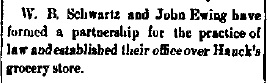
W. B. Schwartz and John Ewing have formed a partnership for the practice of law and established their office over Hauck’s grocery store.

“City and Vicinity,” The Democrat (Brazil, Indiana), 12 February 1885, p. 1, col. 2; digital image, Newspaper Archive (http://newspaperarchive.com : accessed 10 January 2014).

Masonic Meetings

Schwartz, W. B. - 1884-12-11

MASONIC NOTICE

Centennial lodge No. 541 I. & A. M. will meet in regular communication on Thursday Dec. 25 1884 it being the night of our annual election of officers and other import business all members are fraternally invited.

By order of W.M., W. B. Schwartz

“Masonic Notice,” Brazil Miner (Brazil, Indiana), 11 December 1884, p. 5, col. 2; digital image, Newspaper Archive (http://newspaperarchive.com : accessed 10 January 2014).

[Editorial note: They had their meeting on Christmas Day! Evidence of a time when Christmas was not the big celebration that it is today, perhaps…Also the abbreviation W. M. mostly likely stands for Worshipful Master, one of the Masonic Lodge officer titles. According to Wikipedia, this was the highest honor one could achieve in the lodge and was a position usually voted upon annually. The term generally means one “worthy of respect.”]

A Guest

Schwartz, W. B. - 1883-06-02

John R. Ewing, of Holmes county, Ohio, is in the city, the guest of his young lawyer friend, W. B. Schwartz.

[Editorial note: John R. Ewing was W. B. Schwartz’s brother-in-law. He married Sophia Schwartz in 1880.]

“Personals,” Brazil Miner (Brazil, Indiana), 2 June 1883, p. 1, col. 4; digital image, Newspaper Archive (http://newspaperarchive.com : 7 January 2014).

Hanging out his shingle

Schwartz, W. B. - 1883-05-26

W. B. SCHWARTZ,

Attorney at Law

Brazil  –  –  –  Indiana

[?] All business entrusted in his care will receive prompt and careful attention. Collections made a specialty.

“Advertisment,” Brazil Miner (Brazil, Indiana), 26 May 1883, p. 5, col. 2; digital image, Newspaper Archive (http://newspaperarchive.com : accessed 7 January 2014).


New Abode

Schwartz, W. B. - 1883-03-15

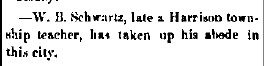
–W. B. Schwartz, late a Harrison township teacher, has taken up his abode in this city.

“Personal,” Brazil Democrat (Brazil, Indiana), 15 March 1883, p. 8, col. 2; digital image, Newspaper Archive (http://newspaperarchive.com : accessed 7 January 2014).

A New Story

For the last 10 days, I have shared the story of Roberta Van Sickle’s tragic death. The process of searching for and then finding contemporary newspaper clippings is exciting. I found that I really like telling stories this way, giving little bits at a time, like an old newspaper, radio or television serial. Yesterday, I reached the end of this part of Roberta’s story. Any good historian or genealogist will tell you that the story is never over. There are always new documents and discoveries to be found. So today, I am picking up a new thread to weave. This one takes place over several decades as the pieces of one man’s life were woven into place. Like Roberta’s story, I will let the documents, clippings and book excerpts tell the tale in chronological order.

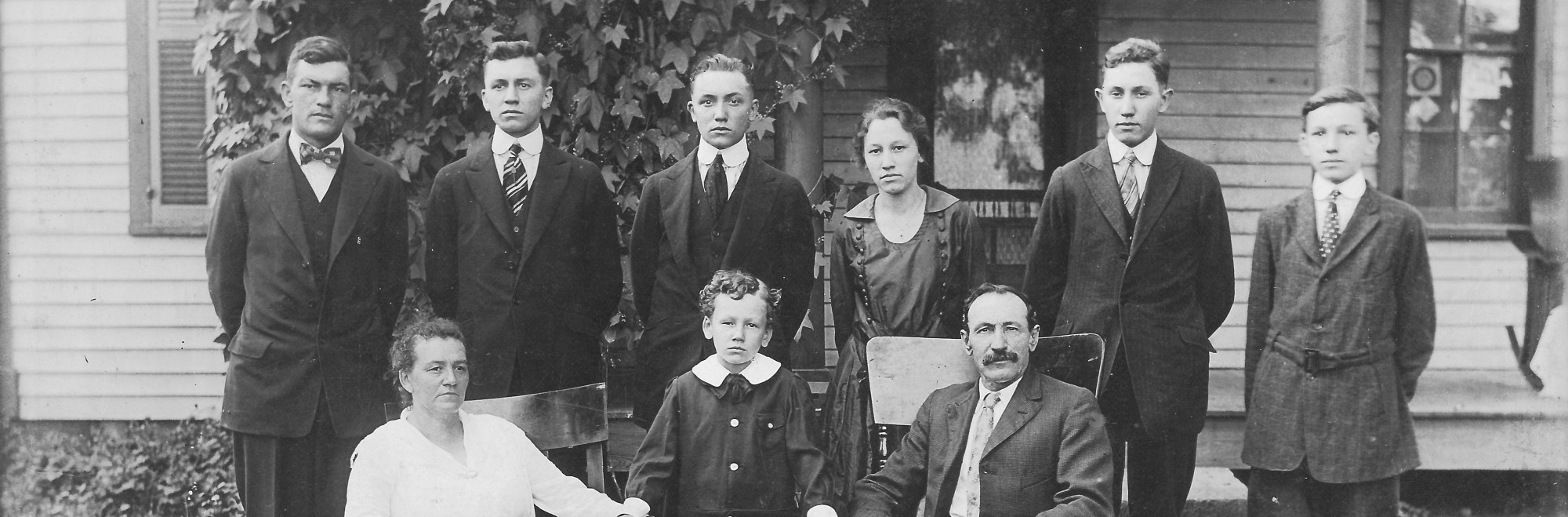
My new story tells the tale of William B. Schwartz, also known as W. B. Schwartz. He was the son of Niklaus Schwartz and his second wife, Anna Barbara Kunz, emigrants from Switzerland. William was one of the younger children in the family so he had the privilege of being born an American. William’s older sister, Elizabeth, became the wife of Christian Yegerlehner. I hesitate to call them half siblings as Niklaus’ two wives were sisters. So even though William and Elizabeth had different mothers, they had the same grandparents. Until 1880, William lived in Holmes County, Ohio where he was born. By 1883, he was living in Clay County, Indiana near his sister Elizabeth and her family. He was a school teacher, teaching his nephews at the local school in Harrison township. This is where my story begins.

Schwartz - 1880 census detail

1880 Census detail from Holmes County, Ohio – Household of Nicholas Schwartz

The first newspaper clipping to mention William was posted several weeks ago in the post School Grades.

©2014 copyright owned and written by Deborah Sweeney
Post originally found at: https://genealogylady.net/2014/01/08/a-new-story/

Roller Coaster Accident at Summit Beach (Part 10)

Roller Coaster accident - 1918-07-12COASTER PROBE ON SHELF WITH GLEN DISASTER

Responsibility for Death of Four Persons Has Not Been Fixed by Officials

NO INQUEST YET CALLED

Police and County Prosecutor Can Find No Evidence of Crime in Affair

After five days, responsibility for the roller coaster crash at Summit Beach park, which on Sunday evening sent four persons to their death, is no more accurately placed than it was five minutes after the disaster.

If the cause is ever determined it will probably be in civil suits for damages brought by heirs of the victims.

The police abandoned their investigation into the case on Tuesday, and Thursday night County Prosecutor Roetzel announced that his investigations into the accident had failed to develop any evidence of a criminal nature.

Meantime it would appear that the coast crash is to be placed on the same shelf as the N. O. T. & L. disaster at the Glen bridge in Cuyahoga Falls.

Officials of the company controlling the coaster still maintain that the disaster was caused by some human agency placing a block of wood on the track of the incline, a theory that is scouted by others who have looked into the matter.

The company insists that no defect was found in the mechanical construction or operation of the coaster. To date this claim has not been given official support from any quarter.

Meanwhile Coroner Metzger has issued no call for a public inquest at which witnesses, including survivors, officials and employees of the company, can be examined.

It will be recalled that up to the present time Coroner Metzger has never held an inquest into the Glen disaster, where several persons were killed when a car on the Mountain line route of the N. O. T. plunged off a bridge into the Little Cuyahoga river although more than four weeks has elapsed since that occurred.
C – 2

“It appears that the only way you can rouse county officials to their duty and get an inquest ordered is by public clamor,” said a prominent attorney Thursday. “In other counties, “he continued, “you will find that the coroner is the first official to get busy following such death cases as we have had here of late. He’s expected to hold an inquest into every death by violence or where the facts are not clearly established. That’s what the coroner’s job is for.

“The people of our city don’t seem to care a rap whether public officials perform their duties or not. You haven’t heard any public clamor for inquests have you? Why, even the relatives of those killed and injured haven’t come forward with demand that an inquest by held. In any other city of the country there would be such a stirring up of things if inquests were not held as to bring about resignations. No public official had a right to slight his job, but the people here are lukewarm apparently. They don’t seem to care a hoot.”

“Coaster Probe on Shelf with Glen Disaster,” Akron Beacon Journal (Akron, Ohio), 12 July 1918, p. 1, col. 6.

A very special “thank you” is in order for the Special Collections Department of the Akron-Summit County Public Library. I emailed my request for more information regarding the roller coaster accident on Saturday and received the results in less than 24 hours. Since I received several days worth of information, I will be breaking the story down into smaller chunks for the rest of this week.
Roller Coaster Accident at Summit Beach (Part 9)

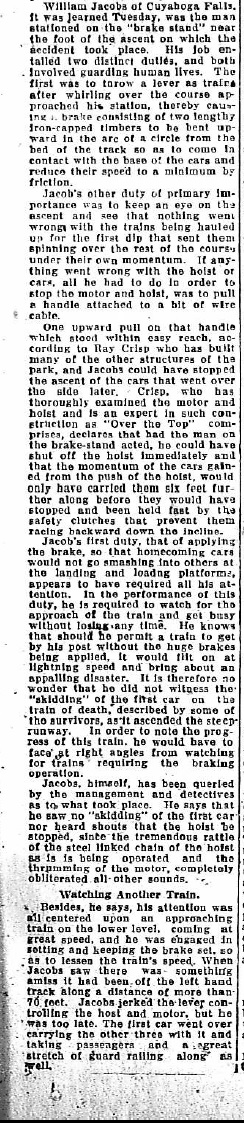
Roller Coaster accident - 1918-07-10, p. 2William Jacobs of Cuyahoga Falls, it was learned Tuesday, was the man stationed on the “brake stand” near the foot of the ascent on which the accident took place. His job entailed two distinct duties, and both involved guarding human lives. The first was to throw a lever as trains after whirling over the course approached his station, thereby causing a brake consisting of two lengthy iron-capped timbers to be bent upward in the arc of a circle from the bed of the track so as to come in contact with the base of the cars and reduce their speed to a minimum by friction.

Jacob’s other duty of primary importance was to keep an eye on the ascent and see that nothing went wrong with the trains being hauled up for the first dip that sent them spinning over the rest of the course under their own momentum. If anything went wrong with the hoist or cars, all he had to do in order to stop the motor and hoist, was to pull a handle attached to a bit of wire cable.

One upward pull on that handle which stood within easy reach, according to Ray Crisp who has built many of the other structures of the park, and Jacobs could have stopped the ascent of the cars that went over the side later. Crisp, who has thoroughly examined the motor and hoist and is an expert in such construction as “Over the Top” comprises, declares that had the man on the brake-stand acted, he could have shut off the hoist immediately and that the momentum of the cars gained from the push of the hoist, would only have carried them six feet further before they would have stopped and been held fast by the safety clutches that prevent them racing backward down the incline.

Jacob’s first duty, that of applying the brake, so that homecoming cars would not go smashing into others at the landing and loading platforms, appears to have required all his attention. In the performance of this duty, he is required to watch for the approach of the train and get busy without losing any time. He knows that should he permit a train to get by his post without the huge brakes being applied, it would tilt on at lightning speed and bring about an appalling disaster. It is therefore no wonder that he did not witness the “skidding” of the first car on the train of death, described by some of the survivors, as it ascended the steep runway. In order to note the progress of this train, he would have to face at right angles from watching for trains requiring the braking operation.

Jacobs, himself, has been queried by the management and detectives as to what took place. He says that he saw no “skidding” of the first car nor heard shouts that the hoist be stopped, since the tremendous rattle of the steel linked chain of the hoist as is is being operated and the thrumming of the motor, completely obliterated all other sounds.

Watching Another Train

Besides, he says, his attention was all centered upon an approaching train on the lower level, coming at great speed, and he was engaged at setting and keeping the brake set, so as to lessen the train’s speed. When Jacobs saw there was something amiss it had been off the left hand track along a distance of more than 70 feet. Jacobs jerked the lever controlling the host and motor, but he was too late. The first car went over carrying the other three with it and taking passengers and a great stretch of guard railing along as well.

“Fifth Victim of Park Crash May Die Today,” Akron Beacon Journal (Akron, Ohio), 10 July 1918, p. 1, col. 1.

A very special “thank you” is in order for the Special Collections Department of the Akron-Summit County Public Library. I emailed my request for more information regarding the roller coaster accident on Saturday and received the results in less than 24 hours. Since I received several days worth of information, I will be breaking the story down into smaller chunks for the rest of this week.

Roller Coaster Accident at Summit Beach (Part 8)

Roller Coaster accident - 1918-07-10, p. 1

Click to enlarge

Dennis Glassford Reported In Dying Condition at Peoples’ Hospital

PROBERS CANNOT AGREE

George Bricker is Released by Police After They Conclude Investigation

With investigators into Sunday night’s fatal accident on the big Summit Beach roller coaster divided into two camps, one supporting the theory that the coaster train was derailed by a block of wood deliberately placed on the track of the ascent for the purpose of causing trouble and the other scouting this theory, further progress in the probe seems doubtful.

A fifth victim of the crash, in the person of Dennis Glassford, is reported at the People’s Hospital as likely to die at any moment.

Following the police Investigation conducted Tuesday George Bricker, arrested Sunday as a suspect, was released by the police who admitted that their investigations had failed to involve Bricker in the affair. Bricker, who was discharged from one of the concessions also managed by J. M. Kaster, manager of the “Over the Top” attraction proved to the satisfaction of the police that he was on duty at another concession at the park all of Sunday evening and that he could have had no part in the accident.

“Fifth Victim of Park Crash May Die Today,” Akron Beacon Journal (Akron, Ohio), 10 July 1918, p. 1, col. 1.

A very special “thank you” is in order for the Special Collections Department of the Akron-Summit County Public Library. I emailed my request for more information regarding the roller coaster accident on Saturday and received the results in less than 24 hours. Since I received several days worth of information, I will be breaking the story down into smaller chunks for the rest of this week.

Roller Coaster Accident at Summit Beach (Part 7)

Roller Coaster accident - 1918-07-09, p. 2

Click to enlarge

Bricker is Grilled.

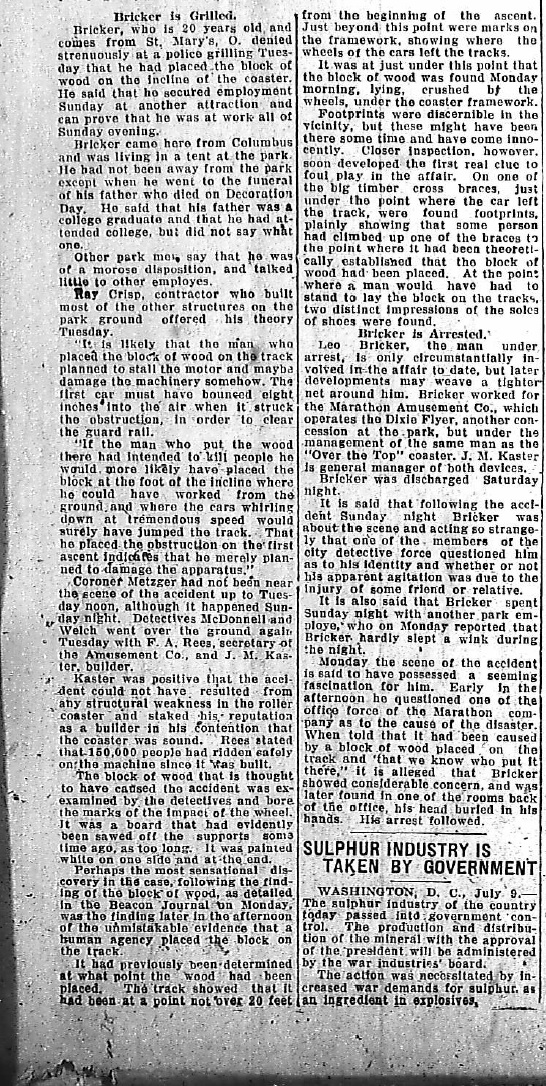
Bricker, who is 20 years old, and comes from St. Mary’s, O. denied strenuously at a police grilling Tuesday that he had placed the block of wood on the incline of the coaster. He said that he secured employment Sunday at another attraction and can prove that he was at work all of Sunday evening.

Bricker came here from Columbus and was living in a tent at the park. He had not been away from the park except when he went to the funeral of his father who died on Decoration Day. He said that his father was a college graduate and that he had attended college, but did not say what one.

Other park men say that he was of a morose disposition, and talked little to other employees.

Ray Crisp, contractor who built most of the other structures on the park ground offered his theory Tuesday.

“It is likely that the man who placed the block of wood on the track planned to stall the motor and maybe damage the machinery somehow. The first car must have bounced eight inches into the air when it struck the obstruction, in order to clear the guard rail.

“If the man who put the wood there had intended to kill people he would more likely have placed the block at the foot of the incline where he could have worked from the ground and where the cars whirling down at tremendous speed would surely have jumped the track. That he placed the obstruction on the first ascent indicates that he merely planned to damage the apparatus.”

Coroner Metzger had not been near the scene of the accident up to Tuesday noon, although it happened Sunday night. Detectives McDonnell and Welch went over the ground again Tuesday with F. A. Rees, secretary of the Amusement Co., and J. M. Kaster, builder.

Kaster was positive that the accident could not have resulted from any structural weakness in the roller coaster and staked his reputation as a builder in his contention that the coaster was sound. Rees stated that 150,000 people had ridden safely on the machine since it was built.

The block of wood that is thought to have caused the accident was ex- [sic ] examined by the detectives and bore the marks of the impact of the wheel. It was a board that had evidently been sawed off the supports some time ago, as too long. It was painted white on one side and at the end.

Perhaps the most sensational discovery in the case, following the finding of the block of wood, as detailed in the Beacon Journal on Monday, was the finding later in the afternoon of the unmistakable evidence that a human agency placed the block on the track.

It had previously been determined at what point the wood had been placed. The track showed that it had been at a point not over 20 feet from the beginning of the ascent. Just beyond this point were marks on the framework, showing where the wheels of the cars left the tracks.

It was at just under this point that the block of wood was found Monday morning, lying, crushed by the wheels, under the coaster framework.

Footprints were discernible in the vicinity, but these might have been there some time and have come innocently. Closer inspection, however, soon developed the first real clue to foul play in the affair. On one of the big timber cross braces, just under the point where the car left the track, were found footprints, plainly showing that some person had climbed up one of the braces to the point where it had been theoretically established that the block of wood had been placed. At the point where a man would have had to stand to lay the block on the tracks, two distinct impressions of the soles of shoes were found.

Bricker is Arrested.

Leo Bricker, the man under arrest, is only circumstantially involved in the affair to date, but later developments may weave a tighter net around him. Bricker worked for the Marathon Amusement Co., which operates the Dixie Flyer, another concession at the park, but under the management of the same man as the “Over the Top” coaster. J. M. Kaster is general manager of both devices.

Bricker was discharged Saturday night.

It is said that following the accident Sunday night Bricker was about the scene and acting so strangely the one of the members of the city detective force questioned him as to his identity and whether or not his apparent agitation was due to the injury of some friend or relative.

It is also said that Bricker spent Sunday night with another park employee, who on Monday reported that Bricker hardly slept a wink during the night.

Monday the scene of the accident is said to have possessed a seeming fascination for him. Early in the afternoon he questioned one of the office force of the Marathon company as to the cause of the disaster. When told that it had been caused by a block of wood placed on the track and “that we know who put it there,” it is alleged that Bricker showed considerable concern, and was later found in one of the rooms back of the office, his head buried in his hands. His arrest followed.

“Fourth Victim of Coaster Crash is Dead…,” Akron Beacon Journal (Akron, Ohio), 9 July 1918, p. 1, col.1-2.

A very special “thank you” is in order for the Special Collections Department of the Akron-Summit County Public Library. I emailed my request for more information regarding the roller coaster accident on Saturday and received the results in less than 24 hours. Since I received several days worth of information, I will be breaking the story down into smaller chunks for the rest of this week.