Category Archives: Uncategorized

World War II Veterans of Kentland (Part 1)

On my recent trip to New York City to see my father, I liberated his copy of the Kentland Newton County Centennial 1860-1960. The book contains pictures, stories and historical facts of Kentland, Indiana’s first 100 years.

Mrs. Rolland Ade wrote a piece titled “Kentland’s Participation in Wars.” Her summary of Kentland’s role in World War II states

“the home front again felt the many privations a war brings. We had sugar rationing and gas rationing and constant other reminders that we were at war. Kentland sons were again in army camps, and more and more were sent overseas.”

Mrs. Ade was correct. A large portion of Kentland’s eligible men (and a few women) served in World War II. The following is the first half of the list who served from Kentland:
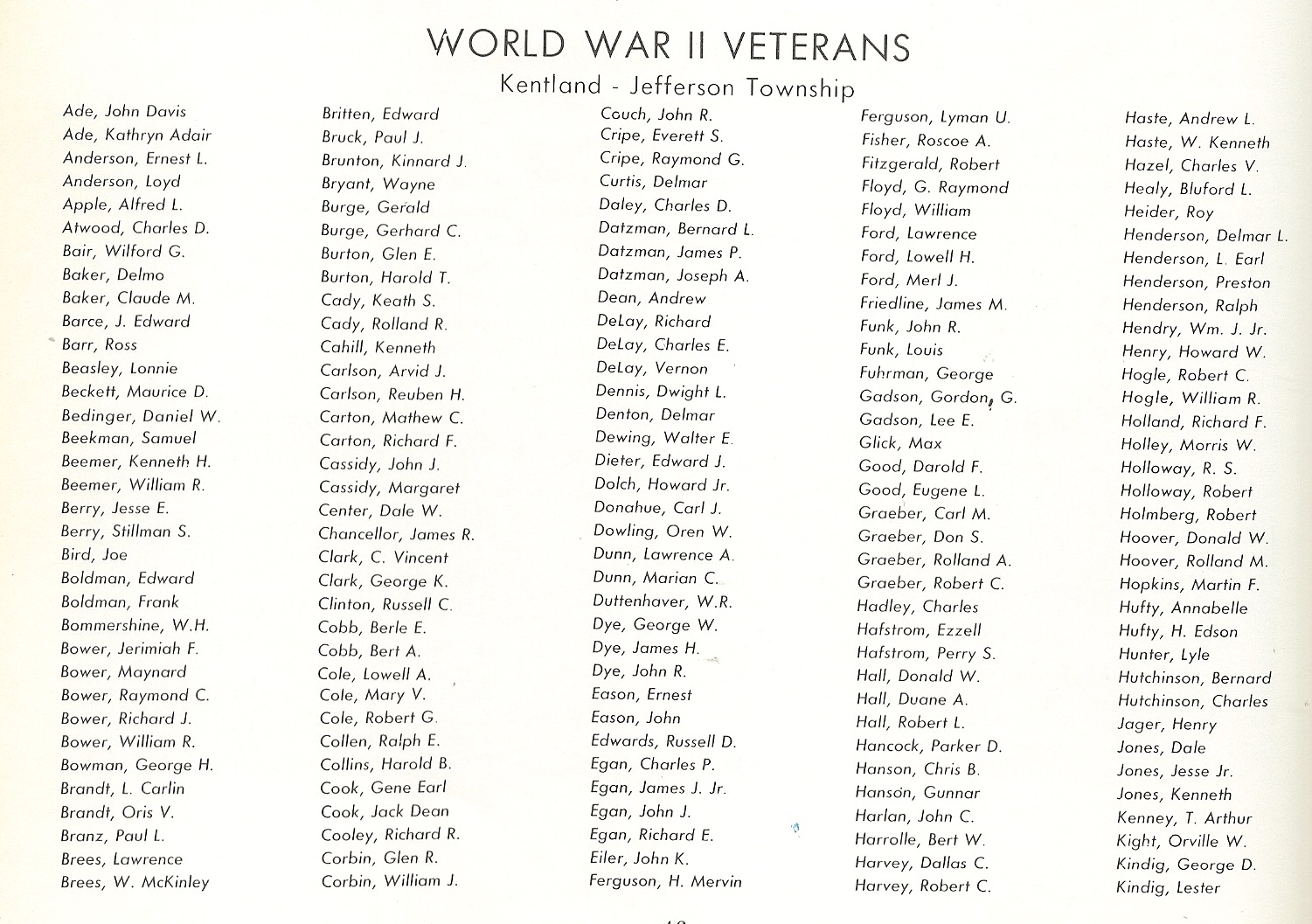
Kentland's World War II veterans, part 1John Davis Ade
Kathryn Adair Ade
Ernest L. Anderson
Loyd Anderson
Alfred L. Apple
Charles C. Atwood
Wilford G. Bair
Delmo Baker
Claude M. Baker
J. Edward Barce
Ross Barr
Lonnie Beasley
Maurice D. Beckett
Daniel W. Bedinger
Samuel Beekman
Kenneth H. Beemer
William R. Beemer
Jesse E. Berry
Stillman S. Berry
Joe Bird
Edward Boldman
Frank Boldman
W.H. Bommershine
Jerimiah F. Bower
Maynard Bower
Raymond C. Bower
Richard J. Bower
William R. Bower
George H. Bowman
L. Carlin Brandt
Oris V. Brandt
Paul L. Branz
Lawrence Brees
W. McKinley Brees
Edward Britten
Paul J. Bruck
Kinnard J. Brunton
Wayne Bryant
Gerald Burge
Gerhard C. Burge
Glen E. Burton
Harold T. Burton
Keath S. Cady
Rolland R. Cady
Kenneth Cahill
Arvid J. Carlson
Reuben H. Carlson
Mathew C. Carton
Richard F. Carton
John J. Cassidy
Margaret Cassidy
Dale W. Center
James R. Chancellor
C. Vincent Clark
George K. Clark
Russell C. Clinton
Berle E. Cobb
Bert A. Cobb
Lowell A. Cole
Mary V. Cole
Robert G. Cole
Ralph E. Collen
Harold B. Collins
Gene Earl Cook
Jack Dean Cook
Richard R. Cooley
Glen R. Corbin
William J. Corbin
John R. Couch
Everett S. Cripe
Raymond G. Cripe
Delmar Curtis
Charles D. Daley
Bernard L. Datzman
James P. Datzman
Joseph A. Datzman
Andrew Dean
Richard DeLay
Charles E. DeLay
Vernon DeLay
Dwight L. Dennis
Delmar Denton
Walter E. Dewing
Edward J. Dieter
Howard Dolch Jr.
Carl J. Donahue
Oren W. Dowling
Lawrence A. Dunn
Marian C. Dunn
W.R. Duttenhaver
George W. Dye
James Dye
John R. Dye
Ernest Eason
John Eason
Russell D. Edwards
Charles P. Egan
James J. Egan Jr.
John J. Egan
Richard E. Egan
John K. Eiler
H. Mervin Ferguson
Lyman U. Ferguson
Roscoe A. Fisher
Robert Fitzgerald
G. Raymond Floyd
William Floyd
Lawrence Ford
Lowell H. Ford
Merl J. Ford
James M. Friedline
John R. Funk
Louis Funk
George Fuhrman
Gord G. Gadson
Lee E. Gadson
Max Glick
Darold F. Good
Eugene L. Good
Carl M. Graeber
Don S. Graeber
Rolland A. Graeber
Robert C. Graeber
Charles Hadley
Ezzell Hafstrom
Perry S. Hafstrom
Donald W. Hall
Duane A. Hall
Robert L. Hall
Parker D. Hancock
Chris B. Hanson
Gunnar Hanson
John C. Harlan
Bert W. Harrolle
Dallas C. Harvey
Robert C. Harvey
Andrew L. Haste
W. Kenneth Haste
Charles V. Hazel
Bluford L. Healy
Roy Heider
Delmar L. Henderson
L. Earl Henderson
Preston Henderson
Ralph Henderson
William J. Hendry Jr.
Howard W. Henry
Robert C. Hogle
William R. Hogle
Richard F. Holland
Morris W. Holley
R.S. Holloway
Robert Holloway
Robert Holmberg
Donald W. Hoover
Rolland M. Hoover
Martin F. Hopkins
Annabelle Hufty
H. Edson Hufty
Lyle Hunter
Bernard Hutchinson
Charles Hutchinson
Henry Jager
Dale Jones
Jesse Jones Jr.
Kenneth Jones
T. Arthur Kenney
Orville W. Kight
George D. Kindig
Lester Kindig

A well deserved vacation!

I am going on vacation soon, but you, dear readers of my blog will never know it. You won’t know when I leave home or when I get back. We live in quite the technologically modern age. I can co-ordinate behind the scenes to make sure the blog continues to post while I am gone. For the last few weeks I have been doubling up on my scanning and transcribing duties. Instead of doing a letter a day, I’ve been doing two, three or even four.  On some days, I forget that I have already read ahead and my readers have not. The most important part of the process is the scanning. As long as I get the letters scanned and online, I can do everything else from the road. While I am gone, I will be able to continue to text and call family. It makes me think how much easier it might have been for my grandparents during World War II, but then we wouldn’t have their wonderful letters to read.

My children have never been to where I grew up. I have wanted to show them the east coast for awhile (plus there are old friends I haven’t seen in ages). We live in the town where their father grew up. They know where he went to school and they have seen the various places from his childhood. This summer we will walk upon the matrilineal ancestral grounds. Through an interesting quirk of fate, my mother was the first generation on her mother’s side NOT to have been born in Massachusetts in over 300 years (at the time of her birth). Luckily for me, she returned to Massachusetts where I was born. The earliest known female in my direct matrilineal line was a woman named Susannah Leach. She was born in Massachusetts in 1703. I have yet to discover her parentage. In 1720, at the age of 17 years, she married Isaac Churchill. They had 7 children. Susannah died at the grand age of 87 in 1790. Both Leach and Churchill are surnames that crisscross my maternal family tree through several generations.

Since we also descend from several pilgrim families one of our destinations is Plymouth, Massachusetts to  explore Plimouth Plantation and the Mayflower II. I have seriously tried to limit the urge to drag my children through endless cemeteries. BUT this morning on the ride to school I asked my daughter if she would be willing to go to a cemetery or two. She begrudgingly agreed. She is not so thrilled with the residents of the animal kingdom that we come across in graveyards, i.e. spiders and the occasional grass snake. Last night, it popped into my head that I should try finding the grave of Marcia Leach (who is possibly related to Susannah but I don’t know how). When Marcia was born, her family lived in Plymouth. As a young girl, the entire family moved to Lynn, presumably for the job opportunities the factory town provided. After Marcia’s brief marriage that produced my great, great grandfather, Marcia and her sister Lizzie lived together for the remainder of Marcia’s life in Lynn.

I am not sure what happened to Lizzie after Marcia’s death in 1911. Several of their siblings are buried at the Pine Grove Cemetery in Lynn, Massachusetts. However, on the death records for Marcia and her parents, even though their deaths occurred in Lynn, burial was given as Plymouth with no cemetery listed. NO CEMETERY LISTED!!! Do you know how many burials there are in the second oldest European settlement in our country? Talk about the proverbial needle in a haystack. To make matters worse, Plymouth has all their known burials online. And guess what? Nothing. Marcia and Lizzie’s brother Robert died in 1902. His death record even gives a cemetery in Plymouth, Vine Hills. Again, nothing. The only Robert Leach buried in Plymouth is their uncle Robert Bartlett Leach. I even resorted to calling the Cemetery Department this morning to see if they could help. Let me just tell you how much I abhor talking on the telephone. It was a big deal for me to make that call. The clerk who assisted me was very kind but she wasn’t able to shed any light on the matter. She even looked at the old cemetery cards for Vine Hills. So at this point, I may just have to come to grips with the fact that I may never find Marcia’s grave. I suspect that this family may not have been well off and may not have been able to afford a plot or cemetery stones. My last resort is to contact the cemetery in Lynn and see if she is buried there, despite the notation that her burial was in Plymouth.

And now that I have taken the time to rant about my genealogical brick wall for the day, I must get back to transcribing those letters. I don’t want you to miss out while I am away.

Liebster Blog Award

liebster-blog-award-small

This week I am being honored with the Liebster Blog Award. For those of you who have never heard of it before, the Liebster is given to newer bloggers with less than 200 followers. Liebster is the German word for “favorite”. The award is typically passed on once you receive it, being a sort of the chain letter for blogging. Once you have been nominated you need to answer eleven questions posed by your nominator, select eleven blogs you would like to nominate, and then come up with eleven questions for the new award recipients that you want answered. Whew!

I was honored by ljhlaura who writes the Branch and Leaf Blog. She was one of my earliest followers. Since I am still relatively new to blogging, I had a hard time coming up with eleven blogs with less than 200 followers. Many of the blogs that I follow at this point have large followings so they are ineligible for nomination. Two examples are Judy Russell’s The Legal Genealogist and Hinges of History. If you follow genealogy blogs, you KNOW who Judy is. Hinges of History is a blog that I only discovered this last week. Its entire focus is the WAVES of World War II. The WAVES, or Women Accepted for Volunteer Emergency Service, were women who enlisted in the Navy. More than 100,000 of these amazing women signed up during World War II. I would like to think that my grandmother might have signed up if she had been 10-15 years younger and had not had a family at home to care for.

I tried to be diligent and make sure that the blogs I nominated had less than 200 followers. Unfortunately, not all the blogs I am nominating have their numbers of followers posted so I tried my best. Many of these bloggers welcomed me right from the start and I can’t wait to read each one of their new posts every day (or week).

  1. Mustang.Koji and his blog Masako and Spam Musubi
  2. Jenn, aka the Writer Gril, and her genealogy blog Unveiling My Past
  3. Donna Catterick and her new genealogy blog This I Leave
  4. Grant Davis and his blog The Stephen Sherwood Letters
  5. Kaitlin and her blog Keeping History Alive
  6. Chris Wimsatt at The Buff Genealogist
  7. Sheryl and her blog A Hundred Years Ago (I know she’s just over 200 followers, and I don’t care!)
  8. Jacqui Stevens  and her blog A Family Tapestry
  9. Gpcox at Pacific Paratrooper 
  10. Jaggh53163 at “Greatest Generation” Life Lessons
  11. Susan Buck and her blog Branches of Our Family

So here are the questions I was asked and my answers:

  1. When did I start my blog? I started my blog over this last Thanksgiving on November 23, 2012.
  2. What motivates you to write? I am not sure I have an answer to this one….I feel a great need to share my grandparents’ letters and to write down some of my family research before the stories or the letters get lost forever. I never really thought much about being a writer so I feel somewhat odd calling myself one.
  3. Do you have closer to a dearth of a plethora of writing ideas to bring to fruition? I love the word plethora. We used the word a LOT in college. I would say that I have a plethora of documents and a whole heck of a lot of source material to draw upon. I don’t see myself stopping anytime soon.
  4. Did you have a hard time naming your blog? I’ve gone by the moniker genealogy lady for awhile now (cough…well over a decade). My husband starting using it as a nickname for me when I would disappear into the office and not emerge for hours. It just seemed like the natural name for my blog.
  5. Where were you born? I was born in Gloucester, Massachusetts.
  6. How far to you currently live from where you were born? I am about as far as you can be and still be in the continental United States.
  7. Where would you live if you could live anywhere? I love the idea of living in Ireland, Scotland, Great Britain, etc. but I would probably be happiest somewhere in the mountains, in the woods near a lake, with very few people around.
  8. What’s your favorite season? Tough one as I like each season individually.
  9. Why is your favorite season your favorite? I like Winter for the snow and the holidays; I like Spring for its sense of newness and everything being reborn and the coming of warmer days; I like Summer for its heat, childhood memories of lazy days of camp on the lake, and its carefreeness; I like Autumn for the beautiful fall colors (which I rarely see anymore) and changing temperatures and the year end rituals of harvest & Halloween
  10. More introvert or extrovert? Hands down I am an introvert, and proud of it!
  11. What kind of people inspire you? Fearless & brave people; those who are not afraid to fight for their causes or against injustice; people who stand up to bullies and defy the odds.  Whether it was the brave women who fought for our right to vote, abolitionists who helped slaves escape the south, Germans who hid Jews during World War II, or the kid who stands up for his friend against the bully on the playground.

My questions for my nominees: 1) Why did you start your blog? 2) Name a hobby besides genealogy/writing that you also love. 3) Who is your favorite ancestor? 4) What is your favorite book? 5) If you could meet one of your ancestors, who would it be? 6) Why did you choose that ancestor? 7) If you could go back in time, what period would you chose? 8) Who is your most frustrating brick wall ancestor? 9) What is your favorite ice cream flavor? 10) Are you a professional genealogist or do you just this for “fun”? 11) Cat or dog person?

Saturday’s Surname – Foster

The Foster Family, by The American Genealogical Research Institite, 1973.

The Foster Family, by The American Genealogical Research Institite, 1973.

Many years ago I was given a copy of the book The Foster Family from the American Genealogical Research Institute. The book is copyrighted  1973 and it does not specify whether there were multiple printings or additions. I know the book was given to me by a well meaning relative but I don’t remember who at this point. The book has several chapters ranging from “the family name and arms”, “census of 1790” and “constructing the foster family tree”. And before you comment upon my lack of capitalization, I am copying straight from the book. Books like this are great for the novice genealogist, I guess. But even when I received the book, I already knew how useless it was for my own research. Books like this are mere grandiose summaries. They talk big, but they have no meat as they are comprised mostly of lists.  And since the book was written in 1973, much of the information is likely inaccurate and obsolete.

One fascinating aspect of the book is the first section “the family name and arms”. It gives a brief history of Europe, which starts laughingly with the collapse of the Roman Empire and the waves of Barbarians sweeping across Europe in the 4th and 5th centuries. Wow! Really, how does this help me trace my Foster family? The narrative continues with the Norman Invasion in 1066 and then engages in a mini lecture on the evolutionary nature of names. According to the book, Foster was originally Forrester. The title of Forrester was given by the Saxons to men appointed to guard the forests and to protect the Lord’s hunting rights. Over time the name Forrester evolved to Forster and then Foster. That may be, but how does that help me trace the lineage of one Gladys Foster, born 1905 in Terre Haute, Indiana. Frankly, it does not. There are multiple origins of the name Foster. What about those individuals who “fostered” children? Or, I like this French version “Shearer or scissors maker” from the Old French “forceter”. Regardless of the actual history of my Foster family, I am sure it has little to do with this pompous tourist brochure that now takes up precious space on my bookshelf. I guess it is good for a laugh or two.

Chart of the children of James B. Foster and Lydia C. (Dicks) Foster, in my grandmother's handwritting

Chart of the children of James B. Foster and Lydia C. (Dicks) Foster, in my grandmother’s handwritting

I was lucky enough to inherit a lineage chart that was written in my grandmother’s handwriting that traced her father’s family. The chart names all of my great grandfather’s siblings and his parents. Considering my grandmother never spoke about her father or his family, it is rather fortunate that the chart even existed. My great grandfather was James Edward “Ned” Foster whose father was James Benjamin Foster whose father was Benjamin Coates Foster. And that, ladies and gentleman, is the end of the line, the brick wall of my Foster family. I have traced the line back as far as my 3rd great grandfather, six generations. That’s decent by some standards, but not good enough by mine. I’ve hit that proverbial brick wall because of those early waves of western migration that brought young Americans from the coastal states to the new territories of Ohio, Indiana and Illinois and the lack of proper recordkeeping.

Benjamin Coates Foster was born April 13, 1797 in Pennsylvania. Yeah, Pennsylvania! No county, just Pennsylvania. On the 1800 census, there were 602,365 people enumerated in Pennsylvania. There were at least 68 heads of household with the surname Foster. (I got this figure from Ancestry so we also have to allow for entries misspelled in the index). The first time I can legitimately find Benjamin C. Foster on a document is his marriage on March 28, 1828 in Lawrence County, Illinois to Belinda Barker. He appears on the 1830 census in nearby Clark County, Illinois where he remained the rest of his life. In 1838 and 1839, there were several land purchases in Clark County. Benjamin can be found on the United States censuses for 1830, 1840, 1850, 1860, and 1870 in Clark County. I have also found him on the Illinois State censuses of 1855 and 1865. One of my favorite things that I learned about Benjamin from the 1850 and 1860 censuses is that Benjamin’s occupation was a tailor! For those of you that don’t know me, I am also a seamstress and pattern maker so it is nice to know that such things are in my genes. This is also why I like the French translation of Foster since it has to do with scissors.

Benjamin and Belinda were blessed with at least 9 children, of which only 6 survived to adulthood, and of those only 4 had children to pass on the genes, 2 were male, leaving my 2nd great grandfather James B. Foster the only child of Benjamin and Belinda to have any male children to pass on the surname of Foster.


I believe this is one of the last letters I have from Uncle Jim for awhile. It is good to know that eventually the brothers-in-law will meet up.

Letter transcription:

U.S.N.C. T.C. Camp Bradford, Ships Co. c/o Camp Allen, N.O.B. Norfolk, VA

Sunday 7 June 1942

Dear Sis-

Just today received a letter from Jake, he wanted me to meet him last night at the Y.M.C.A., mail is not so fast here as you can readily see, anyway I wrote him and I think we will be able to get together soon.

Please let me know when you plan coming for sure I will try to get two or three nights away if you want me to, if that won’t interfere with your plans, maybe we can have a grand party, or something. Anyway I will get to see you at least once, I am writing to find out if Thelma is going to get a vacation, if she does I will have her down here for a week or two. It won’t be in June I am most sure of that, but sometime later.

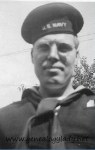
Hello John and Mark, you should see your uncle Jim in a sailor uniform.

Love Jim

©2012, copyrighted & written by Deborah Sweeney