Tag Archives: Clay County

Smallpox Epidemic, Part IV

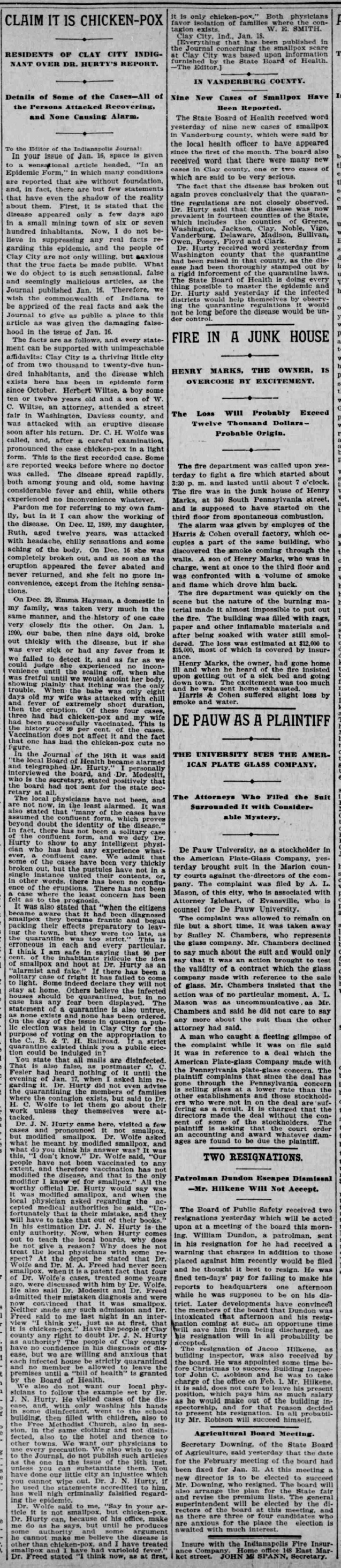
Indianapolis Journal - 1900-01-19 (Smallpox epidemic)CLAIM IT IS CHICKEN-POX

Residents Of Clay City Indig-
nant Over Dr. Hurty’s Report.

Details of Some of the Cases-All of
the Persons Attacked Recovering,
and None Causing Alarm.

To the Editor of the Indianapolis Journal:

In your issue of Jan. 16, space is given to a sensational article headed, “In an Epidemic Form,” in which many conditions are reported that are without foundation, and, in fact, there are but few statements that have even the shadow of the reality about them. First, it is stated that the disease appeared only a few days ago in a small mining town of six or seven hundred inhabitants. Now, I do not believe in suppressing any real facts regarding this epidemic, and the people of Clay City are not only willing, but anxious that the true facts be made public. What we do object to is such sensational, false and seemingly malicious articles, as the Journal published Jan. 16. Therefore, we wish the commonwealth of Indiana to be apprised of the real facts and ask the Journal to give a public a place to this article as was given the damaging falsehood in the issue of Jan. 16.

The facts are as follows, and every statement can be supported with unimpeachable affidavits: Clay City is a thriving little city of from two thousand to twenty-five hundred inhabitants, and the disease which exists here has been in epidemic form since October. Herbert Wiltse, a boy some ten or twelve years old and a son of W. C. Wiltse, an attorney, attended a street fair in Washington, Daviess county, and was attacked with an eruptive disease soon after his return. Dr. C. H. Wolfe was called, and, after a careful examination, pronounced the case chicken-pox in a light form. This is the first recorded case. Some are reported weeks before where no doctor was called. The disease spread rapidly, both among young and old, some having considerable fever and chill, while others experienced no inconvenience whatever.

Pardon me for referring to my own family, but in it I can show the working of the disease. On Dec. 12, 1899, my daughter, Ruth, aged twelve years, was attacked with headache, chilly sensations and some aching of the body. On Dec. 16 she was completely broken out, and as soon as the eruption appeared the fever abated and never returned, and she felt no more inconvenience, except from the itching sensation.

On Dec. 29, Emma Hayman, a domestic in my family, was taken very much in the same manner, and the history of one case very closely fits the other. On Jan. 1, 1900, our babe, then nine days old, broke out thickly with the disease, but if she was ever sick or had any fever from it we failed to detect it, and as far as we could judge she experienced no inconvenience until the scaling off, when she was fretful until we would anoint her body, showing plainly that itching was the only trouble. When the babe was only eight days old my wife was attacked with chill and fever of extremely short duration, then the eruption. Of these four cases, three had had chicken-pox and my wife had been successfully vaccinated. This is the history of 99 per cent of the cases. Vaccination does not affect it and the fact that one has had the chicken-pox cuts no figure.

In the Journal of the 16th it was said “the local Board of Health became alarmed and telegraphed Dr. Hurty.” I personally interviewed the board, and Dr. Modesitt, who is the secretary, stated positively that the board had not sent for the state secretary at all.

The local physicians have not been, and are not now, in the least alarmed. It was also stated that “many of the cases have assumed the confluent form, which proves beyond doubt the identity of the disease.” In fact, there has not been a solitary case of the confluent form, and we defy Dr. Hurty to show to any intelligent physician who has had any experience whatever, a confluent case. We admit that some of the cases have been very thickly broken out, but the pustules have not in a single instance united their contents, or, in other words, there has been no confluence of the eruptions. There has not been a case where the least concern has been felt as to the prognosis.

It was also stated that “when the citizens became aware that it had been diagnosed smallpox they became frantic and began packing their effects preparatory to leaving the town, but they were too late, as the quarantine was too strict.” This is erroneous in each and every particular. I think I am safe in saying that 90 percent of the inhabitants ridicule the idea of smallpox and hoot at Dr. Hurty as an “alarmist and fake.”  If there has been a solitary case of fright it has failed to come to light. Some indeed declare they will not stay at home. Others believe the infected houses should be quarantined, but in no case has any fear been displayed. The statement of a quarantine is also untrue, as none exists and none has been ordered. On the day of the issue in question a public election was held in Clay City for the purpose of voting on the appropriation to the C., B. & T. H. Railroad. If a strict quarantine existed think you a public election could be indulged in?

You state that all mails are disinfected. That is also false, as postmaster C. C. Fesler had heard nothing of it until the evening of Jan. 17, when I asked him regarding it. Dr. Hurty did not even advise the quarantining the members of families where the contagion exists, but said to Dr. H. C. Wolfe to let them go about their work unless they themselves were attacked.

Dr. J. N. Hurty came here, visited a few cases and pronounced it not smallpox, but modified smallpox. Dr. Wolfe asked what he meant by modified smallpox, and what do you think his answer was? It was this, “I don’t know.” Dr. Wolfe said, “Our people have not been vaccinated to any extent, and therefore vaccination has not modified the disease, and that is the only modifier I know of for smallpox.” All the worthy official Dr. Hurty would say was it was modified smallpox, and when the local physician asked regarding the accepted medical authorities he said, “Unfortunately that is their mistake, and they will have to take that out of their books.” In his estimation Dr. J. N. Hurty is the only authority. Now, when Hurty comes out to teach the local boards, why does he not give a reason? Why does he not treat the local physicians with some respect? At the depot he stated that Dr. Wolfe and Dr. M. A. Freed had never seen smallpox, when it is a patent fact that four of Dr. Wolfe’s cases, treated some years ago, were discussed with him by Dr. Wolfe. He also said Dr. Modesitt and Dr. Freed admitted their mistaken diagnosis and were now convinced that it was smallpox. Neither made any such admission and Dr. Freed said to me last night in an interview “I think yet, just as at first, that it is chicken-pox.”  Have the people of Clay county any right to doubt Dr. J. N. Hurty as authority? The people of Clay county have no confidence of his diagnosis of disease, but we are willing and anxious that each infected house be strictly quarantined and no member be allowed to leave the premises until a “bill of health” is granted by the Board of Health.

We also do not want our local physicians to follow the example set by Dr. J. N. Hurty. He visited cases of the disease, and, with only washing his hands in some disinfectant, went to the school building, then filled with children, also to the Free Methodist Church, also in session, in the same clothing and not disinfected, also to the hotel and thence to other towns. We want our physicians to use every precaution. We also wish to say to the Journal, do not publish such articles as the one in the issue 16th inst. Unless you can substantiate them. You have done our little city an injustice which you cannot wipe out. Dr. J. N. Hurty, if he used the statements accredited to him, has well nigh criminally falsified regarding the epidemic.

Dr. Wolfe said to me, “Say in your article it is not smallpox, but chicken-pox. Dr. Hurty can, because of his office, make me do as he says, but until he produces some authority and some argument he cannot make me believe the disease is other than chicken-pox, and I have treated smallpox and I have had varillold fever.” Dr. Freed stated “I think now, as at first, it is only chicken-pox.” Both physicians favor isolation of families where the contagion exists.
W. E. SMITH
Clay City, Ind., Jan. 18.

[Everything that has been published in the Journal concerning the smallpox scare at Clay City was based upon information furnished by the State Board of Health. – The Editor.]

IN VANDERBURG COUNTY

Nine New Cases of Smallpox Have
Been Reported.

The State Board of Health received word yesterday of nine new cases of smallpox in Vanderburg county, which were said by the local health officer to have appeared since the first of the month. The board also received word that there were many new cases in Clay county, one or two cases of which are said to be very serious.

The fact that the disease has broken out again proves conclusively that the quarantine regularions are not closely observed. Dr. Hurty said that the disease was now prevalent in fourteen counties of the State, which includes the counties of Greene, Washington, Jackson, Clay, Noble, Vigo, Vanderburg, Delaware, Madison, Sullivan, Owen, Posey, Floyd and Clark.

Dr. Hurty received word yesterday from Washington county that the quarantine had been raised in that county, as the disease had been thoroughly stamped out by a rigid inforcement of the quarantine laws. The State Board of Health is doing every thing possible to master the epidemic and Dr. Hurty said yesterday if the infected districts would help themselves by observing the quarantine regulations it would not be long before the disease would be under control.

“Claim It Is Chicken-Pox,” The Indianapolis Journal (Indianapolis, Indiana), 19 January 1900, p. 8, col. 4-5; digital image, Chronicling America (http://chroniclingamerica.loc.gov/ : accessed 6 December 2014).

Smallpox Epidemic, Part III

Indianapolis Journal - 1900-01-18 (Smallpox epidemic)WILL DISINFECT MAILS

Dr. Hurty Receives Word From
Government Official

The Postmaster at Lesterville Has
Smallpox and Is Still at Work –
the Developments

The smallpox situation in Clay county has excited the attention of the government authorities at Washington. Late yesterday afternoon Dr. Hurty, secrety of the State Board of Health, received a telegram from Gen. Walter Wyman, chief of the marine service at Washigton [sic], stating that the government would disinfect the mails at all points designated by the Indiana Board of Health. The telegram received was in reply to a message sent by Dr. Hurty to the authorities at Washington, informing them that the postmaster at Lesterville had smallpox and was continuing in the performance of his duties, with an utter disregard of the fact that he might be spreading the contagion all over the United States.

Yesterday reports were brought in from Washington county by Dr. Ferguson, who was sent to investigate rumors of smallpox. He says that the disease is prevailing to an alarming extent and he earnestly advised Dr. Hurty to establish a rigid quarantine. The authorizes at Clay City advised the State Board of Health yesterday morning that many of the citizens of the town were escaping to other towns despite the strict measures of quarantine in force. Dr. Hurty immediately telephoned Dr. Davis, the president of the board at Richmond, advising him of the situation and asking that a meeting of the board be called.

In speaking of a communication in one of the afternoon papers from the citizens of Clay City in which they express themselves as being highly indignant of Dr. Hurty for causing such excitement throught the State over the smallpox situation, when in reality the disease is very mild, resulting in no fatalies, Dr. Hurty said that is was not the policy of the State Board of Health to wait for fatalities before taking action, and the citizens of Clay City would have to abide by the action of the board.

Cases of Smallpox Reported.
Special to the Indianapolis Journal.

TERRE HAUTE, Ind., Jan. 17. – Several cases of what is believed to be the same disease, thought to have been chicken-pox at Clay City, but declared by Dr. Hurty to be smallpox, have been reported north of town. The persons afflicted came from Clay City, and the symptoms of their disease are the same as in the hundred or more cases reported at Clay City.

Clay City Is Not Excited.
To the Editor of the Indianapolis Journal

An undue amount of excitement has been caused by the published reports concerning the prevalence of smallpox at this place. The News of yesterday says: “Residents of the town are almost panic-stricken, but the quarantine prevents them from escaping.” It also states that the population of the town in 700, and that the disease had attacked nearly a third of the population. There has been no excitement here. There has been no quarantine, and people have not tried to escape. There have been between 200 and 300 cases, beginning with the early part of the fall. The physicians have treated for chickenpox and cured every case. We have a population of about 2,500, instead of 700. Many of the patients never went to bed or even quit work.

The Journal’s informant was in error when he stated that “when the citizens of the town became aware that the disease had been diagnosed as smallpox, they became frantic with fear and excitement, and many rushed home and began packing their effects, with the intention of escaping from the town but they were too late. Acting under the instructions of Dr. Hurty the officials immediately began the enforcement of the quarantine laws and no citizen who had come in contact with the disease was permitted to leave.” The utmost freedom prevails as to the coming and going of our citizens – no person being denied the privilege of going where he pleases. No one has heard of any person attempting to get away on account of Dr. Hurty’s announcement. The disease, whatever it is, is not half so severe as many cases of vaccination. There have been no fatalities from the disease.

A great injustice has been done our town by these exaggerated statements, and in order that the public may know the true condition of affairs your informant offers the above correction, without denying any official statement by Dr. Hurty. Our physicians report no cases of the confluent form.
M. MARKLE
Clay City, Ind., Jan. 15

“Will Disinfect Mails,” The Indianapolis Journal (Indianapolis, Indiana), 18 January 1900, p. 4, col. 7; digital image, Chronicling America (http://chroniclingamerica.loc.gov/ : accessed 6 December 2014).

Smallpox Epidemic, Part II

Indianapolis Journal - 1900-01-17 (Smallpox epidemic)ARE HUNDREDS OF CASES

Dr. Hurty, State Health Offi-
cer, Returns From Clay City

Nine Children in One Family with
Smallpox-The Disease Has Spread
to Several Counties.

Dr. Hurty, of the State Board of Health, returned from Clay City, the hotbed of the smallpox epidemic, yesterday, and reports a most alarming state of affairs. He said that there were hundreds of cases, and many of them were of the confluent form, which is exceedingly dangerous. Said he: “It is a common sight to see little children walking along the streets of Clay City with their faces broken out with the eruptive sores of smallpox.”

Smallpox is everywhere in Clay City. It one turns to the right he is confronted with a whole row of houses in every one of which there are to be found one or more cases of fully developed smallpox. The same conditions prevail on every side and Dr. Hurty said that in one instance he found nine children in one family who were smitten with the disease at the same time.

The family referred to is that of George Burkhart, a veteran of the civil war. In speaking of these cases Dr. Hurty said that the fact that  Burkhart, who was vaccinated during the war, did not have the disease was very good evidence that the epidemic was really smallpox. Two of the Burkhart children, Blanche and Mona, have the confluent form of smallpox and it is a very grave question as to their recovery.

Under a misapprehension of the nature of the disease the public schools were continued until nearly two-thirds of the children were inoculated, and it was a common sight to see the little ones going daily to their lessons with their faces broken out with smallpox in the pustular stage. The young, however, are not the only ones who are attacked with the dreadful scourge, for even in the churches there were seen scores of adults whose faces were solid masses of oozing poison. The only excuse to be offered for this apparent criminal neglect on the part of the local board of health is the fact that it was advised by physicians diagnosing the disease that it was nothing more than chickenpox and as a consequence its apprehensions were not aroused until informed by Dr. Hurty of the real nature of the disease. When the Town Council awoke to the fact that the epidemic was really smallpox, the members immediately arranged for a called meeting at which they passed resolutions instructing the health officer to do all he could to prevent the further spread of the disease, and authorizing him to appoint as many deputies as he saw fit, necessary to the preservation of the strictest quarantine. Many new cases of the disease are reported from the district schools in the neighborhood of Clay City and the disease is rapidly spreading throughout the county.

Just prior to Dr. Hurty’s return he was summoned to a meeting of the County Council and he urged upon the members the necessity of doing all they could to stamp out the disease, advising them to instruct the county health officer, by deputies, to inspect all the schools, give free vaccination and quarantine every person who had come in contact with the disease. One of the peculiarities of the disease is its rapid spread, and there is some fear that is may become epidemic throughout the State. Smallpox is reported in Clay, Noble, Jackson, Owen, Green and Scott counties, and unless rigid enforcement of the quarantine law is observed the disease is likely to get beyond control. While Dr. Hurty was in Clay City, Dr. C. E. Ferguson, the diagnostician of the city of Indianapolis, was summoned to Brownstown, Jackson county, where he found a well-developed case of smallpox in the eruptive state. When Dr. Ferguson returned from Brownstown he found a telegram awaiting him from Dr. Hurty bidding him hasten to Scottsburg. The local board of health of that place wired the State Board of Health that it was in urgent need of aid. Dr. Hurty said on his arrival yesterday that he was somewhat at a loss to understand the urgency of the request from Scottsburg, but supposed the disease must be raging in that neighborhood.

The first person known to have the disease in Clay City was Herbert Wiltse, who two weeks after returning home from a street fair in Washington, Daviess county, was taken very sick and afterward went through all the stages of smallpox. His neighbors, believing that he had chickenpox, did not hesitate to visit him and in their manner the disease has been spread all over the country.

“Are Hundreds of Cases,” The Indianapolis Journal (Indianapolis, Indiana), 17 January 1900, p. 8, col. 6; digitial image, Chronicling America (http://chroniclingamerica.loc.gov/ : accessed 6 December 2014).

Smallpox Epidemic, Part I

Indianapolis Journal - 1900-01-16 (Smallpox epidemic)IN AN EPIDEMIC FORM

Smallpox Has Broken Out At And
Near Clay City, Ind.

Secretary Hurty Telegraphs Governor
Mount of the Conditions – Con-
fluent Smallpox

Smallpox is raging in epidemic form in Clay City, a small mining town in Clay county. The town has a population of six or seven hundred and it is estimated that over one-third of it is stricken with the disease. Many of the cases have assumed the confluent form. Dr. J. N. Hurty, the secretary of the State Board of Health, at present in Clay City, has telegraphed the boards of health of the adjoining counties warning them of the prevalence of the disease, and everything possible is being done to prevent its spread.

A few days ago an epidemic resembling smallpox appeared in Clay City, but as the disease was very mild the local physicians believed it to be a malignant form of chicken-pox and the patients were treated accordingly. The disease, however, began to spread very rapidly and it was not long until it was estimated that there were in the neighborhood of three hundred cases. The local board of health in Clay City became alarmed and telegraphed for Dr. Hurty, who is an expert in diagnosing the disease. After an examination of the first patient with whom he came in contact, Dr. Hurty at once pronounced the disease to be smallpox. When the citizens of the town became aware that the disease had been diagnosed as smallpox, they became frantic with fear and excitement, and many rushed home and began packing their effects with the intention of escaping from the town, but they were too late. Acting under the instructions of Dr. Hurty the officials immediately began the enforcement of the quarantine laws and no citizen who had come in contact with the disease was permitted to leave. All incoming and outgoing mails are being disinfected and nothing that would be likely to transmit the disease is allowed to be shipped away from the town. It is said that there are many cases in Owen county just over the line from Clay county, which have probably been contracted by exposure to the disease in Clay City. Greene county also reports a great many cases of so-called chicken-pox, but the cases have exactly the same symptoms as those in Clay county.

The boards of health of the various adjoining counties will hold meeting to-day and take some definite action to prevent the disease from spreading.

At various time chicken-pox has been reported to the State Board of Health, but each time there has always been a diversity of opinion among the physicians as to the diagnosis of the disease, some insisting that it was a mild form of smallpox and others maintaining that it was nothing but chicken-pox. Previous to the present epidemic in Clay City there had been no fatalities in any cases reported and very few of them had even been serious, so that a reasonable doubt might have arisen as to the correct diagnosis of the case. The confluent form of the disease in the epidemic at Clay City which often results fatally, removes the least shadow of a doubt that might exist that the disease is smallpox.

Last night Dr. Hurty telegraphed Governor Mount, notifying him of the conditions at Clay City.

City Board Will Act.

Dr. Clark, of the City Board of Health, was asked last night what precautions the Indianapolis Board of Health will take to prevent any possibility of the disease becoming prevalent in this city. He answered that if the epidemic in Clay county was as serious as Dr. Hurty reported the board will hold a meeting to-day to devise plans to prevent anyone entering the city who might have come in contact with the disease there, and also to take up the question of what would be done with the patients providing smallpox should break out in the city. He added, however, that Dr. Hurty no doubt will take all necessary precautions to prevent the disease from spreading further than the locality to which it is now confined.

“In An Epidemic Form,” The Indianapolis Journal (Indianapolis, Indiana), 16 January 1900, p. 8, col. 4; digitial image, Chronicling America (http://chroniclingamerica.loc.gov/ : accessed 6 December 2014).

Branching Out

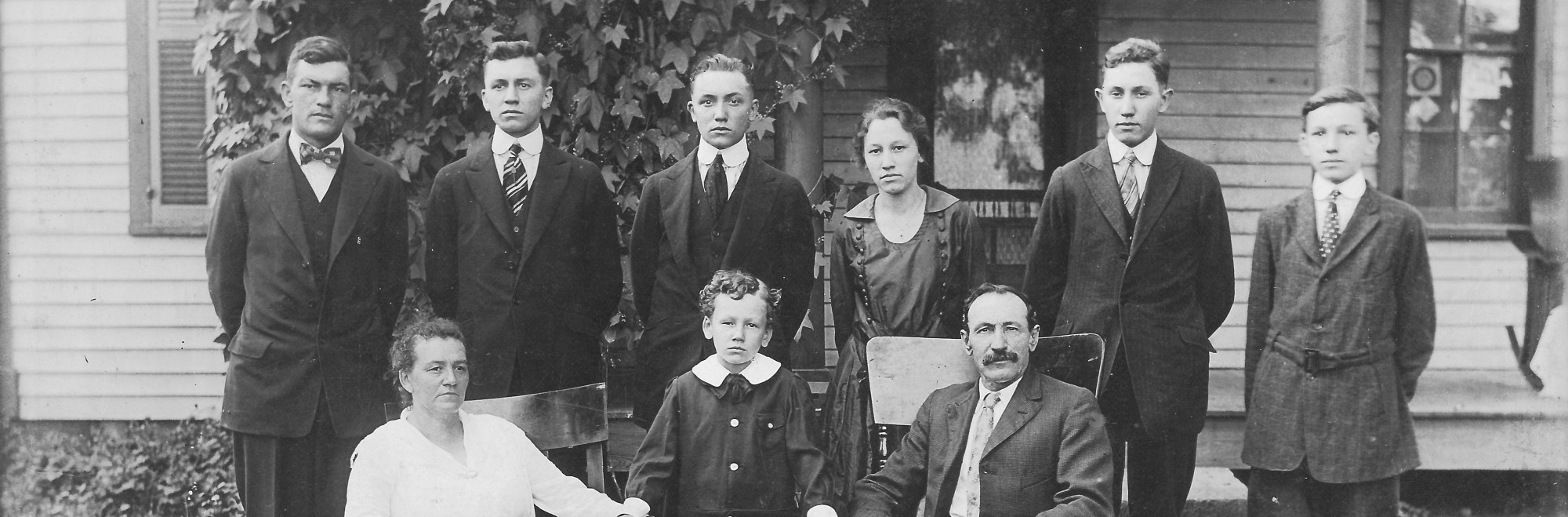
Raymond Yegerlehner with unknown girl, c1920 (Photograph courtesy of Steve Yegerlehner)

Raymond Yegerlehner with unknown girl, c1920 (Photograph courtesy of Steve Yegerlehner)

Some of my faithful readers may have noticed over the last month that there are many subtle changes happening to my blog. There are several new sub-pages that can be accessed through the tabs at the top of the page.

First, I have begun accepting genealogy clients again. I have updated my Services page and my About page. I will likely continue to do so in the coming weeks. I am located in northern California so if you need access to repositories in Sacramento, such as the California State Library, I am available. Among its holdings, the state library has a large collection of California newspapers on microfilm which are not accessible online.

Second, I have begun writing short articles for another website. This is a paid writing job for me (which is fabulous). As much as I love my blog, no one pays me for all the work I do. Ultimately, I do plan on becoming a certified genealogist, so every bit of writing I can do helps me in this greater goal. If you would like to read my first article, follow the link:

http://blog.genealogists.com/2014/11/a-new-parternship-dna-research-and.html

Third, I am now the host of a one name place study. If you missed the announcement before Thanksgiving, I am now attempting to collect and organize information about Harrison Township, Clay County and Clay City. This is the area where my grandfather Roscoe was born and raised. I am hoping to transcribe and post a couple obituaries a week of citizens of that region of Clay County. If anyone has photographs of people who lived in Clay County, I would love to add them to my photo gallery.

And fourth, I hope to have a big announcement by the end of the year, or least by the end of January! So stay tuned!

Daniel Zenor

Zenor, Daniel - Obituary, 1890-03-28


An Old Pioneer Gone

Daniel Zenor died at the residence of J. M Boothe, his son-in-law, in Bowling Green, Ind., March 29, 1890, aged 78 years, 10 months, and 22 days. He was born in Harrison county, Indiana, and moved with his parents to Clay county when he was about 8 years of age, and has resided in Bowling Green, or its immediate vicinity, nearly seventy years. He was married to Elizabeth Leonard, August 16, 1832, and they lived together as husband and wife 56 years, 9 months, and 12 days. There were born unto them 8 children. Four of them are deceased. The four living are Mrs. Brad Orman, Mrs. J. M. Boothe, John H. and Joseph M. Zenor. Daniel Zenor was an honest, upright citizen, and his funeral was largely attended.

“An Old Pioneer Gone,” Clay City Reporter (Clay City, Indiana), 28 March 1890, p. 2, col. 1.

Miss Lizzie Renalds

Reynolds, Lizzie - Obituary, Brazil Miner, 31 January 1885


Miss Lizzie Renalds, of Harrison township, passed from life to eternity Monday, January 26, at 7:30 p.m. She had the prevalent disease, lung fever. She leaves a new-born baby, Charlie, as she called him, and many friends to mourn her loss. Peace in eternity.

“Personal,” Brazil Miner (Brazil, Indiana), 31 January 1885, p. 1, col. 4.

One Place Study

This month I had to create a locality guide for my ProGen monthly assignment. I chose Clay County, Indiana, the birthplace of my grandfather Roscoe. Over the years I have collected quite a bit from this Indiana county, and I have decided to share what I have collected. There is now a Clay County button at the top of the page. The main page contains the bulk of the information I gathered for the locality guide. At this point I have added one sub-page for a photo gallery. I will eventually add another page for biographies of Clay City and Harrison township residents.

Check out the photo gallery so far, and come back often as I will be updating the galleries as time allows. https://genealogylady.net/clay-county/clay-county-photographs/

I have also registered my website as the official Clay County One Place Study.

Wordless Wednesday – Siblings

Yegerlehner - 1970 Reunion at Bells

Left to Right: Floyd, Clarence, Ruth, Roscoe, Ralph

The Yegerlehner Siblings – 1970, Family reunion at Earl Bell’s farm, Clay County, Indiana

Photograph from the personal collection of Deborah Sweeney.

©Deborah Sweeney, 2014.

Post originally found: https://genealogylady.net/2014/05/28/wordless-wednesday-siblings/

Complaint of Carrie Rapson

Schwartz, W. B. - 1894-11-29

Constable Harry Naugle to-day took into custody James Holden, on complaint of Carrie Rapson, who charges him with being the father of her child. The cause was filed in Justice James’ court by W. B. Schwartz, complainant’s attorney. The defendant has been absent since last winter and thereby evaded service up to today.

“Local News of the Week,” The Brazil Democrat (Brazil, Indiana), 29 November 1894, p. 1, col. 3-4; digital image, Newspaper Archive (http://www.newspaperarchive.com : accessed 3 March 2014).