
Lena Scofield’s teaching license, 1877
©2018 copyright owned by Deborah Sweeney
Post originally found: https://genealogylady.net/2018/01/25/throwback-thursday-a-teachers-license/
Lena Scofield’s teaching license, 1877
©2018 copyright owned by Deborah Sweeney
Post originally found: https://genealogylady.net/2018/01/25/throwback-thursday-a-teachers-license/


©2018 copyright owned by Deborah Sweeney
Post originally found: https://genealogylady.net/2018/01/24/wordless-wednesday-gladys-in-a-park-with-a-mysterious-building/
My latest DNA obsession is the online program DNAPainter. To be honest, I’ve been hearing a lot of great things about the program for awhile, but hadn’t wanted to venture into these waters. Because I just knew, once I did, I would fall deep into this rabbit hole.

The purpose of DNA Painter is to map chromosomes, using shared segment data from one’s matches. The program accepts data from several sources, including Gedmatch, 23andme, and familytreeDNA. AncestryDNA data is not usable since the company does not provide a chromosome browser. A match would have to transfer their raw data file to Gedmatch or familytreeDNA first.
As a highly visual person, I like to see how all the different segments I share with my relatives line up. This is especially useful when tracking triangulation groups. Entering data into the program can be time consuming—depending on how many matches one has. I chose to import data from only known relatives at first. I wanted to see how much data I had and if I already had some triangulation groups forming. Below is a screen shot of my chromosome 7. As you can see, I already have a lot of data for this chromosome.

Chromosome 7
The purple bars on my paternal chromosome all belong to relatives on my paternal grandfather’s side—the Yegerlehners and Schieles. Based upon the members of the purple group, I can assign this group specifically to the Schiele side. The small purple segment on the far right belongs to a distant Yegerlehner relative. The red bars are matching segments I have with my paternal grandmother’s side—the Fosters and Lawheads. The first red bar on the left can be attributed to my ancestral couple George Rea and Sarah (Jewell) Rea; and, the longer red bars to James B. Foster and his wife Lydia (Dicks) Foster.
Since I have matching segments with a variety of relatives, it is easy to see where my recombination points occur. There are three recombination points on my paternal chromosome—at about 14 cM, 103 cM, and 152 cM. Compared to the visual phasing that I did between my brother’s DNA and my own last year, the two charts align well together.

Two-sibling visually phased chromosome 7
DNA Painter has many great features, such as the ability to see all the members of a shared group, or how a specific individual matches the profile person. Matches can be assigned to either the maternal or paternal side of the family, or even to an “I don’t know” group if the relationship is unknown. Matches who share more than one set of common ancestors can have each individual segment assigned to different ancestors. Groups can be named or color-coded to the user’s preferences. For my preliminary profile, I used color-coding based on my four pairs of great grandparents. If you haven’t tried playing around with DNA Painter yet, I highly recommend it. There are many great features that I continue to discover as I work with the program, and I have barely mentioned a fraction of them in this review. Happy mapping!
©2018 copyright Deborah Sweeney
Post originally found: https://genealogylady.net/2018/01/23/down-the-dna-rabbit-hole-dna-painter/

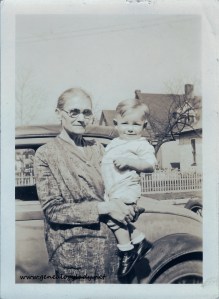
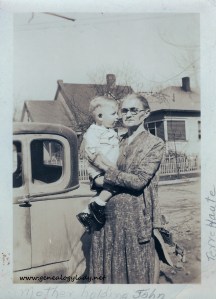
Sometimes we know when photographs are taken. In this case, my grandmother probably labeled the photographs, as the one of the far right refers to Emma as “Mother.” I do not know the occasion for the photographs, but the photographer (again most likely my grandmother) took several. We think nothing nowadays of taking picture after to picture to get the correct shot, to make sure everyone is smiling, eyes are open, etc. Not so in the previous centuries. Film cost money, and you didn’t know what you shot until the film was developed.

James L. Foster, holding his nephew, John Yegerlehner, 28 January 1932, Terre Haute, Indiana, photograph privately held by the author.
If the photographs had not been dated, the automobile provides a great clue, especially to all the old car experts out there. Emma’s dress—although we don’t see much of it since John is in the way—does give some clues as well. Gone is the dropped waist of the 1920s. Seated on the car’s sideboard, the top of Emma’s dress blouses over a waist (left). Soft pleats may also be visible at the hip line (right) as well as a longer skirt. These are clothing characteristics of the 1930s. A great place to look for everyday clothing styles of the 20th century are the Sears catalogues, found at Ancestry.

Sears catalogue, Fall 1931 (Image courtesy of Ancestry.com)
©2018 copyright owned Deborah Sweeney
Post originally found: https://genealogylady.net/2018/01/22/another-photographic-series/


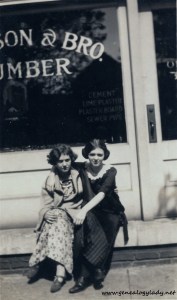
These photographs of my grandmother were taken in Terre Haute, Indiana, in the 1920s. Only these three survive in my collection, and who knows if more were taken? The clothing and hair definitely say 1920s. The length of Gladys skirt indicates the earlier part of the decade, before skirt hems rose to knee length. Born in late 1905, Gladys would certainly have been in her late teens or early twenties when the pictures were taken. The company name on the window provides a fantastic clue for when the photograph might have been taken.

Terre Haute city directory, 1924, Foster listings (image courtesy of Ancestry.com)
I already knew that my grandmother worked as a stenographer before her marriage. After high school she attended some kind of secretarial school. The whole Foster family (with the exception of the eldest daughter Lydia who had married and was deceased by 1924) can be found in the Terre Haute city directory. They lived at 2046 N. 8th Street. Gladys’ entry shows that she worked as a stenographer at Pierson & Bro. I could conclude that the photographer was taken about 1924, possibly on her lunch break with one of her co-workers.
As an added bonus, I found 2046 N. 8th Street on Google Street view. Fortunately, this house still exists (light brown in the center). (One of Gladys’ later residences was torn down and was replaced by a freeway!)
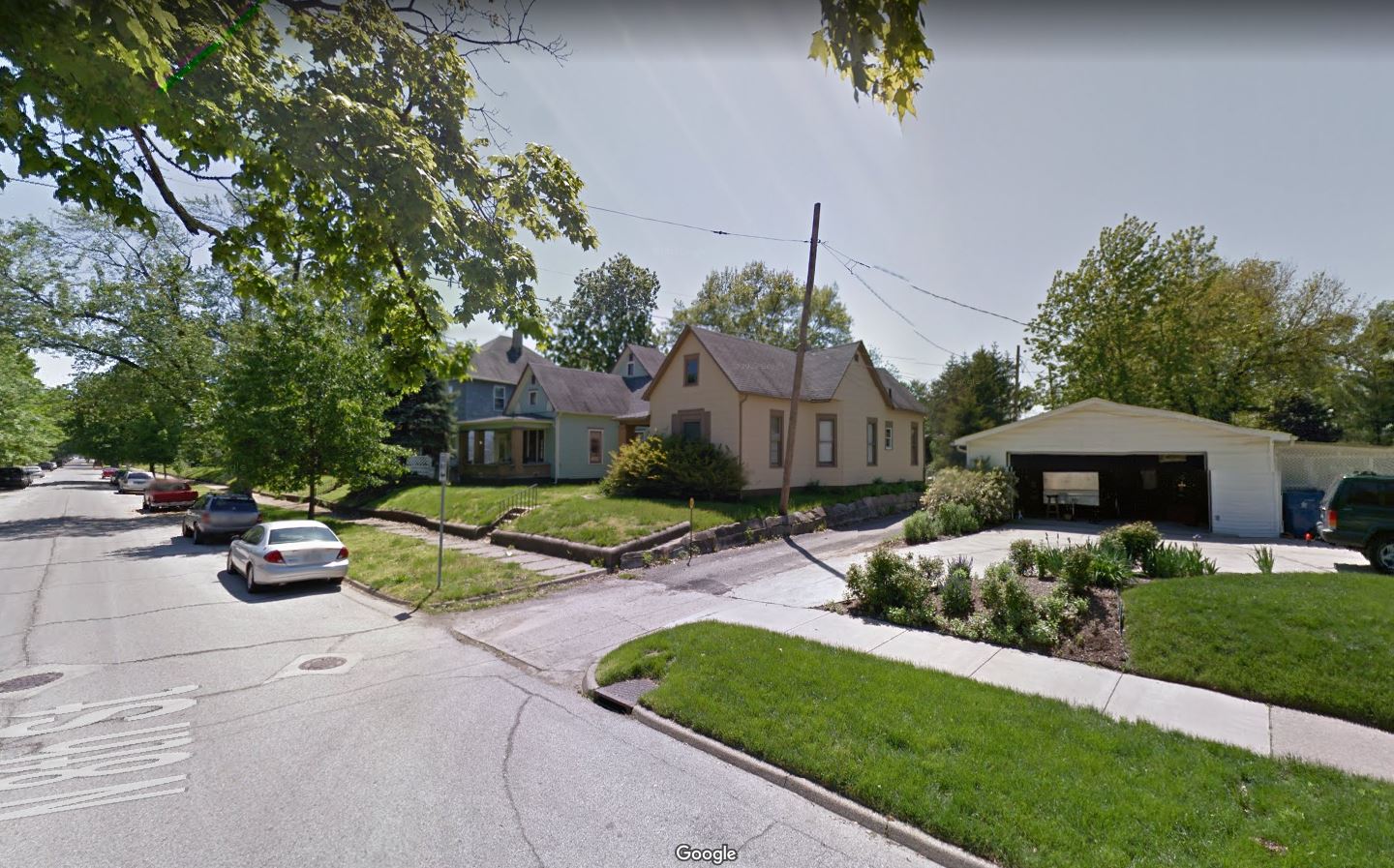
2046 N. 8th Street, Terre Haute, Indiana (Image courtesy of Google Maps)
©2018 copyright Deborah Sweeney
Post originally found: https://genealogylady.net/2018/01/21/photographic-clues/
This month our family lost one of its oldest surviving members. My father’s oldest cousin. The first grandchild of James E. Foster and Emma (Lawhead) Foster, my great grandparents.

Indiana birth certificate, 1914, “Waneta” Geneva McCammon (Image courtesy Ancestry.com)
Born in 1914, Juanita lived a long life! It was a life filled with tragedy early on. Her mother died when she was not yet five. Her only full sibling, Wesley, died in a car accident on his way to school, aged 11. Her father remarried and produced a large family with his second wife. Jesse McCammon survived until his 101st year, but his daughter surpassed him by celebrating her 103rd birthday last November.
I never met Juanita in person. I corresponded with her a few times after I discovered who she was. I even helped, in a small way, to bridge an introduction between Juanita and another first cousin whose branch of the family had disappeared for 50 years. Juanita shared some lovely stories of my grandmother and my great grandmother Emma. After Juanita’s mother died, she spent parts of her childhood living between her two sets of grandparents.
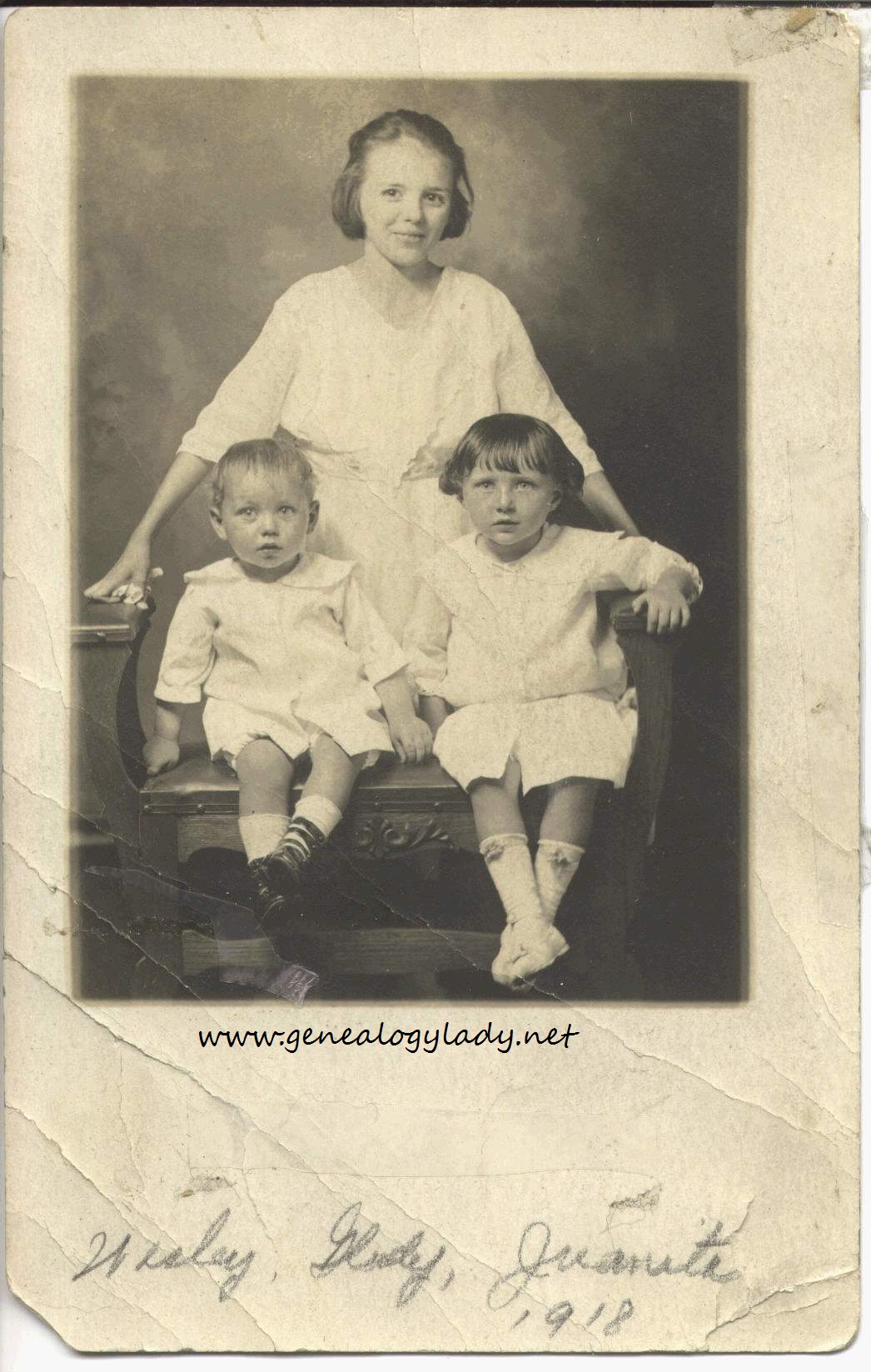
Gladys Foster with Juanita and Wesley, 1918 (Image author’s private collection)
My grandmother, Gladys, was only ten years older than her niece so they were close when they were younger. When my uncles John and Mark were young, Juanita came to stay for a while to help take care of the boys, while Gladys ran her beauty parlour and Roscoe attended medical school.
I am most grateful to Juanita because she left me a legacy, beyond her letters and stories. Her DNA. Several years ago, unbeknownst to me, her family asked her to do an autosomal DNA test. I use this data on a regular basis. Most likely, without really knowing it, Juanita has helped me to solve several family mysteries over the last few years. I will be forever grateful for Juanita’s willingness to take a DNA test. Rest in peace, dear cousin!
©2018 copyright Deborah Sweeney
Post originally found: https://genealogylady.net/2018/01/20/momento-mori/
 Letter transcription:
New Castle, Ind. March 15, 86
My Dear Sister:
You ask why I do not write, and my humble reply is I have no excuse. However, I have been from home so much, and my time has been so occupied when at home with my professional labors that I have little time or disposition to write.
Last Friday Ettie and I went to Summit where she will remain for some ten days during my absence at Cadiz for a week or so. I returned from S. next day, and spent Sunday at Millville, and have just got home. Am all alone. I go to Cadiz this 2 p.m.
We met Bro. Wiles on the train Frid— on his way to Marion. Said he had just heard from folks west. Said the church at Connersville are going to remodel their house to the turn of $3,000. He was

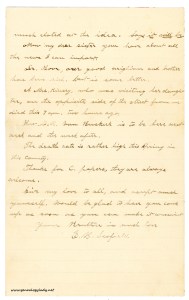
[page 2]
much elated at the idea. Says it will be.
Now my dear sister you have about all the news I can impart.
Dr. Booe, our good neighbor and brother, has been sick, but is some better.
A Mrs. Kinsey, who was visiting her daughter, on the opposite side of the street from us died this 7 a.m. two hours ago.
Bro. D. K. Van Buskirk is to be here next week and the week after.
The death rate is rather high this Spring in this county.
Thanks for C.[Connersville] papers, they are always welcome.
Give my love to all, and accept much yourself. Would be glad to have you come up as soon as you can make it convenient.
Your Brother in much love
E.B. Scofield

©2018 copyright owned and transcribed by Deborah Sweeney
Post originally found: https://genealogylady.net/2018/01/19/fayette-friday-eugene-b-scofield-15-march-1886/

David’s baptism certificate, April 1944
Digging through the family archives, here are a couple documents from the World War II era which I did not scan during the time I was transcribing the WWII letters. Some of my archive is a little more organized since then! Roscoe and Gladys waited until Roscoe returned from the Pacific to celebrate David’s baptism. David was between 18-19 months old when he was baptized!
©2018 copyright owned by Deborah Sweeney
Post originally found: https://genealogylady.net/2018/01/18/throwback-thursday/


©2018 copyright owned by Deborah Sweeney
Post originally found: https://genealogylady.net/2018/01/17/wordless-wednesday/
 Happy New Year! I have decided to skip the year in review/new goals post this year. My priority this year is to work on my BCG portfolio. Finding the time to work on the portfolio with an increasingly packed work schedule is going to be difficult this spring. But the bills come first!
I spent a good portion of my winter vacation working on my Case Study (BCG #6). This last week I discovered a new piece of evidence. I was pursuing the GPS (Genealogical Proof Standard)—conducting reasonably exhaustive research—when I discovered the document. I have always been a big fan of collateral research, even as a young genealogist. I discovered early on that if you cannot find the information you desire from the records left by a direct ancestor, try the siblings. I was tracking down a potential sibling when I hit pay-dirt.
Of course, discovering the document boosted my confidence because I did find it, BUT I started questioning what type of evidence it was. You see, in the Case Study, there are rules. The presentation must use one of three techniques:
(a) assembling indirect or negative evidence, or a combination of the two
(b) resolving a conflict between two or more items of direct evidence
(c) resolving conflict between direct evidence and indirect or negative evidence
I am using the first method, using indirect or negative evidence to prove a relationship. Needless to say, I panicked. Did I just find direct evidence that answered my research question? If so, I have just spent months and hours of research on a project that would have to be scrapped?!? Plus, I would have to find a new problem in my research that would fit the criteria of the project.
As part of the BCG process, applicants are invited to join a list serve. It’s a place where questions can be asked, and certified genealogists will attempt to answer the questions. However, the CGs are not allowed to teach to the test. Often their answers are vague, or they will direct the questioner to re-read the Genealogy Standards, rubrics, or other documents which should enlighten nervous applicants. In my case, I was instructed to review the definitions of indirect and direct evidence.
Indirect evidence, as defined in the Genealogy Standards, is “information items that seem to address and answer a research question only when combined.” In contrast, direct evidence is “information that seems to address a research questions and answer it by itself.”
Dr. Thomas W. Jones in his book Mastering Genealogical Proof defines the two types of evidence:
“Direct evidence is an information item that answers a research question by itself.”
“Indirect evidence is a set of two or more information items that suggest an answer to a research questions only when they are combined.”
There is also a great QuickLesson on the EE (Evidence Explained) website explaining and demonstrating the differences between the three types of evidence.
QuickLesson 13: Classes of Evidence—Direct, Indirect & Negative
The good news is that I am still working on my original Case Study. The better news is that I now know where and when one of my direct ancestors died. I even found his grave-site on FindAGrave. If I hadn’t doggedly pursued the GPS, I would never have located this ancestor. He wasn’t where anyone thought he was when he died.
Since my last post, I have started Jill Morelli, CG®’s Certification Discussion Group. The group meets for seven weeks and discusses each requirement of the portfolio in depth. Having a certified genealogist running the discussion is great! Participants gain access to Jill’s insights into the process as well as to samples from actual passing portfolios. If you are interested, there is a waiting list so contact Jill.
Good luck and happy hunting!
©2018 copyright owned and written by Deborah Sweeney
Post originally found: https://genealogylady.net/2018/01/16/my-path-to-certification-issue-no-8/
 Genealogy Lady