Category Archives: Newspaper Clippings

Smallpox Epidemic, Part III

Indianapolis Journal - 1900-01-18 (Smallpox epidemic)WILL DISINFECT MAILS

Dr. Hurty Receives Word From
Government Official

The Postmaster at Lesterville Has
Smallpox and Is Still at Work –
the Developments

The smallpox situation in Clay county has excited the attention of the government authorities at Washington. Late yesterday afternoon Dr. Hurty, secrety of the State Board of Health, received a telegram from Gen. Walter Wyman, chief of the marine service at Washigton [sic], stating that the government would disinfect the mails at all points designated by the Indiana Board of Health. The telegram received was in reply to a message sent by Dr. Hurty to the authorities at Washington, informing them that the postmaster at Lesterville had smallpox and was continuing in the performance of his duties, with an utter disregard of the fact that he might be spreading the contagion all over the United States.

Yesterday reports were brought in from Washington county by Dr. Ferguson, who was sent to investigate rumors of smallpox. He says that the disease is prevailing to an alarming extent and he earnestly advised Dr. Hurty to establish a rigid quarantine. The authorizes at Clay City advised the State Board of Health yesterday morning that many of the citizens of the town were escaping to other towns despite the strict measures of quarantine in force. Dr. Hurty immediately telephoned Dr. Davis, the president of the board at Richmond, advising him of the situation and asking that a meeting of the board be called.

In speaking of a communication in one of the afternoon papers from the citizens of Clay City in which they express themselves as being highly indignant of Dr. Hurty for causing such excitement throught the State over the smallpox situation, when in reality the disease is very mild, resulting in no fatalies, Dr. Hurty said that is was not the policy of the State Board of Health to wait for fatalities before taking action, and the citizens of Clay City would have to abide by the action of the board.

Cases of Smallpox Reported.
Special to the Indianapolis Journal.

TERRE HAUTE, Ind., Jan. 17. – Several cases of what is believed to be the same disease, thought to have been chicken-pox at Clay City, but declared by Dr. Hurty to be smallpox, have been reported north of town. The persons afflicted came from Clay City, and the symptoms of their disease are the same as in the hundred or more cases reported at Clay City.

Clay City Is Not Excited.
To the Editor of the Indianapolis Journal

An undue amount of excitement has been caused by the published reports concerning the prevalence of smallpox at this place. The News of yesterday says: “Residents of the town are almost panic-stricken, but the quarantine prevents them from escaping.” It also states that the population of the town in 700, and that the disease had attacked nearly a third of the population. There has been no excitement here. There has been no quarantine, and people have not tried to escape. There have been between 200 and 300 cases, beginning with the early part of the fall. The physicians have treated for chickenpox and cured every case. We have a population of about 2,500, instead of 700. Many of the patients never went to bed or even quit work.

The Journal’s informant was in error when he stated that “when the citizens of the town became aware that the disease had been diagnosed as smallpox, they became frantic with fear and excitement, and many rushed home and began packing their effects, with the intention of escaping from the town but they were too late. Acting under the instructions of Dr. Hurty the officials immediately began the enforcement of the quarantine laws and no citizen who had come in contact with the disease was permitted to leave.” The utmost freedom prevails as to the coming and going of our citizens – no person being denied the privilege of going where he pleases. No one has heard of any person attempting to get away on account of Dr. Hurty’s announcement. The disease, whatever it is, is not half so severe as many cases of vaccination. There have been no fatalities from the disease.

A great injustice has been done our town by these exaggerated statements, and in order that the public may know the true condition of affairs your informant offers the above correction, without denying any official statement by Dr. Hurty. Our physicians report no cases of the confluent form.
M. MARKLE
Clay City, Ind., Jan. 15

“Will Disinfect Mails,” The Indianapolis Journal (Indianapolis, Indiana), 18 January 1900, p. 4, col. 7; digital image, Chronicling America (http://chroniclingamerica.loc.gov/ : accessed 6 December 2014).


Smallpox Epidemic, Part II

Indianapolis Journal - 1900-01-17 (Smallpox epidemic)ARE HUNDREDS OF CASES

Dr. Hurty, State Health Offi-
cer, Returns From Clay City

Nine Children in One Family with
Smallpox-The Disease Has Spread
to Several Counties.

Dr. Hurty, of the State Board of Health, returned from Clay City, the hotbed of the smallpox epidemic, yesterday, and reports a most alarming state of affairs. He said that there were hundreds of cases, and many of them were of the confluent form, which is exceedingly dangerous. Said he: “It is a common sight to see little children walking along the streets of Clay City with their faces broken out with the eruptive sores of smallpox.”

Smallpox is everywhere in Clay City. It one turns to the right he is confronted with a whole row of houses in every one of which there are to be found one or more cases of fully developed smallpox. The same conditions prevail on every side and Dr. Hurty said that in one instance he found nine children in one family who were smitten with the disease at the same time.

The family referred to is that of George Burkhart, a veteran of the civil war. In speaking of these cases Dr. Hurty said that the fact that  Burkhart, who was vaccinated during the war, did not have the disease was very good evidence that the epidemic was really smallpox. Two of the Burkhart children, Blanche and Mona, have the confluent form of smallpox and it is a very grave question as to their recovery.

Under a misapprehension of the nature of the disease the public schools were continued until nearly two-thirds of the children were inoculated, and it was a common sight to see the little ones going daily to their lessons with their faces broken out with smallpox in the pustular stage. The young, however, are not the only ones who are attacked with the dreadful scourge, for even in the churches there were seen scores of adults whose faces were solid masses of oozing poison. The only excuse to be offered for this apparent criminal neglect on the part of the local board of health is the fact that it was advised by physicians diagnosing the disease that it was nothing more than chickenpox and as a consequence its apprehensions were not aroused until informed by Dr. Hurty of the real nature of the disease. When the Town Council awoke to the fact that the epidemic was really smallpox, the members immediately arranged for a called meeting at which they passed resolutions instructing the health officer to do all he could to prevent the further spread of the disease, and authorizing him to appoint as many deputies as he saw fit, necessary to the preservation of the strictest quarantine. Many new cases of the disease are reported from the district schools in the neighborhood of Clay City and the disease is rapidly spreading throughout the county.

Just prior to Dr. Hurty’s return he was summoned to a meeting of the County Council and he urged upon the members the necessity of doing all they could to stamp out the disease, advising them to instruct the county health officer, by deputies, to inspect all the schools, give free vaccination and quarantine every person who had come in contact with the disease. One of the peculiarities of the disease is its rapid spread, and there is some fear that is may become epidemic throughout the State. Smallpox is reported in Clay, Noble, Jackson, Owen, Green and Scott counties, and unless rigid enforcement of the quarantine law is observed the disease is likely to get beyond control. While Dr. Hurty was in Clay City, Dr. C. E. Ferguson, the diagnostician of the city of Indianapolis, was summoned to Brownstown, Jackson county, where he found a well-developed case of smallpox in the eruptive state. When Dr. Ferguson returned from Brownstown he found a telegram awaiting him from Dr. Hurty bidding him hasten to Scottsburg. The local board of health of that place wired the State Board of Health that it was in urgent need of aid. Dr. Hurty said on his arrival yesterday that he was somewhat at a loss to understand the urgency of the request from Scottsburg, but supposed the disease must be raging in that neighborhood.

The first person known to have the disease in Clay City was Herbert Wiltse, who two weeks after returning home from a street fair in Washington, Daviess county, was taken very sick and afterward went through all the stages of smallpox. His neighbors, believing that he had chickenpox, did not hesitate to visit him and in their manner the disease has been spread all over the country.

“Are Hundreds of Cases,” The Indianapolis Journal (Indianapolis, Indiana), 17 January 1900, p. 8, col. 6; digitial image, Chronicling America (http://chroniclingamerica.loc.gov/ : accessed 6 December 2014).

Smallpox Epidemic, Part I

Indianapolis Journal - 1900-01-16 (Smallpox epidemic)IN AN EPIDEMIC FORM

Smallpox Has Broken Out At And
Near Clay City, Ind.

Secretary Hurty Telegraphs Governor
Mount of the Conditions – Con-
fluent Smallpox

Smallpox is raging in epidemic form in Clay City, a small mining town in Clay county. The town has a population of six or seven hundred and it is estimated that over one-third of it is stricken with the disease. Many of the cases have assumed the confluent form. Dr. J. N. Hurty, the secretary of the State Board of Health, at present in Clay City, has telegraphed the boards of health of the adjoining counties warning them of the prevalence of the disease, and everything possible is being done to prevent its spread.

A few days ago an epidemic resembling smallpox appeared in Clay City, but as the disease was very mild the local physicians believed it to be a malignant form of chicken-pox and the patients were treated accordingly. The disease, however, began to spread very rapidly and it was not long until it was estimated that there were in the neighborhood of three hundred cases. The local board of health in Clay City became alarmed and telegraphed for Dr. Hurty, who is an expert in diagnosing the disease. After an examination of the first patient with whom he came in contact, Dr. Hurty at once pronounced the disease to be smallpox. When the citizens of the town became aware that the disease had been diagnosed as smallpox, they became frantic with fear and excitement, and many rushed home and began packing their effects with the intention of escaping from the town, but they were too late. Acting under the instructions of Dr. Hurty the officials immediately began the enforcement of the quarantine laws and no citizen who had come in contact with the disease was permitted to leave. All incoming and outgoing mails are being disinfected and nothing that would be likely to transmit the disease is allowed to be shipped away from the town. It is said that there are many cases in Owen county just over the line from Clay county, which have probably been contracted by exposure to the disease in Clay City. Greene county also reports a great many cases of so-called chicken-pox, but the cases have exactly the same symptoms as those in Clay county.

The boards of health of the various adjoining counties will hold meeting to-day and take some definite action to prevent the disease from spreading.

At various time chicken-pox has been reported to the State Board of Health, but each time there has always been a diversity of opinion among the physicians as to the diagnosis of the disease, some insisting that it was a mild form of smallpox and others maintaining that it was nothing but chicken-pox. Previous to the present epidemic in Clay City there had been no fatalities in any cases reported and very few of them had even been serious, so that a reasonable doubt might have arisen as to the correct diagnosis of the case. The confluent form of the disease in the epidemic at Clay City which often results fatally, removes the least shadow of a doubt that might exist that the disease is smallpox.

Last night Dr. Hurty telegraphed Governor Mount, notifying him of the conditions at Clay City.

City Board Will Act.

Dr. Clark, of the City Board of Health, was asked last night what precautions the Indianapolis Board of Health will take to prevent any possibility of the disease becoming prevalent in this city. He answered that if the epidemic in Clay county was as serious as Dr. Hurty reported the board will hold a meeting to-day to devise plans to prevent anyone entering the city who might have come in contact with the disease there, and also to take up the question of what would be done with the patients providing smallpox should break out in the city. He added, however, that Dr. Hurty no doubt will take all necessary precautions to prevent the disease from spreading further than the locality to which it is now confined.

“In An Epidemic Form,” The Indianapolis Journal (Indianapolis, Indiana), 16 January 1900, p. 8, col. 4; digitial image, Chronicling America (http://chroniclingamerica.loc.gov/ : accessed 6 December 2014).

Dynamite Explosion

Heller, David & Fred Miller - Clay City Reporter, 1890-06-27, p. 2David Heller and Fred Miller, of Brazil, were killed by an explosion of dynamite, last Friday. The two men were torn to pieces in a horrible manner, and the Times states that “the only way the two dead men could be told apart was by their clothes and difference in their size. Both are married men and leave families.”

Clay City Reporter (Clay City, Indiana), p. 2, col. 1

Miller, Viola - Clay City Reporter, 1890-06-27, p. 2


Frederick Miller, one of the men killed by an explosion of dynamite, at Brazil, last Friday, was the father of Miss Viola Miller, who was killed last summer by a piece of terra cotta cornice falling upon her.

Clay City Reporter (Clay City, Indiana), p. 2, col. 1


Frederick Miller was buried at Cottage Hill Cemetery, Brazil, Indiana. His tombstone is quite spectacular and non-traditional. His daughter Viola was also memorialized on the same stone. Find A Grave


Fred A. Carpenter

Carpenter, Fred - 1890-07-11, notice

It is said that Fred Carpenter was conscious until the last moment, and gave directions concerning all matters pertaining to his business, funeral, etc.

“Town and Neighborhood,” Clay Clay Reporter (Clay City, Indiana), p. 3, col. 3

Carpenter, Fred - 1890-07-11, funeral notice

The funeral service of  Fred A. Carpenter, the young Normal student who was taken sick while attending school in this place, occurred at Cloverland, last Saturday. The exercises were conducted, by Elder J. W. Nye, and the attendance is said to have been the largest ever witnessed upon any similar occasion in that place. W. H. Chillson, J. S. Goshorn, M. Markle, J. E. Travis, P. E. church, and Mr. and Mrs. Frank Funkhouser, of Clay City, were present to witness the last sad rites of the popular young man.

“Town and Neighborhood,” Clay Clay Reporter (Clay City, Indiana), p. 3, col. 3

Daniel Zenor

Zenor, Daniel - Obituary, 1890-03-28


An Old Pioneer Gone

Daniel Zenor died at the residence of J. M Boothe, his son-in-law, in Bowling Green, Ind., March 29, 1890, aged 78 years, 10 months, and 22 days. He was born in Harrison county, Indiana, and moved with his parents to Clay county when he was about 8 years of age, and has resided in Bowling Green, or its immediate vicinity, nearly seventy years. He was married to Elizabeth Leonard, August 16, 1832, and they lived together as husband and wife 56 years, 9 months, and 12 days. There were born unto them 8 children. Four of them are deceased. The four living are Mrs. Brad Orman, Mrs. J. M. Boothe, John H. and Joseph M. Zenor. Daniel Zenor was an honest, upright citizen, and his funeral was largely attended.

“An Old Pioneer Gone,” Clay City Reporter (Clay City, Indiana), 28 March 1890, p. 2, col. 1.

Miss Lizzie Renalds

Reynolds, Lizzie - Obituary, Brazil Miner, 31 January 1885


Miss Lizzie Renalds, of Harrison township, passed from life to eternity Monday, January 26, at 7:30 p.m. She had the prevalent disease, lung fever. She leaves a new-born baby, Charlie, as she called him, and many friends to mourn her loss. Peace in eternity.

“Personal,” Brazil Miner (Brazil, Indiana), 31 January 1885, p. 1, col. 4.

Progress – September 27th

Well, this update is not about the book because I am on book hiatus until the end of October. [Insert crying face emoticon here] I have too many other projects on the stove cooking at the moment to devote time to the book. I am frustrated by this lack of time. I want to be able to focus on the book completely instead of stealing a moment here or there. But the time just is not there at the moment, and I have to be realistic.

My main focus is writing my proof argument for my ProGen Study Group. The first draft was due September 25th which I turned in a few days early. After I wrote mine, I had to review the four papers of my group mates. We have such different writing styles and research problems. It is great to see what we are all working on. This next month we have to take the comments and suggestions of our group mates and polish up our first drafts into the final arguments.

I chose a research problem which I have been working on for 20 years, since I first starting working on Gladys’ family. One branch of her family has Quaker ancestry which stretches back to the early days of Pennsylvania and William Penn. Due to all the various migrations across the eastern part of the United States in the early years of the nineteenth century, some records are non-existent. The purpose of a proof argument is to gather indirect and direct evidence together in one place, and to write an argument “proving” whether or not events occurred. In my case, I have been searching for the parents of Alfred M. Dicks, Gladys’ great grandfather.

I believe I have a very solid argument. My first draft was 18 pages long, and over 6,000 words. I received some good feedback from some of my study group mates, and now I am beginning to make some corrections and additions. It is also my plan to publish the argument as an eBook when I am done in October.

In my genetic genealogy work, my father’s mtDNA results came in last week. I have two exact matches, but I think they are several generations too far away to help me at present. Mitochondrial DNA is the type of DNA which was used to prove that the bones buried under a parking lot in England belonged to Richard III. My goals are a little less lofty, but no less important to me. I am hoping to prove the connection between Sarah Ann (Jewell) Rea and her parents with mitochondrial DNA. The most plausible candidates are John P. Jewell and his wife Mary (Hoagland) Jewell. My father’s haplogroup is H1g1. This haplogroup appears to be more common in Germany and the Northern European countries. If Sarah’s mother was Mary Hoagland (who was of German ancestry), and I can find another of Mary’s descendants who matches, then I may have solved this mystery.

Last night, as I was searching for more information about Crawford and Clark counties (in Illinois) where Gladys’ family lived, I discovered that the Marshall Public library has begun digitizing the local county newspapers, back to the 1850s. This is AMAZING news! I have been stymied by the lack of records access in these two counties for the last two decades. I finally had to step away from the computer at midnight, but I could have gone on for hours more. The website says that they are still scanning and adding more newspapers, so patrons should check back often! [Can you see me doing Snoopy’s happy dance?] I was able to find the obituary of Gladys’ great grandmother, Belinda C. Foster, which previously I had only been able to find in a transcription, and many other little tidbits of gossip about my ancestors.

I will leave you with a small sample from the weekly news gossip column of West York, Illinois, from March 1896, announcing the marriage of Gladys’ parents.

Foster-Lawhead Marriage Announcement, 1896

Clark County Herald (Marshall, Illinois), 11 March 1896, p. 5, col. 2.

©2014 Deborah Sweeney.

Post originally found: https://genealogylady.net/2014/09/27/progess-september-27/

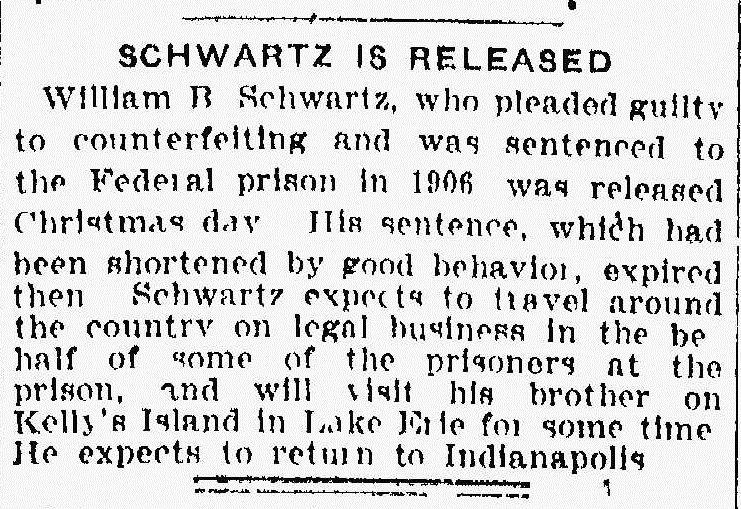
Schwartz is Released

Schwartz, W. B. - 1909-12-28 (cropped)

SCHWARTZ IS RELEASED

William B. Schwartz, who pleaded guilty to counterfeiting and was sentenced to the Federal prison in 1906 was released Christmas day. His sentence, which had been shortened by good behavior, expired then. Schwartz expects to travel around the country on legal business in the behalf of some of the prisoners at the prison, and will visit his brother on Kelly’s Island in Lake Erie for some time. He expects to return to Indianapolis.

Source:

“Schwartz is Released,” Indianapolis Star (Indianapolis, Indiana), 28 December 1909, p. 14, col. 4; “Historical Newspaper Collection,” digital image, Ancestry.com (http://www.ancestry.com : accessed 25 April 2014).

On Way To Prison

Schwartz, W. B. - 1906-12-13
ON WAY TO PRISON

GROUP OF CONVICTED MEN STARTED WESTWARD IN MARSHAL’S CHARGE

Eight men sentenced to terms in the United States prison at the last term of the federal court started for that institution at Fort Leavenworth, Kas., Thursday, in charge of United States Marshal H. C. Pettit and Duputies Dave Rankin and Tom Martin, leaving the city at 11:45. The prisoners are William Schwartz, the Indianapolis attorney, sentenced for four years for counterfeiting; John row, one year for making false affidavit as to pension papers; Theodore Linninger, three years, for passing counterfeit coins; Theodore Englebert, of Richmond, one year for taking money from a letter, as an employee of the postoffice; Judson Sturtevant, three years for robbing a postoffice; Alexander Rusilla, one year for counterfeiting; Napoleon B. Livingston, one year for impersonating a government pension officer; Clarence Robertson, one year for forging a money order.

Mrs. Gustave A. Consman, of Terre Haute, true to her husband, who is serving a term in prison for embezzlement, called at the marshal’s office before the officers departed with the prisoners, and entrusted to them a package intended to make her husband’s Christmas brighter.

“On Way to Prison,” Indianapolis Sun (Indianapolis, Indiana), p. 2, col. 6; digital image, Newspaper Archive (http://www.newspaperarchive.com : accessed 16 April 2014).