Category Archives: World War II

It takes a village

One of the things that I find _____ (insert word: cool, fascinating, thrilling, etc.) about this project is seeing all the people that my grandparents interacted with in their daily lives. We spend so much time in genealogy research tracking down all the branches in the family tree.  I think sometimes we forget that our ancestors also interacted with their neighbors intimately as well.  The neighbors might not have been blood relations but they were best friends, mortal enemies, business partners, customers, patients, teachers, or students. As I come across names in the letters, I find myself wanting to know who these other people are. I also think (as a historian/genealogist) that maybe some of these people’s descendants might also be interested in hearing about their relations, even briefly. How often have we wondered at a witness’s signature on a will? Or thought about the other person in a land dispute? Who are these people that our ancestors knew?

Today’s letter mentions several people: Mrs. Nosker, Dr. Lentz, D. Ream, Mrs. Worrell, Larry Ried, Jim [Foster], Raymond Bower. Since Dr. Lentz is someone who served with my grandfather, he was one of the first people that I tried searching for.  I didn’t know Dr. Lentz’s given name until I found a letter from Dr. Lentz to my grandfather.  It was written in 1944 right after my grandfather had returned to the states. The return address was labeled E. T. Lentz, Comdr. (mc) NSNR.  The letter was also signed Ed. Now, I had something to go on.  Ed is short for several names: Edward, Edmund, Edwin. I did some searching through the Veterans databases on Ancestry and came up with Edmund T. Lentz. Then I searched the 1940 census and found Dr. Lentz living in Pennsylvania.  The first letter in which my grandfather mentions Dr. Lentz, he says “I met a doctor from Pennsylvania”. They must have got on fairly well because they quickly became roommates.

Dr. Lentz was about 5 years older than my grandfather.  Just older enough that he served briefly in World War I as a young man before he became a doctor. Dr. Lentz affectionately referred to my grandfather as “Junior”, either because of their age difference or perhaps due to a difference in rank. I was able to track down Dr. Lentz’s social security record and his marriage record. He married Margaret Broomhall in 1926 in Philadelphia. Finally, I found the Find A Grave memorials for Dr. Lentz & his wife. Sadly, I was able to determine that Dr. Lentz had not had children, so there are no descendants to share my grandfather’s letters with.

I’ve already started looking for Mrs. Nosker . . .


Letter transcription:

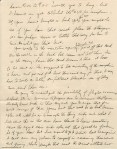
May 28 1530

Dear Mother,

I have the P.M. off since I was on duty all night and just got home. Bought two more shirts. I’ve worn this one since Sun. and I can hardly stay in the same room with it. I got two more today so I can clean up tomorrow. These shirts that I have are 31 sleeves but this is too short, but the ones I got this P.M. are 33 + 35, it’s the best I could do so I’ll have to sew a ruffle in them.

I didn’t ordered a prescription(?) for Mrs.  Nosker but they didn’t have that type so I didn’t reorder. We owe the Blue line bill so write them a check. We also owe Schnible in Laf. [Lafayette] so pay that one when they send the bill. That bill to physicians supply just sent 5 on it now and then and don’t forget to send D. Ream his interest check. We get our first pay either Sat. or Mon. I still have with my travel money and the traveler checks about $92.00 but I don’t have a blue uniform, nor any white suits. The whites seem to be hard to get. I bought regulation white shoes + black ones both for 10.50. All total I think I still

(page 2) have $100 to $125 worth yet to buy – but I haven’t as yet collected the $250 for uniform. If you haven’t bought a bond yet this mo[nth] you might do so if you have that much plus the stamps. We can perhaps save a little that was from time to time. Do what you think best.

You write to the narcotic agency Indianapolis Ind. Get it off that card on the wall in the back Lab. Room and tell them I’m in the navy. Save that card because I think it has to be sent in. I’m supposed to take inventory of the morphine I have and get rid of it, but there isn’t any for that. I may have to write a letter or fill out blanks so if they come send them on.

I’m going to investigate the possibility of flight examiner’s school. It’s a course to prepare one to examine the flyers. The only drawback is that they ask you to sign that you won’t resign for three years but that won’t be so bad because after all we’ll be in 6 mo. after the thing ends and what I like about this is that one has a chance to learn something about the eyes + ears and after all that would be of value so if you hear that I’ve signed to go to school don’t be surprised. I can’t see any value to myself in examining these recruits and giving shots. Maybe that isn’t the correct attitude but

(page 3)They say the navy trains you for some job so why not. Two or three of the boys from here are being transferred to Fla. for that training.

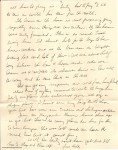
We have a very nice room and our landlady is something like Mrs. Worell used to be – if you get what I mean.

I still would like for you to come down but give me time to get a place for you to stay. Without a car here it’s tough to get any place. There is a hotel ($2.50 per day) across the Bay for officers + wives. Used to be a summer resort but the navy took it over and that is generally a good place but at times it is filled. In order to get to town from there one must take a boat and then ride about 15 miles on street car. When one of the boys came to the base he got off the Boat down town and got a taxi to the base and it cost $5.00 so a round trip would be $10.00 plus bot boat fare.

This town is long and narrow – lies in a sort of horseshoe and there is no way only from the extreme south to get here but by water. Train cars buses etc.

(page 4) all have to ferry in. Lentz had to pay $3.50 to come in with his car from the north.

The lease on the house is not progressing very rapidly – since things are uncertain. If the houses were only furnished. There is so much trash living here I’d almost hate for the boys to be here. Workers out at the base are a tough looking lot and lots of them. We are about half way between the base + home and when we leave at 4:30 (1630) it’s almost drive in low all the way and the same think in the A.M.

Did you get any response or word from Larry Ried. I don’t know of anything unusual to write the boys. Seen lots of airplanes and anti air craft guns. All size + shape planes. I haven’t seen any large battle ships yet but have seen some cruisers and destroyers at a distance.

Jim or Raymond Bower haven’t shown up as yet, but there are so many places down here for them to be. Everyone that was tall made me look the second time but it wasn’t Jim.

Well, Dr. Lentz isn’t home yet but I’ll have to stop and clean up –

Love Daddy

©2012, copyrighted & written by Deborah Sweeney

Amanuensis Monday – May 28, 1942

An Amanuensis is a person employed to write what another dictates or to copy what has been written by another.  My whole blog is dedicated to the transcription of my grandparents’ letters, so I may rightfully call myself an amanuensis. I did some sorting of the letters last Friday. I organized my grandmother’s letters from 1942. I don’t have a definite count as yet as to how many letters there are in total.  On Friday, I opened 107 letters by my grandmother which were written between August and December 1942. I know there are also over 100 V-mail letters written by my grandmother between the years 1942 and 1944. I would estimate that there are at least 500 letters total at this point. Over the next few weeks as I pull out each letter and organize it, I will have a firmer count. I consider myself fortunate that my grandparents had fairly legible penmanship. It makes the task of transcribing their letters even more enjoyable.

Today’s letter was a short one, but it had a lot of genealogical information. Roscoe mentions Jim and Raymond. Jim was Jim Foster, my grandmother Gladys’s brother. As for Raymond, I’m not sure about him yet. Roscoe had a brother Raymond, but he died in 1922. I might just have to wait and see if another letter gives me more clues.  I’m not sure if Raymond is an extended family member or a neighbor from Kentland.

Another genealogical event mentioned in the letter was the anniversary. My grandparents were married on May 25, 1929. The year 1942 was their 13th anniversary. There was no mention of the anniversary in the letter dated on that day.  Roscoe really did forget.  Hopefully, Gladys was very forgiving for this lapse of memory. I think they had more important things to worry about in 1942.


Letter translation:

Thurs.

Dear Mother-

Just been on duty all night and you possibly will not get a letter as usual. I’m writing this while still on duty.

As yet I haven’t seen any of the boys that are supposed to come from up there – I mean Jim & Raymond. I’m going to write more later on today and get you the low down on things. Just this is 7:00 AM and I can’t think much.

I Really forgot the anniversary but the days are just days no Mon, Tue, etc – And I’ve

(page 2) heard one raid since and that wasn’t news. I’m off at noon today so want to get some more sock & shirts.

For until later,

Daddy

© 2012, copyrighted & written by Deborah Sweeney

Sunday’s Obituary – Floyd V. Yegerlehner

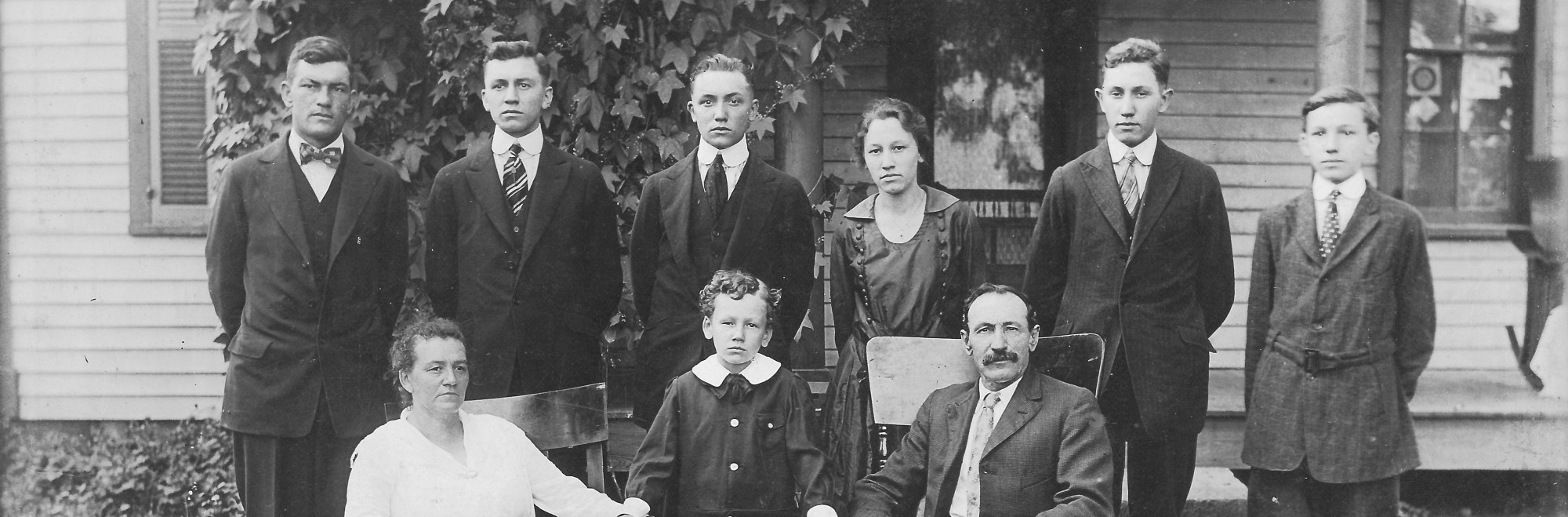
One of the people mentioned frequently in my grandparents’ letters is Floyd. Floyd was my grandfather’s youngest brother. Floyd was the outlier in the family.  All of his siblings were born relatively close together between the years 1897-1904. Floyd’s older siblings were born fairly regularly, 2-3 years apart.  My grandfather was born in 1904, and then, Floyd wasn’t born until 1911, almost 7 years later. My great grandmother Lovina was 35 when Floyd was born.  By modern measure, 35 isn’t that old. I had my youngest child when I was 38. I don’t know if there were any other pregnancies or miscarriages between the birth of my grandfather and my great uncle.  There is no left who remembers as their generation is gone.

I’m sure at some point I met my Great Uncle Floyd when I was little but I don’t remember.  When I first started with my genealogy obsession, I contacted Floyd.  He was the one who was actively searching the family’s genealogy.  We exchanged several letters in the mid to late 1990s. He passed on some great information he had gathered on some of the other branches of the family.  He gave me information on the Schwartz side of the family. My great, great grandfather Christian Yegerlehner married another Swiss ex-patriot named Elizabeth Schwartz. Floyd also passed on information on the descendants of John Yegerlehner and Rosina (Yegerlehner) McCormick, siblings of Christian. He also helped me to identify people in several photographs.

One thing that Floyd had searched for years to locate was the ship manifest.  We knew that the Yegerlehners had arrived in America around 1851. But Floyd was limited in his access to records.  He had to search the old fashioned way.  He had to travel to libraries and archives, hoping to find the right depository.  It wasn’t until after he died that Ancestry added digital images from ship’s manifests.  I did finally locate the manifest which had eluded Floyd for so long.  I wish he had been around for that discovery.


Letter transcription:

Tue 1715

Dear Mother-

I missed a letter today but I think it’s due to the change in address, etc. I got your letter with the letter about Carl Koon in it last night after I had written you. I’ll send it back and you can call him and have him take it to whomever he wants.

Since we are located where we are it isn’t so necessary that one has a car – it is only 2 blocks to the car line. I’m

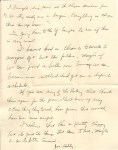
I’m wondering if you might plan on coming down in a week or ten days. Maybe Ruth & Floyd would come over and get the kids or you & Dorothy or Lucille might take them over. We are pretty uncertain as to how long we might be here. Some have been here 10-12 weeks and some only 2-3. We could talk over the living down

(page 2) here business much better if you were here. You should plan on staying about one week at least so that almost let makes it out of the question for anyone to drive you down. They probably wouldn’t want to stay that long. Week-end is the best time since I have Sun. off. Only ever so often we have to be on duty Sun. I’ll find out. I know next Sun. is free but I don’t know about one week from Sun. yet.

You be thinking this thing over and let me know what you decide. I think the train would be better and of course a Pullman. I wish we had inquired as to the amount a Pullman cars.

Well, the above is food for thought

Love Daddy

©2012, copyrighted & written by Deborah Sweeney
Surname Saturday – Yegerlehner

Yegerlehner is a rather rare surname.  You can generally bet that anyone in the United States with the surname Yegerlehner is related to me. Yegerlehner is Swiss in origin, and in fact, is correctly spelled Jegerlehner. When my ancestor David Jegerlehner arrived in America in 1851 with his wife and 3 children, they changed the spelling to reflect how the name should be pronounced.  In the Germanic languages, the letter J is pronounced as an English Y. The second letter e in the name is also pronounced ā (long a).  So the Je (in Jegerlehner) is pronounced Yay.

My grandmother always told me that the name Jegerlehner meant “hunter of the hills”.  I always thought this was rather romantic considering there are some rather impressive hills in Switzerland that I would like to see some day. Jeger, the first part of the surname, is the German word for hunter.  So that part of the translation seems to be correct.  I haven’t really been able to come up with a satisfactory translation for lehner though.  Lehner appears to be “a status name for a feudal tenant or vassal, from an agent derivative of Middle High German lēhen ‘to hold land as a feudal tenant’.  (http://genealogy.familyeducation.com/surname-origin/lehner)

David Jegerlehner had two sons, Christian and Johannes (John). After first settling in a Swiss populated area of Berlin Township, Holmes County, Ohio for a few years, the family decided to move further west. Christian and his father moved to Owen County, Indiana for a few years and then permanently settled in neighboring Clay County.  The other son John moved his family to northeastern Indiana around Ft. Wayne. The descendants of Christian traditionally spelled their name Yegerlehner.  John’s descendants wrote the name Yagerlehner. Over the next few generations members of the family continued to alter the spelling of the name, mainly in an effort to aid pronunciation. I have seen variants as: Yager-Lehner, Yagerline, Yegerline, Yegerlener.  John Henry Yegerlehner, the son of Christian and grandson of David, continued to spell the name Yegerlehner.   John Henry is the only son of Christian’s that continued a male line into the 21st century. So that is why if you find someone with the name Yegerlehner today, they are most likely related to me.

If you would like to learn more about the surname Jegerlehner, one of my distant Swiss cousins maintains this website: http://www.jegerlehner.ch/world/


Letter translation:

Mon Eve 1800

1026 Magnolia Ave

Dear Mother-

We are now in our new home and I think we are very lucky to get such a nice place for 5.00. We have twin beds and plenty of drawer space but the bath is upstairs. Ou

Our working hours have been changed from 4:00 to 4:30 but we still have to be there at 8:30 three mornings per week and 7:30 the other three.

I think in a week or so you should come down and stay a week. We can get rooms at the Chamberland Hotel for $2.50 per day but of course we would have to ride the street car unless you could bring the car but we can see about that in a few days.

We had our first air raid warning today – just practice. Everyone had to stand by for 30 min. The station Unit X had to be prepared – all windows closed lights & water shut off. It was day time. The

(page 2) warning is a weird sort of a noise – sounds like a big Jackass but at least every one can hear it. There hasn’t been any night block out since I’ve been here. I don’t know how much of this stuff I’m supposed to write or not write but I did anyway.

The two letters I got Sat. were the only ones I have received so far but the others will be forwarded when they get here. I don’t believe I’d ever get a letter thru the naval station. From the

Hope the collections are still coming in as we will need them. I’m not sure yet how the finances are coming out. The income tax probably will be the hardest to meet but next year it won’t be so much.

Well, I’ll try to do better tomorrow-

Love Daddy

©2012, copyrighted & written by Deborah Sweeney

Silvester Schiele

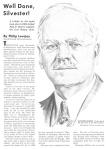
In yesterday’s letter (1942-05-23 730 AM), my grandfather mentioned the Rotary Club.  He asked Gladys to thank the Rotary Club members for the pen they gave him.  For a man about to write hundreds of letters, this was a practical gift. On the surface, this would seem like an ordinary gesture; the local Rotary Club giving a leading citizen a gift as he went off to war. However, in the case of my family, there is a second deeper understanding of these events. My family is inexplicably bound to the Rotary movement. You may recall from an earlier post that my grandfather’s middle name was Schiele. Schiele was his mother’s maiden name. My great grandmother was Lovina Jane (Schiele) Yegerlehner. She was the sister of a man named Silvester Schiele. If you know anything about the Rotary movement, this name should be very familiar to you. In 1905, Silvester Schiele and his lifelong friend Paul Harris founded the Rotary Club in Chicago.

Silvester and his wife Jesse were frequent visitors at my grandparent’s house.  They would often stop by Kentland on their way to Clay City from Chicago, or on other trips that Silvester took for the Rotary.

If you are interested in learning more about Silvester Schiele, check out the RGHF (Rotary Global History Fellowship) Internet project: http://www.rotaryfirst100.org/leaders/schiele/


Getting settled

As with any new project, there are lots of things to consider while executing the long term goals. In the case of my grandparents’ letters, there are some basic logistics to consider.  There are hundreds of letters that I wish to share with family, friends and the world.  My first step is to organize the letters into a presentable format for publication.  I have sorted the letters by the individual writer. In some cases, there are more writers and recipients than my grandparents. Occasionally I have found a letter written to my uncles or letters written by them to their father. There are also the rare letters from an additional family member or friend. I have separated out these letters for the time being. I will place the letters back into their chronological context at a later point. The next step is to put the remaining letters in chronological order. Many of the letters are not dated. The only clue I have to go by is the postmark on the envelope.  This is not always helpful either.  Since my grandfather often wrote one or two letters a day, I sometimes have to stop and read each letter to see if there is contextual evidence that will place one letter before the other. The post office didn’t always sort the letters chronologically either so sometimes an earlier letter has a later postmark.  Some of the postmarks are illegible or missing. I will definitely have my work cut out for me with those letters.

Another aspect of this project is the long term preservation of the original letters. I don’t currently have the backing of a major archive to help me do this. What I can do in the short term is open up each individual letter and unfold them. The fold lines are one of the areas in which wear and tear can break down the paper. Storing the letters flat will help preserve them as well.  I am also placing each letter into a protective sleeve. This will limit their exposure to handling. Once the letters are scanned and transcribed, I am putting them back into their protective sleeves and storing them in binders for easy access.

One day, I hope to donate the letters to a suitable institution that can more properly preserve them for posterity and future World War II scholars. But not until I have read and savored them all.


Letter transcription:

Sat.

Dear Mother,

Just got home and not feeling so hot. Took shot for typhoid & smallpox. As yet I haven’t gotten any mail from home so your letters must be somewhere in the mixup. We may try to move tomorrow to a Hotel across the bay it will be a little more reasonable only $1.25 per day.

I had to go to to work this A.M. at 7:30 but and home at 4:00 so that isn’t bad. I think we should arrange for you to come down at least for a visit and to look the place over. I think I could get an X gas card and sent it to you so you would have no trouble. You would have to make it in two or three days because it is very near 1,000 miles – 970 to be exact

(page2) at least that is what I got paid for. And I wrote a check today for 15.80 for the insurance. It is to be taken out each mo. But it is such a short time until I’ll be 38 that they didn’t have time to take it from my pay.

There are lots of interesting things to see here and it rains almost every P.M. This is the first day it hasn’t but from the way it looks it will before long. There are numerous airplanes in the air both night and day and anti air craft guns can be seen at various places as well as lots of search lights crisscrossing at night. Down along Virg. Beach cars must dim their lights. We went driving and a cop came up and invited us to turn on our dimmers (we did)

(page 3)I’m not used to navy life as yet. Just as soon as I got the uniform every one under me saluted me and I wasn’t sure of what to do but I guess we’ll learn that as time goes by. You got my address in the last letter in case you didn’t-

Lt. (jg) MC V(S) RS Yeg—

Unit “A” Dispensary N.O.B.

Norfolk, VA

The time of a complete change of clothes seem to be gone I’ve worn the same shirt now three days and the same underware 2 days. At the base it takes 10 days to get laundry and up town it is so high. The only thing I’ve changed my socks daily – can’t stand it otherwise. I had to get some sock – must wear black or brown

(page 4)I bought six pair at the ships service for $1.50. They really are a bargain. Everything is cheaper there than up town.

I’m going down to the Y. tonight to see if there is any mail.

I haven’t had a chance to write to anyone yet but the folks. Maybe if we can find a better room tomorrow we can become more settled. And get on a definite schedule.

If you see any of the Rotary Club thank them again for the pen, I don’t know of any other thing they could have given that would have been more useful.

I realize that this is pretty choppy but it’s just the things that came to me. Maybe I can do better tomorrow,

Love Daddy

©2012, copyrighted & written by Deborah Sweeney
Setting goals

Since I started my blog last week, I have been waking up every morning with my mind brimming over with ideas about what to write. There are so many fascinating stories about my family that I have been collecting for years.  I have this overwhelming urge to tell them all at once. The logical part of my brain keeps telling me to be patient.  The stories will all come out eventually. Another part of my brain keeps flitting about.  There are so many things to do in order to organize and to preserve my family’s history.  There are all the photographs that need to be sorted through, all the letters that need to be read, more hints to follow on Ancestry, binders of correspondence and research to cull and reorganize, update my Facebook page, and now, write a blog.  I think I am getting overwhelmed just re-reading that last sentence. Focus Deborah! I want to shout at myself. So as I take a moment to breathe, I focus on: why am I writing a blog? Two of my goals in writing a daily blog are to 1) get into the habit of writing every day and 2) share the letters that my grandparents wrote.

One of the things that I enjoy about reading articles and history websites is that it seems like historians are always finding new treasures to explore and analyze. My grandparents had five grandchildren. From the five grandchildren, there are now ten great grandchildren.  Soon some of those great grandchildren will begin to get married and have their own kids. Since I was the daughter of my grandparent’s youngest son, my children aren’t anywhere near that point in their lives. I did not know my Yegerlehner cousins very well when I was growing up.  We lived in different states, a thousand miles apart.  I only ever saw them at one or two Christmases or briefly during summer vacation when I was little and then later, at my grandparents’ home in Florida.  This part of my family has been slowly drifting away from each other for the last twenty years, if not longer.  In the mid 1990s, I made contact with two of my cousins.  We exchanged letters for awhile to catch up on who was married, who had kids, etc.  Then my cousin Becky died in 1998. She was 38 with two young sons.  And the drift resumed.

Eventually the descendants of Roscoe and Gladys (Foster) Yegerlehner will drift apart so much that we won’t really know that we exist anymore.  Some future descendant from one of my cousin’s branches will be searching around for information about his or her ancestors, and what will they find? (I must note that if any descendant of mine fails to discover anything about our family tree, it won’t be because I didn’t try!) For years, my father read biographies on every United States president.  He once quipped that he would never forgive Martha Washington for burning all the letters that she and George wrote.  What would historians be saying today about our country’s history without the letters written between John Adams and his wife Abigail? I use the Adams letters as an example as I would never presume to say that my grandparents were as historically important.  My grandparents were everyday people, living in extraordinary times. Their letters make up one tiny piece of a much larger puzzle.

With this blog, I will share parts of myself so my children will know what was going on inside my head, all those many times they were orphaned by the family’s history; I write my blog to connect with distant family members; I write my blog to share fascinating stories from my family tree; AND I write my blog to share how two ordinary people lived through an extraordinary period in our country’s and our world’s history.


Letter Transcription:

Fri.
Dear Mother,

The address I gave wasn’t right but in case any comes then it will be forwarded. From now on address me as

RSYegerlehner Lt. jg MCV (S) Unit A
Unit A Dispensary
N.T.O.
Norfolk Va.

There isn’t much to write as yet but more will follow we hope. I think I would like it swell if you could be here but will see about that later-

Daddy

©2012, copyrighted & written by Deborah Sweeney

New Horizons, part II

Yesterday I got inspired and pulled out the box with all the letters that my grandparents wrote.  Since I am going to try to post and write about them, I figured I needed to get them in order.  At some point, they were neatly tied together and labeled, most likely by my grandmother.  The bundles generally contained the letters for one month with the month, year and author written on a slip of paper.  Since the letters came into my possession, I have mostly left the bundles alone.  Occasionally I have gone hunting for some detail or another.

During the war, soldiers were not allowed to divulge to their loved ones where they were stationed in case their mail was captured by the enemy.  This practice still continues today for obvious security reasons. My grandparents knew this so they developed a code. I haven’t actually cracked the code, but I know when to spot it.  Whenever my grandparents started talking about the yard and lawn care, this was an indication of where my grandfather was currently stationed. One of the family stories that has survived over the years is about the letter that arrived the third week of September 1942.  This is the week my father was born.  My grandfather had recently arrived at his destination in the Pacific and wanted to let my grandmother know where he was. There was a mail delay of one to two weeks depending on how far out a soldier was stationed. My grandmother had been waiting for such a letter for weeks.  When my grandmother finally received the letter indicating when my grandfather was stationed, she went into labor.

When I first received the letters, one of the first things I did was to try and track down this infamous letter that sent my grandmother into labor.  I found several letters that alluded to yard care and shrubbery, but sadly I don’t know the rest of the code. Since there were also two or three letters which referenced the lawn, I can’t be sure which one it actually was.

Another instance of my digging through the letters was to follow the death of my great grandmother, Emma Foster.  I knew that she died in November 1943.  I also knew that she came to live with my grandmother near the end. By reading through the letters, I was able to see the tragedy of my great grandmother’s death unfold over the months leading up to her death.

So yesterday, I unwrapped the remainder of the letters from their little strings and neat labels.  I organized them in the box, chronologically and by author. I had already put some of the letters in sheet protectors and had previously attempted to scan them. At this point, the story begins from my grandfather’s point of view.  I’m not sure if he kept her early letters with all the moving around he did that first summer of 1942 but her narrative does not really begin until September 1942.

I also wanted to note that the letter I posted yesterday was not my grandfather’s first letter.  It was actually his second.  He wrote two letters that were postmarked May 21, 1942. Somehow the first letter received the later postmark at 5:30 PM.


Letter Transcription:

Wed. Eve
Dear Mother,

Haven’t much in the way of encouragement or discouragement as far as your coming down. Because there hasn’t been much time to think of that.
It was after 12:00 when the boat arrived. The last ¾ hour is made by boat. The train comes to one side of the bay and then all the passengers take a large steam ferry. The Y M
The Navy Y.M.C.A. is only about 2 blocks from the lang landing of the boat. So when I saw it I thought I might as well try to get a room but they wouldn’t let me have it until I showed them my orders. It cost $1.00 per day for room. The naval base is so far from town, however, that the biggest drawback – It takes about ¾ hour to get there by street car.
This first day has been somewhat like registering day at college – first here then there. I got plenty of walking and really wanted the car. A fellow in the personnel Dept. gave me the names of some people having rooms

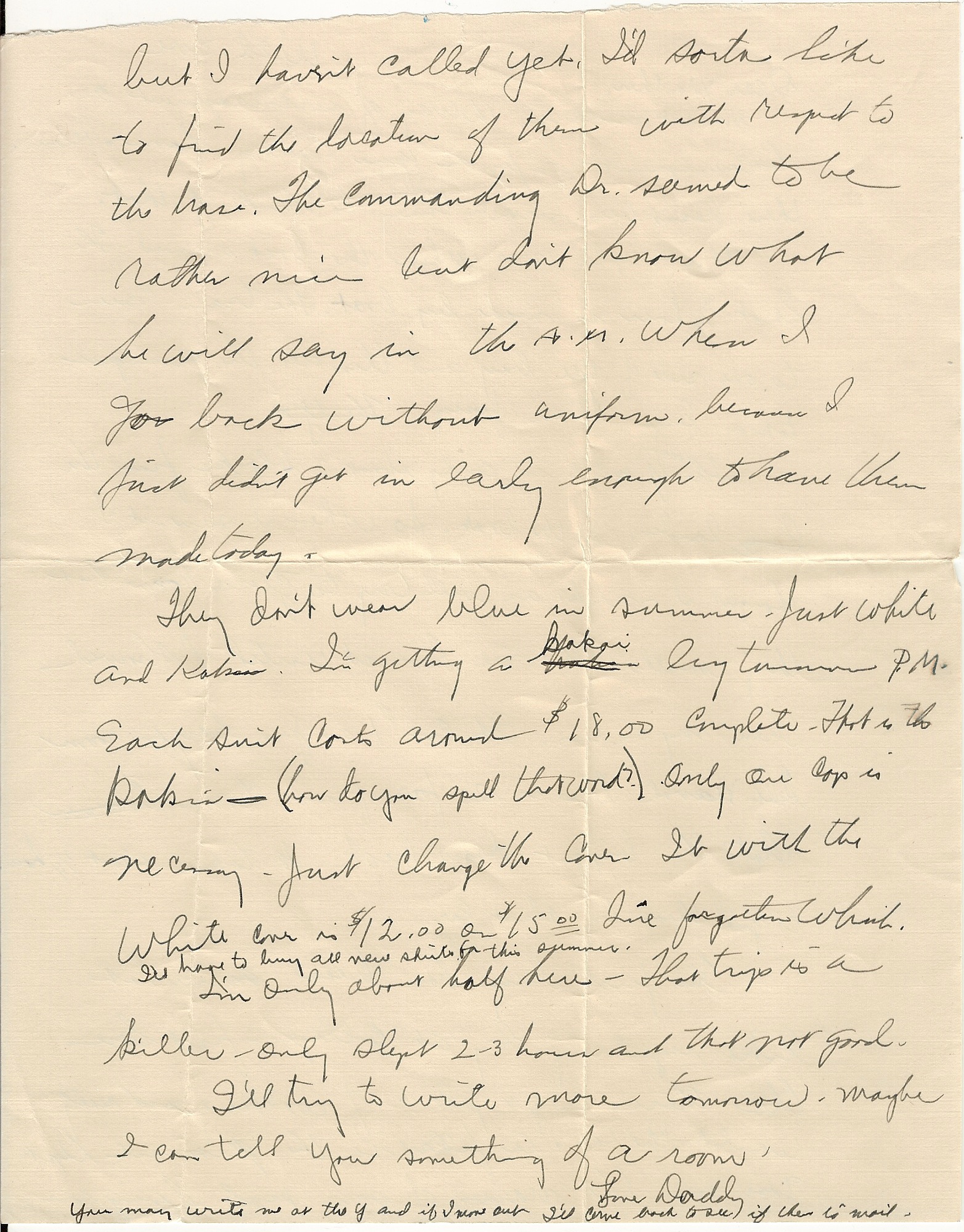
[page 2] but I haven’t called yet. I’d sorta like to find the location of them with respect to base. The commanding Dr. seemed to be rather nice but don’t know what he will say in the A.M. When I go back without uniform. Because I just didn’t get in early enough to have them made today.
They don’t wear blue in summer. Just white and Kakai. I’m getting a white Kakai by tomorrow P.M. Each suit costs around $18.00 complete. That is the Dakin – (how do you spell that word?) Only one cap is necessary – Just change the cover. It with the white cover is $12.00 or $15.00. I’ve forgotten which. I’ll have to buy all new shirts for this summer.
I’m only about half here – That trip is a killer – only slept 2-3 hours and that not good. I’ll try to write more tomorrow. Maybe I can tell you something of a room.

Love Daddy

You may write me at the Y and if I move out I’ll come back to see if there is mail.

©2012, copyrighted & written by Deborah Sweeney
New Horizons

On October 6, 1941, both houses of Congress passed a resolution fixing Thanksgiving as the last Thursday in November.  The practice was to go into effect the following year in 1942. Between the years, 1939 and 1941, there was much debate as to when Thanksgiving should be officially celebrated. In 1939, President Roosevelt had declared the holiday should be observed on the last Thursday of the month.  But due to football schedules and arguments between the Republicans and Democrats, Roosevelt’s declaration was largely ignored.

Why am I talking about Thanksgiving the week after the holiday?  I started thinking about the events that led up to the United States participation in World War II.  Yesterday, my husband was watching the film Tora! Tora! Tora! which tells the story of Pearl Harbor, from both the American and Japanese perspectives.  The attack on Pearl Harbor occurred on December 7th, 1941, almost 71 years ago. I was thinking about how that event changed the lives of my grandparents. I was imagining them sitting down to their Thanksgiving dinner, not knowing their impending future.  I don’t know if they stayed in Kentland or traveled to Clay City to be with family.  One week or two weeks later (depending on when they celebrated the holiday), the United States was plunged into World War II, and their lives took a different course.

My father was born in September 1942.  If we calculate back from then, I would presume that he was conceived around Christmas or New Year’s of 1941.  The attack on Pearl Harbor was most likely very much on the minds of my grandparents, just like the destruction of the World Trade Towers lingered on my mind for months after the event.  By May of 1942, my grandfather had enlisted in the Navy.  In fact, less than six months after the attack on Pearl Harbor, my grandfather was in Norfolk, Virginia receiving his military training before he was shipped off to the Pacific.

My grandmother traveled to Norfolk soon after he reported for duty.  She stayed a couple of weeks while he settled in, and then she returned to Kentland.  She was 5 months pregnant with her fourth child.  During the War, my grandparents wrote to each other almost every day, some days more than once.  Their letters are filled with the daily troubles they both experienced: discussions over money, updates on the children, family and friends, boredom, missing one another and wondering when my grandfather would return home.

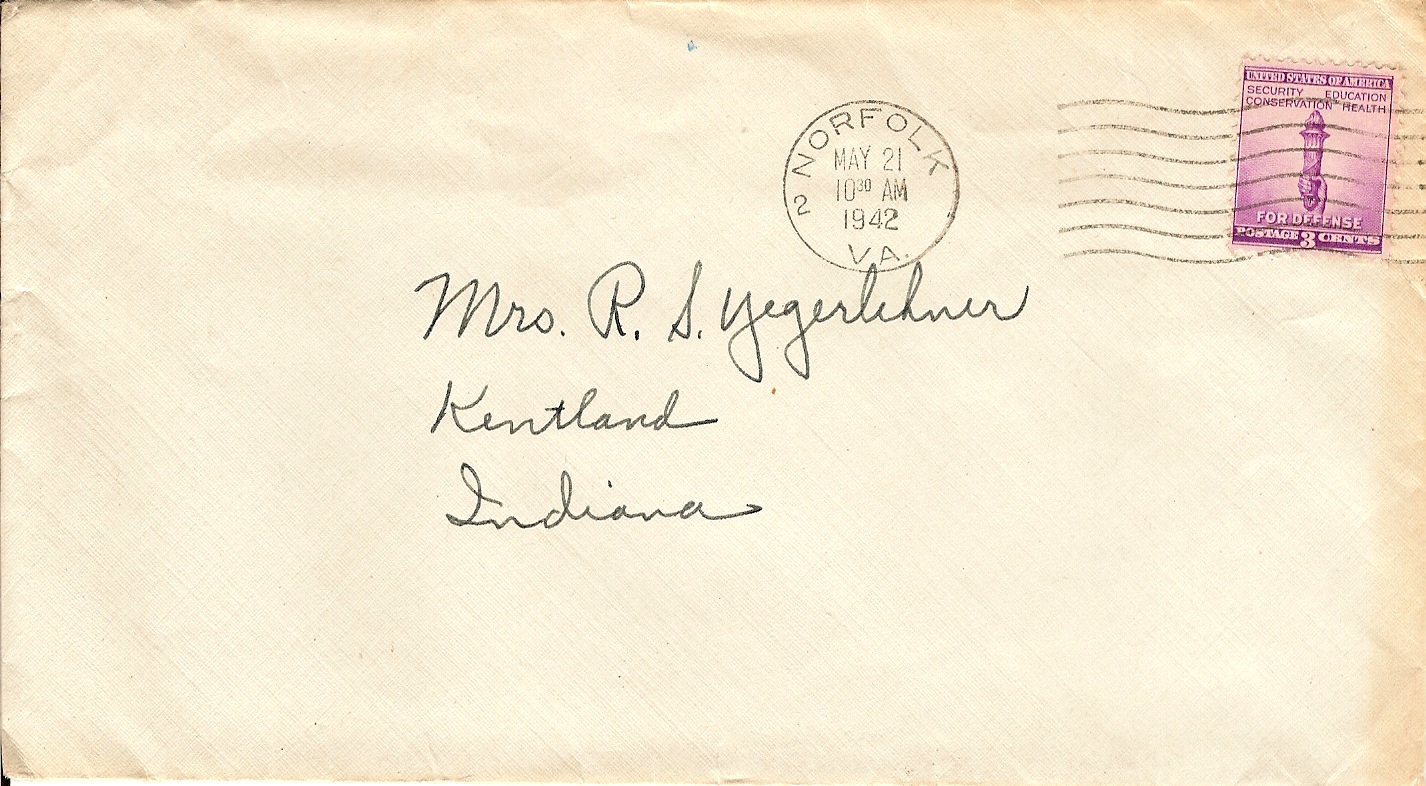
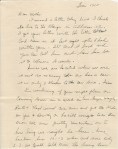
The first letter has the postmark on May 21, 1942 10:30 AM.  It was sent from Norfolk, Virginia. My grandfather was 38.  He was about to be gone from his family for two years.  He wouldn’t see his youngest son until he was 18 months old.  But he was one of the lucky ones, he made it home.


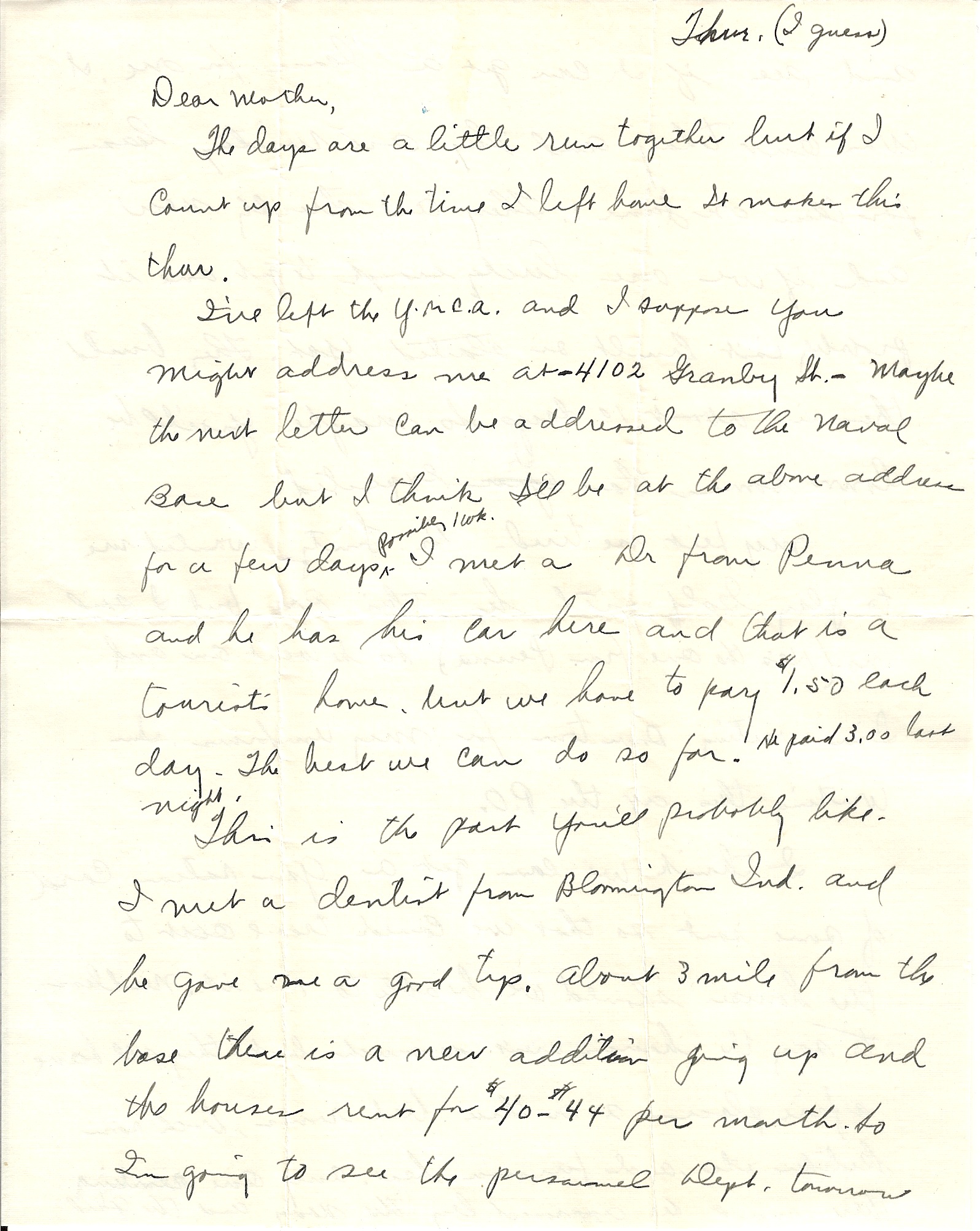
Transcription of letter:

Thurs. (I guess)
Dear Mother,

The days are a little run together but if I count up from the time I left home it makes this Thurs.
I’ve left the Y.M.C.A.  and I suppose you might address me at – 4012 Granby St.- Maybe the next letter can be addressed to the naval base but I think I’ll be at the above address for a few days (possibly 1 week). I met a Dr. from Penna and he has his car here and that is a tourist’s home, but we have to pay $1.50 each day. The best we can do so far. He paid 3.00 last night.
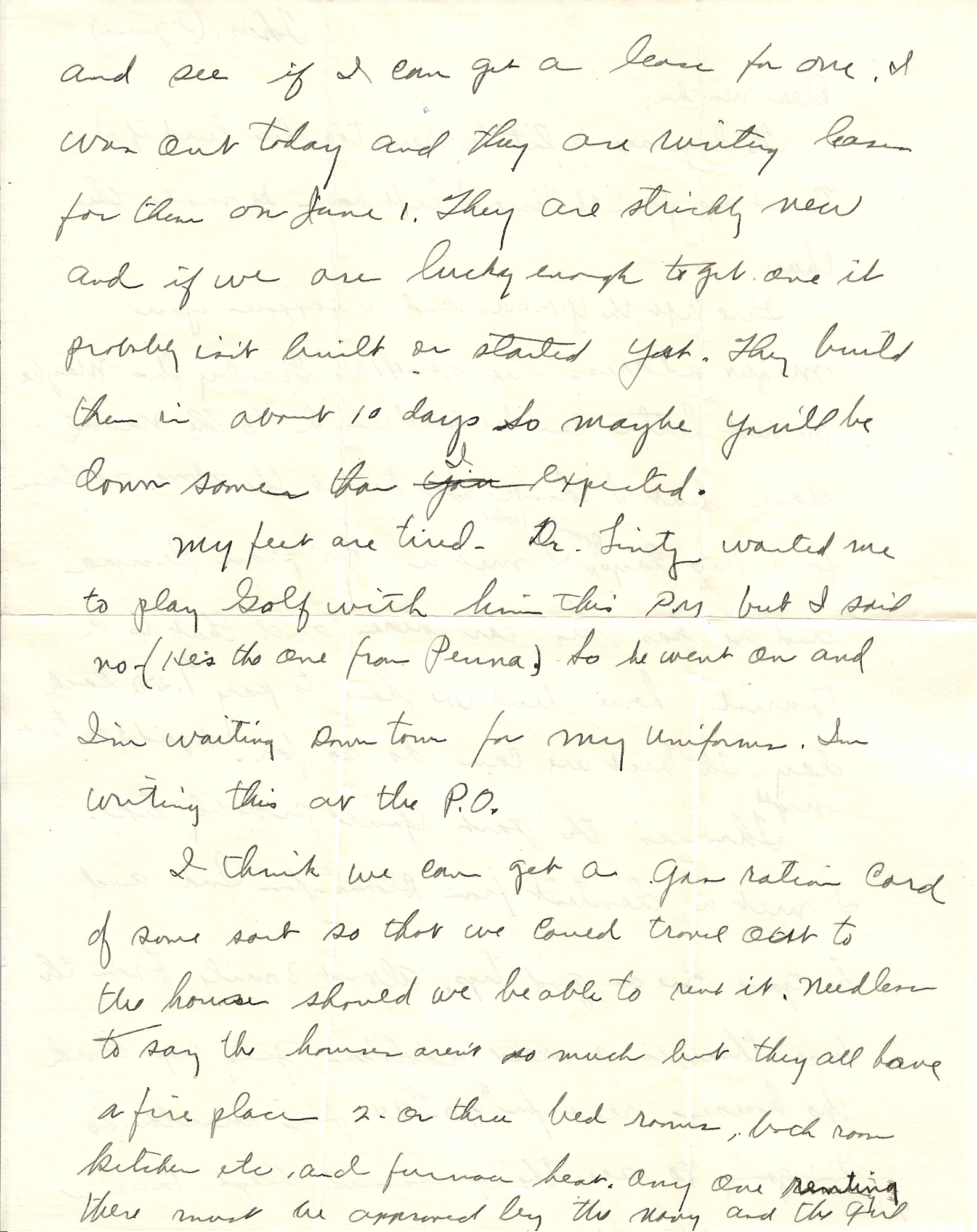
This is the part you’ll probably like. I met a dentist from Bloomington Ind. and He gave me a good tip. About 3 mile from the base there is a new addition going up and the houses rent for $40-$44 per month. So I’m going to see the personnel  Dept. tomorrow

[page 2] and see if I can get a leave for one. I was out today and they are writing leases for them on June 1. They are strichly new and if we are lucky enough to get one it probably isn’t built or started yet. They build them in about 10 days so maybe you’ll be down sooner than I you I expected.
My feet are tired. Dr. Lintz wanted me to play golf with him this PM but I said no-(He’s the one from Penna) so he went on and I’m waiting downtown for my uniforms. I’m writing this at the P.O.
I think we can get a gas ration card of some sort so that we could travel out to the house should we be able to rent it. Needless to say the houses aren’t so much but they all have a fire place 2 or three bedrooms, back room kitchen, etc, and furnace heat. Any one renting there must be approved by the Navy and the girl

[page 3] said that any officer of the Navy will be approved. Of course the lawns and streets are muddy & Rusty for the time being, but that isn’t so bad.
Well, I’ll try to write to the boys and others when I get more settled. I wrote to the folks yesterday.
You might be thinking of the essentials that you would want to bring down – They have stoves (gas) and refrigerators furnished.
Will write more when I get time. I was excused today to settle some of this running around.

Love Daddy

©2012, copyrighted & written by Deborah Sweeney