Protected: Dear Mark (Roscoe)
Enter your password to view comments.
 This is week 4 of a 15 month writing project. This week’s assignment is to write about your favorite season. This writing challenge is provided by Julie Goucher from the blog Angler’s Rest.
In case you are just coming to my writings, I want to point out that I am consciously writing all my posts in the third person. My plan is put all the posts together in the end as a book to give to each of my children. I want each post to have a consistent style so I am trying to look at my life and my memories as an outsider looking in, like a reporter or a historian would. I also know that I have my own family photographs that illustrate this memory. Once I locate them, I will update this post!
Favorite Season
New England is one of those places that has distinct seasons. Summers are typically on the shorter side and can be hot and humid with an occasional thunderstorm to break the heat. Winter can last longer than expected. The first snow can fall early in October or late September. The last snow may come as late as Memorial Day at the end May. Or there may be little snow at all, just the bracing temperatures and limited sunlight that signal the season. Spring and Autumn, the transitional seasons, can be leisurely and pleasant or over in the blink of an eye. Northern California is in many ways the complete opposite. Spring, Summer and Autumn often slide unnoticeably together. The Central Valley does not have a high enough elevation to generate snow with only rain and occasionally hail as precipitation. Because of the high heat in the summer, the California landscape is a flip flop of what one might expect in New England. Dried yellow and brown grasses cover the land in summer while plush green fields are visible in the winter and spring during the rainy months. For a child of New England, California can take some getting used to. The normal seasonal cues are not as apparent. If one wants to “visit” the snow or the autumnal foliage, leaving home is required with a minimal 2-3 hour drive. There are some benefits to never having to shovel one’s driveway, but the loss of such seasonal pageantry is debatable.

Cars stuck on the highway
As for a particularly favorite season, Deborah never liked to play favorites. Each season brought its own delights and pleasures. One memorable seasonal event from her childhood occurred in February 1978. A monster storm was heading towards New England. At that time it was very hard to predict and track the weather. This storm took the east coast by surprise in its ferocity. On Sunday, February 5, 1978, the snow storm was predicted but it did not arrive Monday morning as anticipated. Everyone went to school and work as usual. Deborah does not completely remember whether they were sent home from school early that afternoon, but it was a distinct possibility. Other government agencies closed up mid-day and sent their employees home. Sadly, many people did not make it home in time. Thousands were stranded in their cars on the roadways while trying to make it home. Over 3,500 abandoned cars were discovered, just on Interstate 95 alone, after the storm and clean-up commenced. Many people perished from carbon monoxide poisoning when the snow covered up the exhaust in their idling vehicles. Many more people were left without electricity for almost a week. Boston recorded all time high snow falls. Snow drifts reached heights of 15 feet in some locations. After the snow stopped, people were scared to leave their homes for fear of disappearing underneath all the snow. In fact, automobile traffic was suspended for the remainder of the week in Eastern Massachusetts. Only emergency vehicles and snow ploughs were allowed on the roads.[1]
Now why, one might ask, might this be a happy memory? Imagine the psyche of an elementary school aged child. The snow cancelled school for two weeks. In the end, public school children were out of school for three weeks because winter vacation was already scheduled for late February. The drifts were piled as high as small mountains, especially after the ploughs cleared the roads. Once it was safe to go outside, the snowy landscape became an imaginary wonderland. People dug underground tunnels to rival any Eskimo’s igloo. Fantastical snow sculptures were created. No hills were required for sledding. All other snowstorms pale in the memory of this storm. Anyone who lived through this blizzard immediately knows what one means when referring to the “Blizzard of ‘78”.
[1] Wikipedia (www.wikipedia.org), “Northeastern United States Blizzard of 1978,” rev. 10:38, 10 June 2013.
This is week 3 of a 15 month writing project. This week’s assignment is to write about your physical attributes. This writing challenge is provided by Julie Goucher from the blog Angler’s Rest.
This week’s instructions are:
Describe your physical self
Your size – clothes size
Scars
Eye color
Draw your hands
Finger Prints

Ballet recital, early 1980s at Worcester State College (Deborah is second on the left)
As a child, Deborah was always thin. Although she loved to dance, she was never considered athletic and was probably a bit on the clumsy side. Her genetic makeup predetermined her greater than average height but this did not become truly apparent until junior high (and probably contributed to the death of her dancing career). During her teen years, she grew taller than her mother and three of her four grandparents. She finally stopped growing just shy of 5’10”. Beanpole was a common nickname during this time in her life. In college, one of her roommates affectionately called her Olive Oil, after Popeye’s girlfriend because of her height and relative thinness. Throughout her life, Deborah despised clothes shopping. Standard sizes were not made for tall people. Many a tear was shed throughout the years over high waders and bare wrist bones. Even as a child, she preferred dresses and skirts because pants were never made long enough. Learning to sew was another strategy she used to compensate for gangling limbs. The advent of tall sizes at the end of the 20th century and early 21st century did alleviate some of Deborah’s shopping nightmares, but only a little.
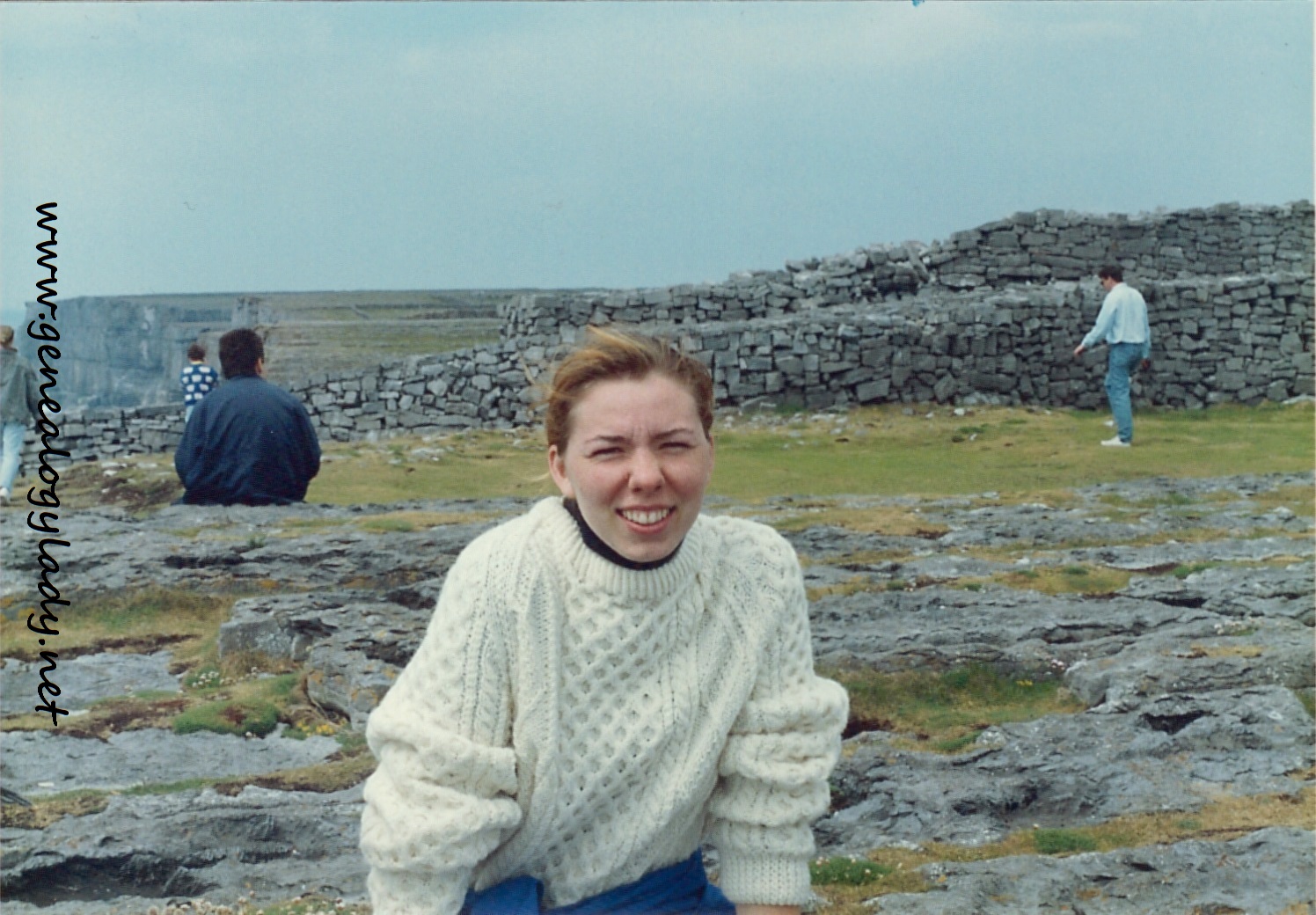
Deborah, early 1990s (Aran Islands, Ireland)
Deborah did not have many scars or birthmarks. She never really broke a bone (toes don’t count) or severely cut herself. When she was in elementary school (before the chicken pox vaccine), she had the disease during one summer vacation. Several of the scabs were quite itchy. There was one in the middle of her brow that she scratched quite often. As a result, a small uneven scar was formed. Most people would not notice until it was pointed out. There were some minor scars on her fingers from the unsafe handling of sharp objects, or her possible clumsiness. During her first week in the kitchen at Kabeyun, she sliced the top knuckle of the right pointer finger trying to open a 20 lb bag of carrots. Another scar was created on her right pinkie from trying to open a pop top can of cat food. She maintained a healthy fear of such evil devices (pop top cans) for most of her adult life. On the other hand’s thumb was a scar made when a chunk was removed with a pair of scissors. The most noticeable scar was the one at the base of her neck, in the dip of the collarbone. In her mid-twenties, it was discovered that her thyroid had a cancerous tumor. The doctors attempted to take only the affected lobe but later had to go back in and remove the rest of the organ. This was perhaps the most dramatic and meaningful scar.
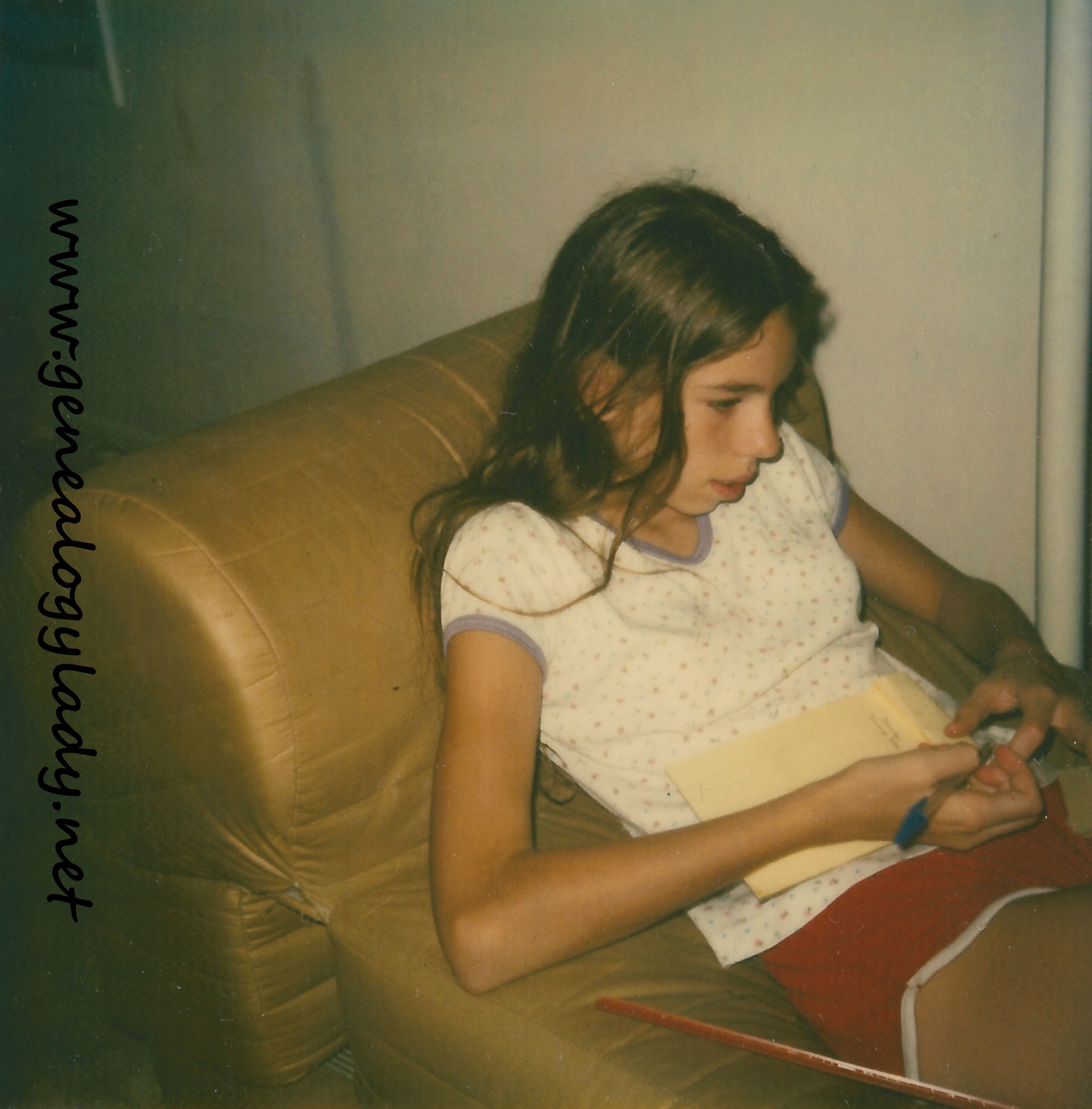
Deborah – c1982
Having nearly 100% northern European ancestry, Deborah was fair skinned. She was never one to get a tan, and frequently ended up with sunburns unintentionally. She was sprinkled liberally with freckles as a result. Her eyes were hazel, predominately brown with flecks of green. When she was younger, her hair was lighter but it eventually morphed into a brown with golden highlights. Since she loved red hair, she often dyed her hair red in her late teens and twenties. Typically, she preferred longer hair although there were sporadic periods when she kept it short. When she was married, her hair was almost long enough to sit upon.
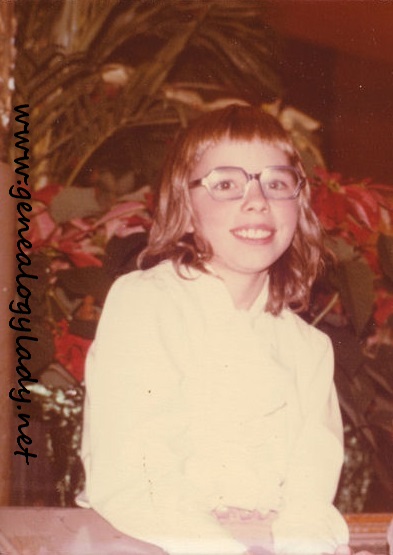
Deborah in 5th or 6th grade
In first grade, it was discovered that she couldn’t read the board from the back of the room. In those days, children were frequently seated in alphabetical order. With a surname starting with the letter Y, she often found herself sitting in the back of the room. Glasses became a part of her wardrobe. As a teenager, she stopped wearing glasses as the problem seemed to have corrected itself temporarily. However, in her 20s, the difficulty of seeing distances returned, especially street signs on the highway. When she became a teacher, she had a hard time seeing the board again! So the glasses returned. Eventually, they became a permanent requirement on her driver’s license.
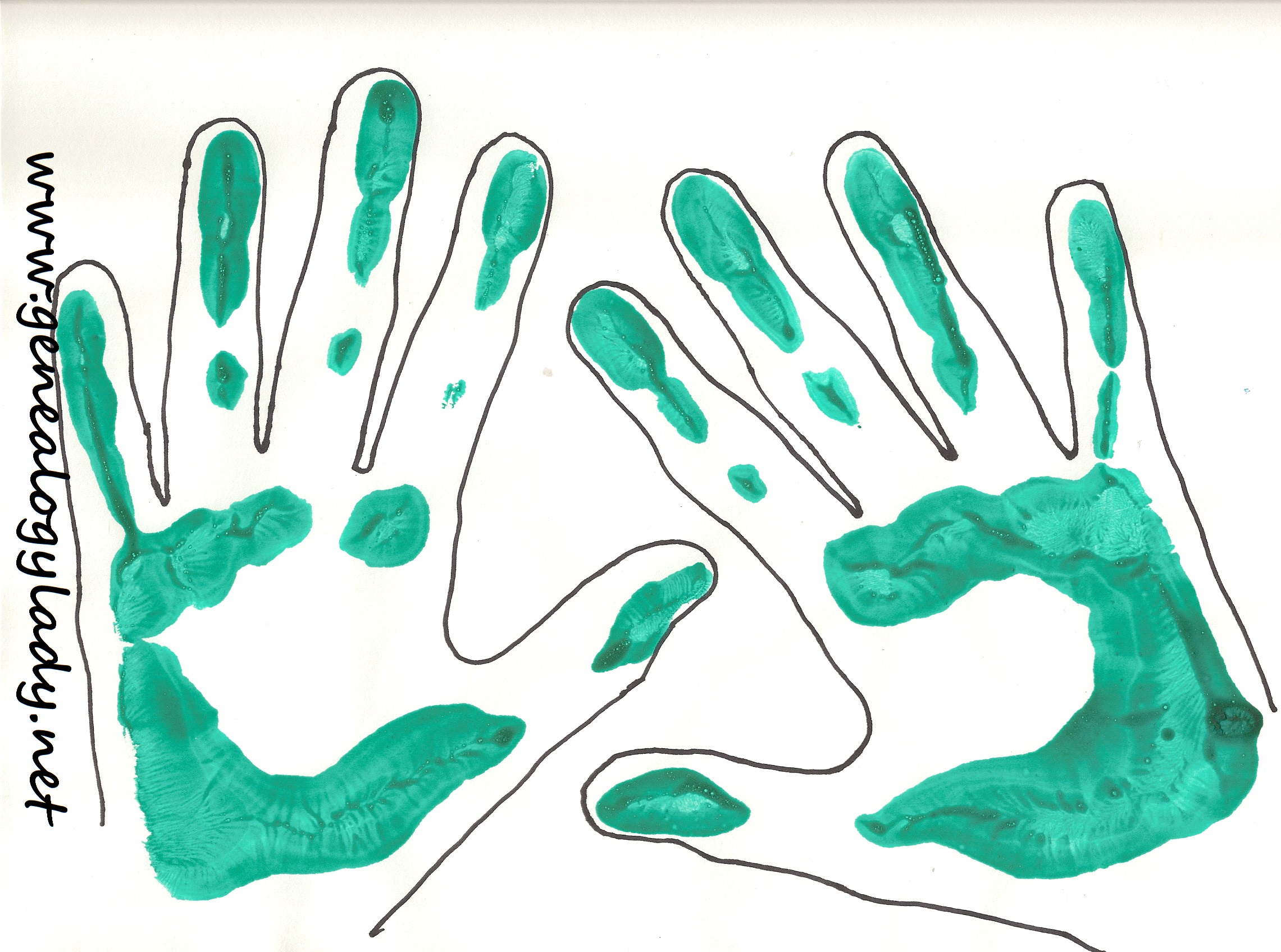
Handprints, 2013
©2013 copyright owned and written by Deborah Sweeney
Post originally found at: https://genealogylady.net/2013/09/14/book-of-me-pro…cal-attributes/

