Protected: Questions, questions, questions…(Roscoe)
Enter your password to view comments.

Photograph of gravestone by Tonya & Keith Tetidrick from Find A Grave
Carrie E. Steuernagel was the youngest child of Charles A. Steuernagel and his first wife, Henrietta Paulina Yegerlehner. If you recall from last week’s Wednesday’s child, Henrietta was my grandfather’s aunt. Carrie died one month and nineteen days after her mother died, and just one month shy of her own second birthday. I do not know the cause of her death. I also find it hard to fathom the amount of grief that Charles experienced in his life. He had a rough time when it came to family. He lost his first wife and two of their three children within four years. When he married his wife’s younger sister Matilda, their marriage did not fare much better. Matilda and Charles were married seven years before she died a month after giving birth to her last child. They had five children together; two of which died as infants. Charles married a third time and lost this wife after only five years of marriage. Dorothy died within days of giving birth to her third child. I think Charles gave up trying to find a wife afterwards.
Carrie is buried at the St. Peter’s Church Cemetery at Hickory Corner, Owen County, Indiana (FindAGrave).
____________________________________________


Letter transcription:
Mon. P.M.
Dear Mother,
It seems as if I’m getting the run around. Now the Captain has put me off until Friday. He may know of some orders coming in etc. or something else anyway today he told me to come back Fri. Fri I’m going to tell him I have some definite plans made for Sun and Mon and must get off at that time. Of course he may have other definite plans also. It might be as you said some time off between duties.
I wrote Mrs. Ahern so probably won’t be bothered by that anymore.
I’m just as much put out and feel as badly as you do about the summer but I can’t figure any solution because if there is no place to live I don’t know what can be done. These houses in Oakdale are OK but they don’t have gas or electricity so that is definitely out. A Lt. and his wife and 7 children are living in one and cooking in the fireplace but I don’t want that. They have been there 3 wks. Yesterday. Sounds
(page 2) like Wittenberg, but they can’t get the stuff to finish the lines.
Maybe we can talk those things over when I get home. I’ve been more dissatisfied here in the last 2 wks than before because its just like you said, the whole summer is almost gone, but I can’t see what can be done about it.
Got a letter from Uncles Wess today¹. They are in Mich., spending the summer. He still writes about the Spanish + American War². Guess it was as big to him as this one is now.
I washed out a suit of underware today. Mine are all in the wash. One bunch has been there since June 30, Maybe they will be out by Fri. Hope so or I’ll have to come home dirty.
Well, as I said last week. I’ll keep on writing each day because Fri. he may put me off again.
Love Daddy
Notes:
My grandfather’s middle name was Schiele. It was a common custom in the past to saddle a child with the maiden name of its mother as a middle name. My grandfather was the “lucky” child in the family who got Schiele as his middle name. Have I mentioned that my grandfather hated his name and preferred to be called “Jake”? My grandparents continued the tradition and gave my grandmother’s maiden name to my uncle John, hence John Foster Yegerlehner. I hope my uncle didn’t dislike his middle name as much as his father detested his.
Regardless, Schiele was the surname of my grandfather’s maternal grandmother. Schiele is German. My family always pronounced the name Shē – lē. Two syllables, both with long e. I have seen it spelled phonetically as Sheely in old census records and on Michael’s naturalization papers. I don’t really know what the name means or where exactly my Schiele family comes from in Germany. I found one definition for Schiele that is quite funny (or tragic) “one who was crippled; one who squinted.”¹ I picture some near-sighted Germans wandering about the forest, running into stuff. If you can’t see very well, I am sure you could very easily cripple yourself, walking into things.

Naturalization paper for Michael Schiele, Clay county, Indiana, 1866
All humor aside, my great, great grandfather Michael Schiele is a bit of an enigma to me. In many ways, he is one of my earliest and most prolonged brick walls. Why? He is from Germany. His branch is one of the most recent branches of my family to land on North American soil and therefore, more difficult for me to trace. Until recently, there have not been many German records available to search, either in a library or online, and they are usually in German. I have always wished that I knew how to read German, especially when one wants to read old German records. Michael also did me the disservice of dying before 1900. So no death record! And so far, I haven’t been able to locate an obituary either. He did leave two biographies in Clay county history books which have provided me with a wealth of clues and some bread crumbs.
In The History of Clay County, Indiana by William Travis (1909), there is a very nice biographical sketch of Michael within the write up of his son, Reuben Jacob Schiele. In addition, the book’s section “Memoirs of leading and familiar home people” includes a separate biography just for Michael. These biographies are written after Michael’s death and they provide a lot of good information which I have mostly verified. Travis gives Michael’s birthplace as Wittenberg, Germany. Wittenberg is a city located in the Saxony area of Germany. The only problem is that other sources give Michael’s nativity as Württemberg which is located in the area now known as Baden-Württemberg in southern Germany. These two cities are nowhere near one another and I have been told that there are also multiple locations that have used these names in the past. Some even better and more tantalizing clues are in Charles Blanchard’s Counties of Clay and Owen, Indiana (1884). This biography gives information on Michael’s parents. It opens with “MICHAEL SCHIELE, farmer and stock-raiser, was born, November 2, 1831, in Germany, and was the fourth child born to Michael and Mary (Smith) Schiele, both natives of Germany”. Oh woe is me! A SMITH! 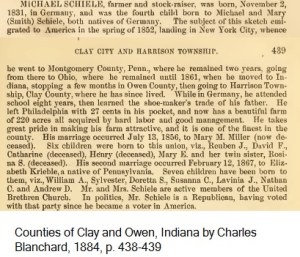
I keep hoping someday that a database will come online with German birth and marriage records that will reveal more about my Schiele family (AND that I can read in English). I do know when Michael was born and I know the names of his parents. I know all the names of his children and grandchildren. For now, that is enough.
Notes:

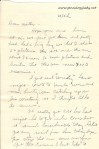
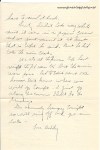
Wed (postmark June 24, 1942 8:30 PM)
Dear Mother-
Hope you are home all OK. We just got home and pretty tired, had a big day we had to shoot 22 platoons this A.M. and there are about 84 men to each platoon and besides that there was near 400 to examine.
I got real “writey” last night – wrote to Uncle Wes and Mom. Lentz was catching up on his writing so I thought I’d do the same.
It really got cold here last night – had to get under cover but it warmed considerable today-Didn’t get any mail from home today. Hope you stop that as soon as you get there because I don’t like to
(page 2) have to send it back.
Lentz didn’t take my white suit-it was in a paper cover and we just missed it at least that is what he said. But he did take the raincoat.
We ate at the Famous Café last night the food was OK but the service was poor had to wait about one hour. Don’t know where we will go tonight. I just go along because I don’t do the driving.
I’m unusually hungry tonight so will ring off and get some eats-
Love Daddy
©2012, copyrighted & written by Deborah Sweeney


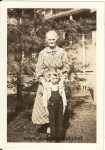
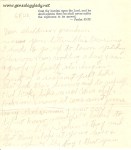


Today’s letter is very special. I believe it is the only letter I have in my collection by my great grandmother, Emma Foster. Chronologically, it falls right after my grandfather’s last letter. The two letters are postmarked the same day. Word is definitely getting around that my grandmother is heading to Norfolk. An added bonus (genealogically speaking) in the letter is that Emma ran into Uncle Wes and Aunt Jessie one night in Terre Haute. Uncle Wes is Silvester Schiele, my grandfather’s uncle. You may recall an earlier post I did on Silvester. His friends and family called him Wes for short. Wes and Jessie must have just come through Kentland on their way down to Clay City from Chicago.
My great grandmother’s story is one that I had to figure out mostly on my own. My grandmother gave me a little information to start with but the rest of the journey was all mine to uncover. Emma was a twin. Aunt Minerva, the one mentioned in the letter, was my great grandmother’s twin sister. One story that my grandmother did relay to me regarding her mother was the story of her naming. Emma Foster was born Emily Hogue Lawhead, daughter of James Henry Lawhead and his second wife, Margaret Allie Rea, on November 14, 1872. The twins were the second and third children of Margaret & James. Margaret was to have four more children, but none survived their infancy. Their oldest child was a boy, Jasper, who was born in 1869. When the twins were born, Margaret did not know what to name them. I suppose Margaret was out of the question as she already had an older step-daughter named Margaret. The story goes that Margaret named her daughters after the first two women who came to visit after the babies were born. I don’t know what Minerva’s middle name is so I haven’t been able to track down her namesake. There was a young woman named Emily Hogue who lived in the neighborhood so there does appear to be some validity to the story.
In 1894, when Emma was 22, she had a child out of wedlock. I have no idea who the father was. According to my Dad’s cousin Juanita, Emma talked about Jesse all the time but she didn’t know who he was. She assumed he was given away. On the 1900 census, Jesse was living with his grandparents, Emma’s parents. If he was given away, it wasn’t very far. Jesse lived with his grandparents and migrated with them to Arkansas. Jesse stayed in Arkansas after his grandmother died and his grandfather returned to Illinois. Another comment made by Juanita in one of her letters was that Emma had grandchildren but they were too far away. Jesse had three children: Alvin, Elwin and Francis. On his death certificate, Emma is named as his mother, but the line for his father is blank. Who knows what happened to this mysterious male in my great grandmother’s life? Was she raped? Did he run away? Why didn’t they marry? I have lots of questions and no solutions for solving this puzzle.
On February 29, 1896, Emma married James Edward “Ned” Foster in Hutsonville, Crawford, Illinois. I would love to say that he was a good man, and was able to accept Emma’s past. I don’t really have an answer to that. What I do know is that their marriage was a rocky one. James was an alcoholic. Over the years, Emma threw him out several times. I assume in the beginning that things were good, but I really don’t know. Love works in mysterious ways, plus it might just have been all about the sex. James and Emma had at least five children. The ones who grew to adulthood were Lydia Allie, Glenn Edward, James Laughead, and my grandmother, Gladys Ruth. Evidence suggests that there was another child Forrest that died young. I have a photograph of a large family grouping. On the back it written: James, Emma, Lydia, Glenn & Forrest. Emma is holding Glenn and a baby on her lap in the picture while Lydia is sitting by her feet . Lydia was born in 1897 and Glenn in September 1900. There is a jump in births before James was born in February 1904. The 1900 census records that Emma is the mother of two living children; this would be Jesse and Lydia as Glenn wasn’t born until after the enumeration. On the 1910 census, Emma is the mother of 6 children, 5 living. The five would include: Lydia, Glenn, James, Gladys and Jesse.
I don’t know where or when baby Forrest died or where he is buried. The family moved back and forth between Crawford and Clark counties in Illinois and Terre Haute during these years. James was a laborer and he moved to where the work was. They were probably pretty poor and couldn’t afford a stone for Forrest’s grave. Both my grandmother and Uncle Jim were born in Terre Haute. After that, I think the family pretty much stayed in Terre Haute. Sometime before 1920, Emma kicked James out for his drinking for good. On the 1920 census, James is not enumerated with the family. Emma’s profession was a pie baker for a Baking company. Cousin Juanita also mentioned in one of her letters that Emma did this along with Aunt Cora. Cora Miller was one of James’ sisters. Apparently at one time, they all lived in the same building (but not on the 1920 census). A couple of the Terre Haute directories after 1920 record James and Emma living together but I think this might have been a smoke screen. Emma and James never divorced. Even on Emma’s death certificate, my grandmother reported that Emma was married.
Emma had a decent life but it was filled with hardship over the years. Any of these events would have broken a weaker person: an illegitimate child, an alcoholic husband, the death of a baby, being a single working mom, her beloved oldest daughter dying young, her grandson being killed in an accident. Her life could be measured by these tragedies but I would rather think of her as my grandmother’s mother, the woman who came to Kentland to help my grandmother while her husband was away at war, during the time after she had the baby (my father). I like to look at her pictures and her elusive smile. Yes, she does look old for her age in most of the pictures, but I look and I see a little part of me looking back at me, and it makes me proud to be her great granddaughter.
In school, Emma achieved a sixth grade education according to the 1940 census. While transcribing her letter I struggled between trying to make the letter readable and making an accurate transcription. If you want to see the actual letter, click on the pictures above.
This letter also mentions that Gladys’ mother-in-law, Lovina Yegerlehner, has not been feeling well lately and that Ruth has been home helping her mother while she was sick. Paired with yesterday’s letter from Roscoe which also mentions his mother not feeling well, that’s a nice bit of documentation from two corroborating sources.
Letter transcription:
6.8.42
Dear children + grandson
Receive your letter this morning. I had to go up to town yesterday afternoon + was walking along + seen a group of folks? standing in front of a restaurant first like that had their dinner, said to myself that look like uncle Wes + stop + look + sure among it was aunt Jessie, Mary Sheperman + some more I didn’t know so stoped + talked to them a litter whin? + they said that they stop at your house + seen you + the boy + that
(page 2) you was going to see Jake next week. Said that they would tell you that way seen me. I have had a letter from James + he never said anythins about seeing Jake yet James has got his insinmet[assignment] + will be there six month or a year he said I sure am glad that Ruth is at home with her mother this week it will help her as much as the medison[medicine]. I thought that I would get down there this week but it has been so hot here it seems to take all of the pep out of me your aunt Minerva is looking for me to come over there + stay
(page 3) a few day but can’t pick up the nerve to go. I am writing you some of her tales of woe. when I got up yesterday morning I felt like going back to bed + giving up the strnge[strength?] + say here lord take me I have a little more pep today. I don’t feel sick + can eat good but is seems like it don’t do my any good hade plenty to eat this is my tail of wo[e] I said to my self this sond like aunt Minera letter.
(page 4)I would like to hear John play at the resite[recital] hope that he comes out first it sure is hot today I hope that you do go + see Jake + get to see James it will cheer him up to see you if I had a place for the boys to sleep they could come + stay with me. I see so many dresses in the window up to down. I told Mrs. Welsere I was going to write + tell you about their that is the seersucker only haha will sign off
Mother love
©2012, copyrighted & written by Deborah Sweeney

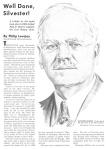

In yesterday’s letter (1942-05-23 730 AM), my grandfather mentioned the Rotary Club. He asked Gladys to thank the Rotary Club members for the pen they gave him. For a man about to write hundreds of letters, this was a practical gift. On the surface, this would seem like an ordinary gesture; the local Rotary Club giving a leading citizen a gift as he went off to war. However, in the case of my family, there is a second deeper understanding of these events. My family is inexplicably bound to the Rotary movement. You may recall from an earlier post that my grandfather’s middle name was Schiele. Schiele was his mother’s maiden name. My great grandmother was Lovina Jane (Schiele) Yegerlehner. She was the sister of a man named Silvester Schiele. If you know anything about the Rotary movement, this name should be very familiar to you. In 1905, Silvester Schiele and his lifelong friend Paul Harris founded the Rotary Club in Chicago.
Silvester and his wife Jesse were frequent visitors at my grandparent’s house. They would often stop by Kentland on their way to Clay City from Chicago, or on other trips that Silvester took for the Rotary.
If you are interested in learning more about Silvester Schiele, check out the RGHF (Rotary Global History Fellowship) Internet project: http://www.rotaryfirst100.org/leaders/schiele/
 Genealogy Lady