Tag Archives: Methodist Church

David’s Diary – June 16, 1969

Monday, 16 June 1969

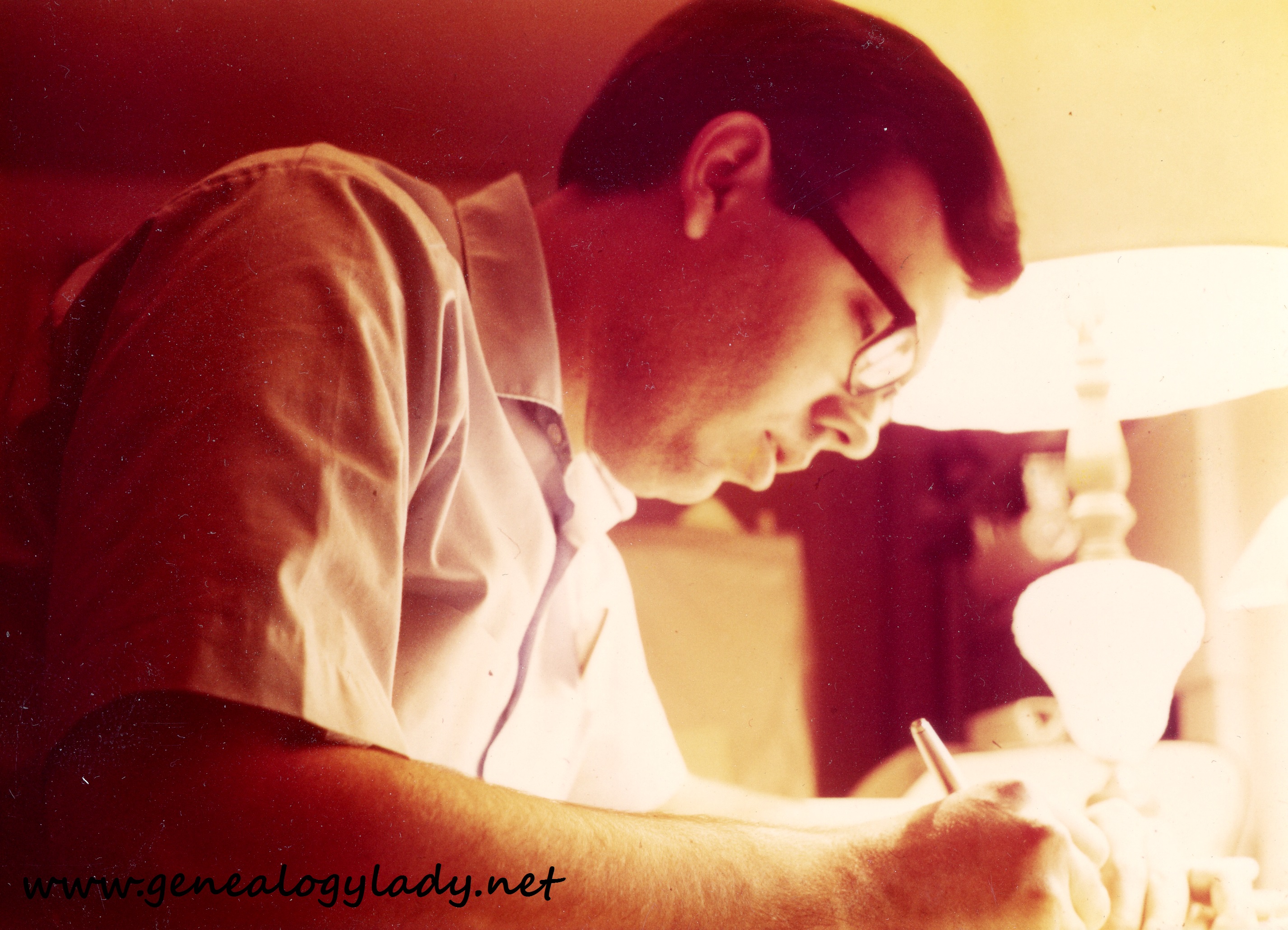
Debby 10 months old. Weary after yesterday’s meeting—in bed until after 9:00; Θ before arising; breakfast—rather slow in getting around to German, but by 10 o’clock, with several interruptions (phone calls, picture taking, etc.) I had made some progress. Lunch, shaved; worked further on German. About 3:30 went to call on Gazella Dodd then at 4:30 to see Daisy Jodrey. Home after 5:00; wrote two letters, one to Dr. Beck and another to the realtor in Cambridge which he recommended. Had supper about 6:30. At 7:30 Jim Bussey and Forrest Clark arrived—we had to talk over steps to be take[n] to help get Fund For Reconciliation money for Gloucester needs. This lasted until about 9:00; then we went down to Patriquins; saw movie of Debby + George Harris. Visited, came home about 11:00; worked on German; bathed; off to bed, lights out 12:07.

Tuesday, 17 June 1969

Passport came in mail. Debby was awake before 5:00 (!) but she was put downstairs. At 9 o’clock I was gotten out of bed by the phone; Alan Federick wanting to use our basement since he had to move his things out immediately. I worked on German some this morning, but by 11:00 was hard at work for Alan—moving his things—via his car—into our basement. Stopped about 12:30 for lunch, and then relaxed shortly. Then back to the loading and unloading. Didn’t finish until almost 4:00. I got back to work on German, but was very weary. Went to the front bedroom and relaxed, fell asleep. Got up about 6:30. We watched news; Bonnie was late getting supper. We didn’t eat until about 7:30. By 8:00 I got back to work on German. Phone call from Homer Orne. About 10:00—shortly before—I called Kent Millard in Newton Upper Falls—re: conference resolution on Vietnam; worked on German until 11:30. Stopped to bathe + have snack; off to bed; lights out 12:16.

Wednesday, 18 June 1969

Up at 8:35 after Θ. Had breakfast—gave Debby her breakfast while Bonnie got some more sleep. Hadn’t shaved yesterday, so began on this right after eating; while in the process Alan Federick came over with his last load of items to go in basement. About mid-morning I got to work on German; lunch about 1:00, then made progress at German. Took a coffee break about 3:30—at which time Ray + Ellen Stoner arrived from Schnectady. While they + Bonnie (+Debby) went to the Christmas Dove, I went to see Mr. + Mrs. Patience. At 5:00 I walked down to end of Bearskin Neck—to Christmas Dove, in search of the girls—but found them at home. Visited with the girls, had super—got back to work on German while they all went down to the Neck; I stayed home with Debby, studied; Debby walked about 3-4 feet (12 tiny steps); listened to Tom Lehrer when girls got home; snack, relaxed, visited, off to bed, lights out 11:53.

Thursday, 19 June 1969
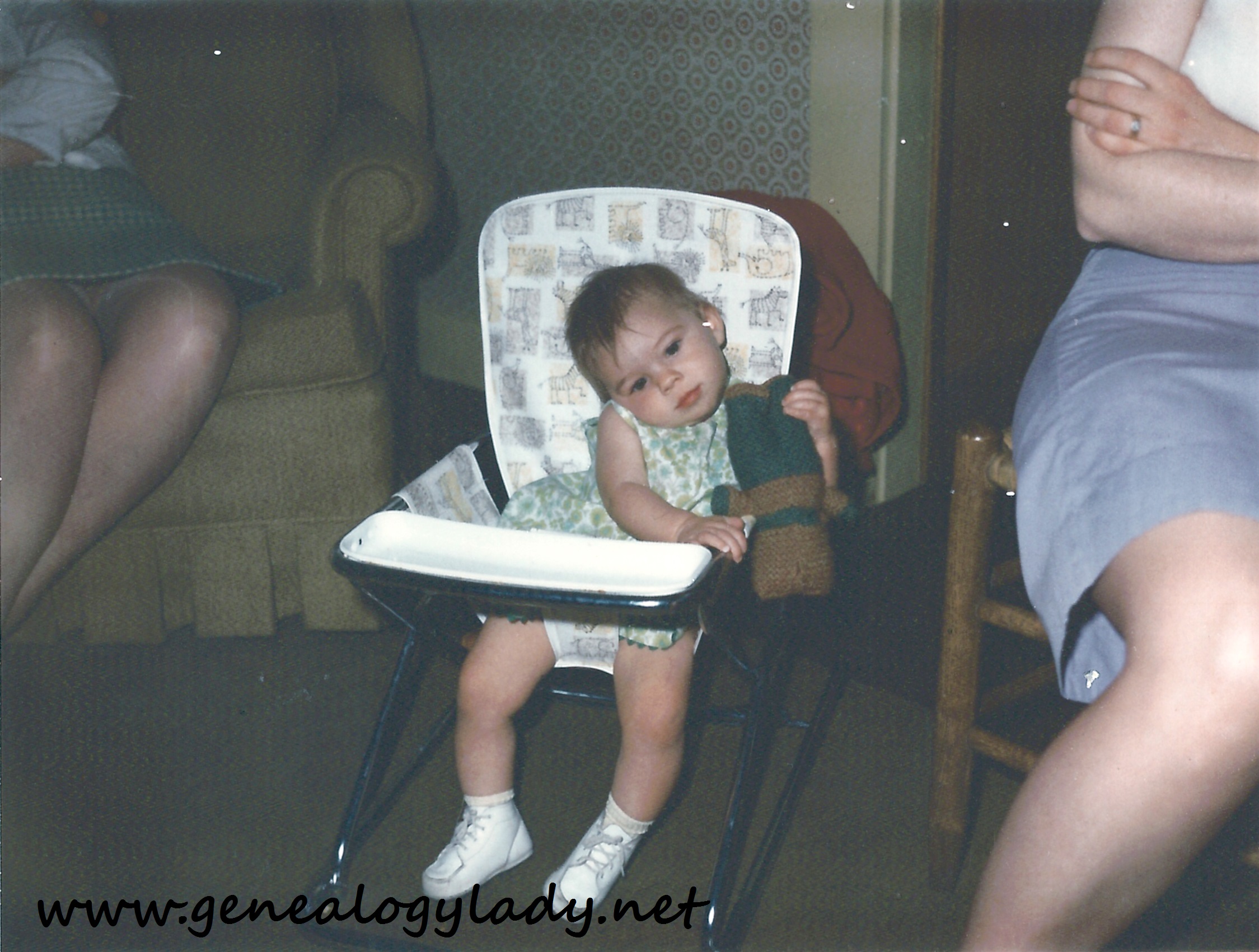
Debbie, May 1969

Up about 8:35—had breakfast, then while Ellen, Kay and Bonnie went off seeing sights, I worked on German. Made progress until about noon. Stopped to shave and have lunch—about 1:15 we left for Dr. Kline’s office for Debby’s regular checkup appointment; Debby is 28½ inches tall, 18 pounds—we were out of his office by 2:15. Came home, Bonnie again went out with Kay + Ellen—I napped. Very briefly around 3:30 Bob Mezzoff (?) + his wife dropped in to see the parsonage; they served here several years ago; back to German for a while. When Kay + Ellen came back, we showed them our slides—had supper around 6:30. They left by 7:00. We watched President Nixon’s new conference. Just a few minutes after this was over, much to our surprise, Paul + Marty arrived. Spent the evening visiting—showing slides; bathed about 11:00. German—off to bed; lights out 11:55.

Friday, 20 June 1969

Up not too long after 8:00; we all got up and just sat around talking for a while. At nine I went to the store for bread, then we had breakfast. After break [?] I had to tend to doing the bulletin and packing. The others went out for a walk around town. I went to the church briefly, came home, worked at my desk. Around noon shaved, the others returned, we had lunch. About 1:30 they then left for Gloucester to see Busseys. I got ready to go, then worked on German until 3 o’clock when the Ornes came for me. We drove to Natick—Fisk Memorial Church. Registered, chatted with friends—executive session got under way about 5:15—over around 6:00. We had supper at a huge hall of a girl’s school near the church. Evening session 8:00—not very thrilling; over by 9:30. Ornes brought me to the home where I’m staying; bathed, off to bed, lights out 11:41.

Saturday, 21 June 1969

Up about 7:30, shaved, had small breakfast; Mr. McEwan drove me to the church—arrived about 8:30. Nothing very exciting at the morning session; had lunch with George Collis; in the morning there was some discussion among those of us pushing for a stronger Vietnam resolution. The afternoon session was likewise rather dull. At one point Jim Bussey, Dr. Uhlinger + I had an extended chat about Forrest Clark and Riverdale Church. Uhlinger indicated that an interim pastor might serve Rockport and that I could return. Bussey and I talked further—we walked to the lunch hall together—and back. After supper we maneuvered further re: the Vietnam resolution, but the evening session was devoted entirely to a resolution of black requests to the conference. Received with resistance—the older church structure fought it. The session finally ended before 11:30. Ornes brought be out to McEwans; bathed; relaxed, lights out 12:38.

Sunday, 22 June 1969

Up at 8:30. Shaved, had breakfast; about 10 o’clock we left for the church—Mr. McEwan drove me. Didn’t sit in the service with anyone I knew; Bishop Mathew’s sermon was not terribly profound or original—but it was interesting, and not the least bit dull. After service went with Busseys and some others for lunch in Framingham at a shopping center. After lunch goofed off. Came back to church; I very much wanted to nap, but of course couldn’t. The ordination service was at 3:30—lasted until 5:00—it too was interesting. Who knows when I’ll go through the Elders process? After the service I joined the Ornes and we went to the Walnut High School for supper—which wasn’t too good. After supper we wandered back to the church. A suggested business meeting was not held, so I left, since I didn’t care to attend the retirement service; Kent Millard drove me to my room; relaxed, visited with the McEwans in the evening; lights out 11:15.

©2017 copyright owned and transcribed by David Madison and Deborah Sweeney
Post originally found: https://genealogylady.net/2017/06/11/davids-diary-june-16-1969/
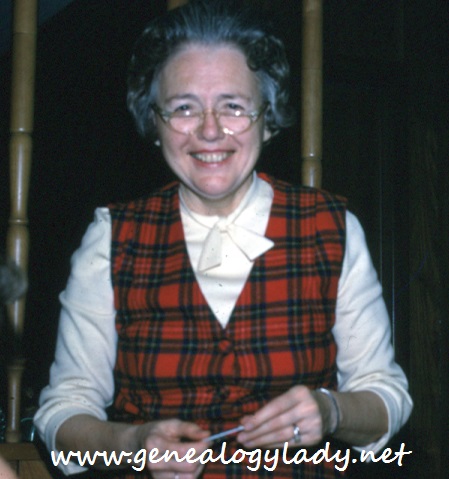
Gladys – March 25, 1969

Letter transcription:

118 Juniper Court
West Lafayette, Ind. 47906
March 25, 1969

Dear David, Bonnie and Debby,

When going through my papers found I had brought some of your things home with me – Senator Kennedy’s letter, etc. Sorry about that. Have been very busy since returning. The following weekend we went over to Champaign. John had an Indonesian dinner for us on Saturday evening. Lea helped him prepare it. On Sunday we had dinner at Lea’s. We attended the Wesley (on campus) service on that Sunday morning and heard Rev. Richard Hamilton from Bloomington, Indiana, preach. In this month’s Together Magazine there was quite a bit about (in our Indiana section) about the Fund for Reconciliation and how the two Conferences are going about the job of raising the funds. Rev. Hamilton is in charge of the South Indiana Conference fundraising and Rev. Bjork is in charge of the North.

Last Monday a week ago I had to go to Plymouth to attend a meeting of the Division of Christian Outreach. Have another meeting next week with the Section of which I am Chairman – Social Witness – to get what we have to say ready to go into Conference Minutes. As I said to our associate minister’s wife – I wonder if it is worth all the effort – I set the meeting at Logansport – that is some closer than Plymouth. There will only be four of us so only two of the four will have a long way to drive – one from Mishawaka and one from Gary. The other member lives at Peru – just a short distance from Logansport.

Thanks Bonnie for sending the cuff links. They made quite a hit with one or two of the men – but the women all thought they were quite unusual and wanted to help choose for their husbands – saying if they didn’t wear them, the wives would. I gave each one a card telling what Beach Glass is.

Last week I watched the hearings on TV about the ABM and thought Fulbright got a load off his mind when he brought in Vietnam. Heard Proxmeyer from Wisconsin this morning telling about the enormous amounts being spent by the Defense Dept. which he thinks could be cut drastically. The Today Show has been talking about the subject of “Poverty and Hunger” and said that so many people have no idea how widespread hunger is in this “the most affluent country in the world.” I was in a meeting last week and was a little bit “shook up” when I heard some of the comments made. One woman was not in favor of the Fund for Reconciliation. She couldn’t see turning over all that money to an agency. Her argument was, “How do we know how they will use the money?” I thought about calling her this week after reading the Together Magazine and if she doesn’t take it, send her my copy. However, when people are like that, no doubt one article won’t change their thinking. Heard on the Today show this morning that the President of South Vietnam has finally consented to include the Vietcong in the peace talks. Wonder what kind of threat was used to bring about that sort of about-face. Also have been hearing former Sec. of St. D. Rusk on the Today program. After listening to him I thought, how could anyone in his position be so far removed from facts. He said this morning he thought the Peubolo (sp.) incident should just be forgotten as something that was unfortunate. In other words – when he was at the head – they goofed.

Love Mother

©2017 copyright owned and transcribed by Deborah Sweeney
Post originally found: https://genealogylady.net/2017/05/28/gladys-march-25-1969/

Gladys – January 28, 1969

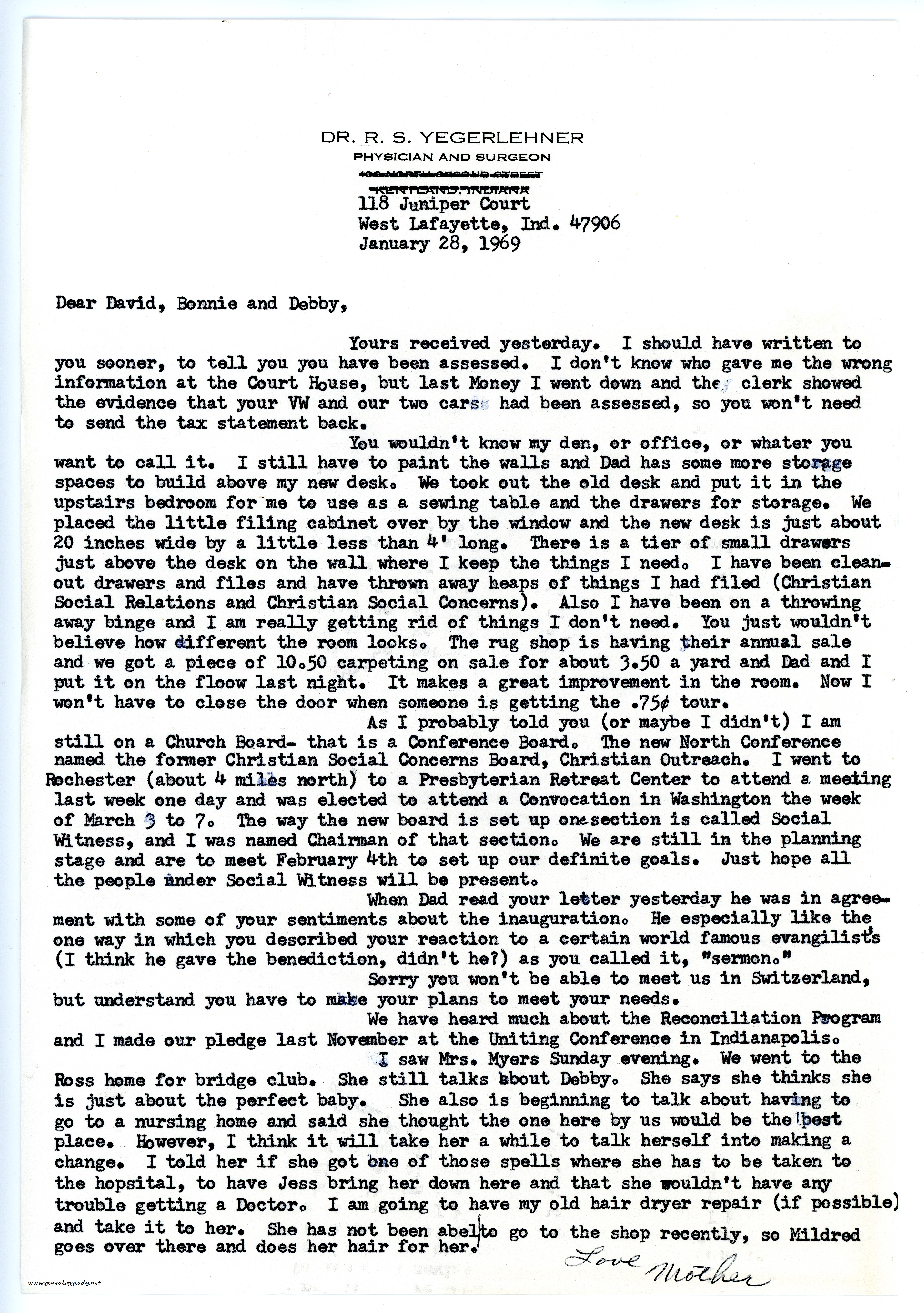
Letter transcription:

118 Juniper Court
West Lafayette, Ind. 47906
January 28, 1969

Dear David, Bonnie and Debby,

Yours received yesterday. I should have written to you sooner, to tell you you have been assessed. I don’t know who gave me the wrong information at the Court House, but last Monday I went down and the clerk showed the evidence that your VW and our two cars had been assessed, so you won’t need to send the tax statement back.

You wouldn’t know my den, or office, so whatever you want to call it. I still have to paint the walls and Dad has some more storage spaces to build above my new desk. We took out the old desk and put it in the upstairs bedroom for me to use as a sewing table and the drawers for storage. We place the little filing cabinet over by the window and the new desk is just about 20 inches wide by a little less than 4’ long. There is a tier of small drawers just above the desk on the wall where I keep the things I need. I have been cleaning out drawers and files and have thrown away heaps of things I had filed (Christian Social Relations and Christian Social Concerns). Also I have been on a throwing away binge and I am really getting rid of things I don’t need. You just wouldn’t believe how different the room looks. The rug shop is having their annual sale and we got a piece of 10.50 carpeting on sale for about $3.50 a yard and Dad and I put it on the floor last night. It makes a great improvement in the room. Now I won’t have to close the door when someone is getting the 75₵ tour.

As I probably told you (or maybe I didn’t) I am still on a Church Board – that is a Conference Board. The new North Conference named the former Christian Social Concerns Board, Christian Outreach. I went to Rochester (about 4 miles north) to a Presbyterian Retreat Center to attend a meeting last week one day and was elected to attend a Convocation in Washington the week of March 3 to 7. The way the new board is set up one section is called Social Witness, and I was named Chairman of that section. We are still in the planning stage and are to meet February 4th to set up our definite goals. Just hope all the people under Social Witness will be present.

When Dad read your letter yesterday he was in agreement with some of your sentiments about the inauguration. He especially liked the one way in which you described your reaction to a certain world famous evangelist’s (I think he gave the benediction, didn’t he?) as you called it, “sermon.”

Sorry you won’t be able to meet us in Switzerland, but understand you have to make your plans to meet your needs.

We have heard much about the Reconciliation Program and I made our pledge last November at the Uniting Conference in Indianapolis.

I saw Mrs. Myers Sunday evening. We went to the Ross home for bridge club. She still talks about Debby. She says she thinks she is just about the perfect baby. She also is beginning to talk about having to go to a nursing home and said she thought the one here by us would be the best place. However, I think it will take her a while to talk herself into making a change. I told her if she got one of those spells where she has to be taken to the hospital, to have Jess bring her down here and that she wouldn’t have any trouble getting a Doctor. I am going to have my old hair dryer repair (if possible) and take it to her. She has not been able to go to the shop recently, so Mildred goes over there and does her hair for her.

Love Mother

©2017 copyright owned and transcribed by Deborah Sweeney
Post originally found: https://genealogylady.net/2017/05/18/gladys-january-28-1969/

Mother’s Day Sermon

[Editor’s Note: At the end of May 1968, David received his first degree from Boston University’s School of Theology. To see a brief newspaper clipping click here.]

Typed by Gladys Yegerlehner

SUSSANAH
Rockport, Mass.

Susanna Wesley – Sermon by Rev. David Yegerlehner, Mother’s Day, May 1968

John Wesley shared in the prejudice of his time against women. In one of his arguments against Democracy – for Wesley did not believe in government by the people, he freely accepted the idea of Divine Rights of Kings – he argued that government by the people, if drawn to its logical conclusion, would involve giving the vote to 21 year olds and to women: “But no one did ever maintain this,” said Wesley, “nor probably will they ever.”

History has proved Wesley wrong on his political ideas, but his attitude on women was typical of his time and typical of most of Western history. For there is no one group that has been more discriminated against than women. Only in modern times have women been emancipated to a degree – even now it would be hard for a woman to become President, or to become a freely accepted member of the clergy. How many human resources have been untapped over the centuries because women have been held back and kept in their place! It is a tragedy which staggers the imagination.

Some women, however, who lived in periods when women were repressed, have stood out and made names for themselves. Such a woman was Susannah Wesley, the mother of the founder of our denomination. I thought it fitting, on mother’s day, to talk about one of the better known women in the history of the church.

Susannah Wesley was born Susannah Annesley in 1669 in England. She was the last child of a large family. When she was born, her father was reportedly asked which number she was: he replied that he couldn’t remember whether she was the two dozenth or the quarter-hundredth!

She was born into a religious home; her father was minister in the Puritan tradition; that is, he was a dissenter, a member of a group which officially dissented against the Established Church, The Church of England. Such groups had to be officially registered.

Testimony to Susannah’s seriousness on religious matters is the fact that, of her own free will, she decided that she preferred the Church of England – and at the age of 12, much to the disapproval of her family, entered the Church of England. We will find that this spirit of independence by no means decreased as she grew older.

When Susannah was 20 years of age she married a young pastor named Samuel Wesley. He was a pastor of the Church of England, and he too had gone against a family history of dissent and joined the Established Church. The couple was married in 1698 – just a year after the glorious revolution, in which William and Mary had been invited to the throne of England to replace the exiled James II. Susannah Wesley’s biography from this point on is not the chronicle of an extraordinary ministry, or the building of a great religious movement, for what she did now was raise and run a family – a very large family; over a period of twenty-one years she bore 19 children – ten of whom died in infancy or childhood.

She and her husband lived in Epworth – a small rural community which was in many way unsuited to Samuel Wesley; for Samuel Wesley was a scholar of really amazing proportions. He read Hebrew, Latin, Greek; He wrote a life of Jesus in verse. But most of his congregation was illiterate. Furthermore, he was supposed to farm part of the land surrounding the parsonage to help feed the family; he neglected to do this however – his heart was not in agriculture – which added to the hardship of his family. The family went through periods of great trial and great stress – at times there was a great deal of ill feeling in the community directed toward them. Through all this, including a fire in the parsonage which almost took the life of John Wesley – Susannah held to a firm faith and stands forth as a strong and admirable personality. Her husband Samuel died in 1735 and during the last few

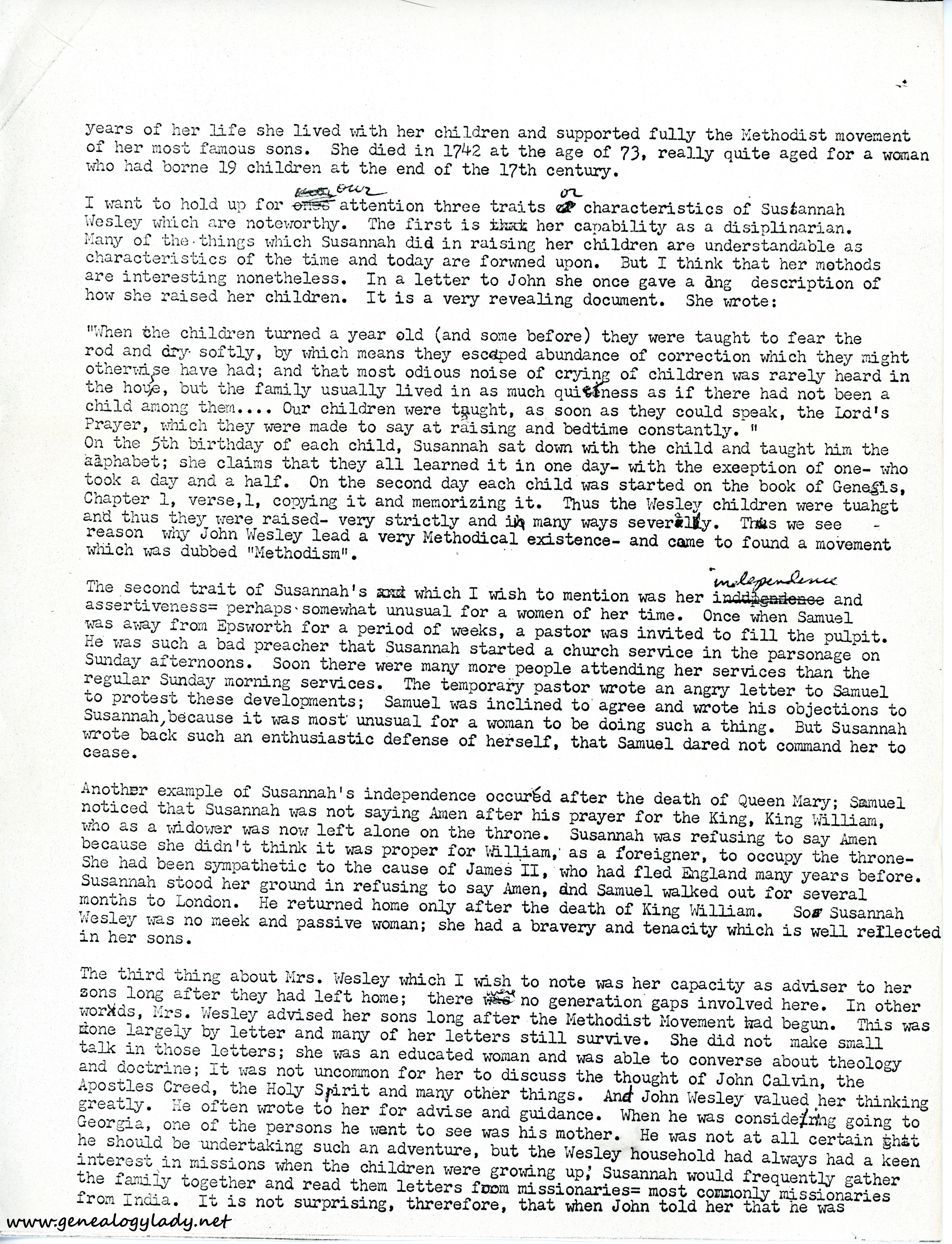
[page 2] years of her life she lived with her children and supported fully the Methodist movement of her most famous sons. She died in 1742 at the age of 73, really quite aged for a woman who had borne 19 children at the end of the 17th century.

I want to hold up for our attention three traits or characteristics of Susannah Wesley which are noteworthy. The first is her capability as a disciplinarian. Many of things which Susannah did in raising her children are understandable as characteristics of the time and today are frowned upon. But I think her methods are interesting nonetheless. In a letter to John she once gave a long description of how she raised her children. It is a very revealing document. She wrote:

“When the children turned a year old (and some before) they were taught to fear the rod and cry softly, by which means they escaped abundance of correction which they might otherwise have had; and that most odious noise of crying of children was rarely heard in the house, but the family usually lived in as much quietness as if there had not been a child among them…Our children were taught, as soon as they could speak, the Lord’s Prayer, which they were made to say at raising and bedtime constantly.”

On the 5th birthday of each child, Susannah sat down with the child and taught him the alphabet; she claims that they all learned it in one day – with the exception of one – who took a day and a half. On the second day each child was started on the book of Genesis, Chapter 1, verse 1, copying it and memorizing it. Thus the Wesley children were taught and thus they were raised – very strictly and in many ways severely. Thus we see reason why John Wesley led a very Methodical existence – and came to found a movement which was dubbed “Methodism.”

The second trait of Susannah’s which I wish to mention was her independence and assertiveness = perhaps somewhat unusual for a woman of her time. Once when Samuel was away from Epworth for a period of weeks, a pastor was invited to fill the pulpit. He was such a bad preacher that Susannah started a church service in the parsonage on Sunday afternoons. Soon there were many more people attending her services than the regular Sunday morning services. The temporary pastor wrote an angry letter to Samuel to protest these developments; Samuel was inclined to agree and wrote his objections to Susannah, because it was most unusual for a woman to be doing such a thing. But Susannah wrote back such an enthusiastic defense of herself, that Samuel dared not command her to cease.

Another example of Susannah’s independence occurred after the death of Queen Mary; Samuel noticed that Susannah was not saying Amen after his prayer for the King, King William, who as a widower was not left alone on the throne. Susannah was refusing to say Amen because she didn’t think it was proper for William, as a foreigner, to occupy the throne – She had been sympathetic to the cause of James II, who had fled England many years before. Susannah stood her ground in refusing to say Amen, and Samuel walked out for several months to London. He returned home only after the death of King William. So Susannah Wesley was no meek and passive woman; she had a bravery and a tenacity which is well reflected in her sons.

The third thing about Mrs. Wesley which I wish to note was her capacity as advisor to her sons long after they had left home; there were no generation gaps involved here. In other words, Mrs. Wesley advised her sons long after the Methodist movement had begun. This was done largely by letter and many of her letters still surive. She did not make small talk in those letters; she was an educated woman and was able to converse about theology and doctrine. It was not uncommon for her to discuss the thought of John Calvin, the Apostles Creed, the Holy Spirit and many other things. And John Wesley valued her thinking greatly. He often wrote to her for advice and guidance. When he was considering going to Georgia, one of the persons he went to see was his mother. He was not at all certain that he should be undertaking such an adventure, but the Wesley household had always had a keen interest in missions when the children were growing up; Susannah would frequently gather the family together and read them letters from missionaries = most commonly missionaries from India. It is not surprising, therefore, that when John told her that he was

[page 3] considering going to Georgia, Susannah (who was recently widowed, and might have asked her sons to stay near here) enthusiastically endorsed the idea. She exclaimed: “Had I twenty sons, I should rejoice if they were all so employed.” Her attitude might have been a significant factor in Wesley’s decision, because he did go to Georgia. So, for many years Susannah was a trusted and respected advisor to her famous son.

In the last century William Wallace wrote: The hand that rocks the cradle is the hand that rules the world.” I am not concerned to prove or disprove this, but we can certainly say that the hand the rocked the cradle of John Wesley is the hand that significantly molded Methodism. Methodism can be glad that it is one of the few religious movements in history, whose founders’ home life is so well known – we certainly know more about Susannah Wesley than we do about Mary. We can cherish the abundance of information we have about the Epworth parsonage and the woman who ran it.

Notes:
Samuel remained in Church of England. Did not approve Methodist movement.
Of the nine children who survived – 3 were sons – John, Charles, and Samuel. In a book about S.W. which I read recently I learned the daughters had by and large unhappy lives. Only one seemed to find happiness in adulthood and she died about two years after her marriage. The Wesley girls were well educated which was unusual for that day and age. Since their father was a poor country pastor he could not provide them with dowries and they were too well educated to be satisfied with marriage to persons with no education. – One incident is recorded about one daughter who brought disgrace (according to the standards of that day).

©2017 copyright owned and transcribed by Deborah Sweeney
Post originally found: https://genealogylady.net/2017/04/21/mothers-day-sermon/

Sunday School Materials

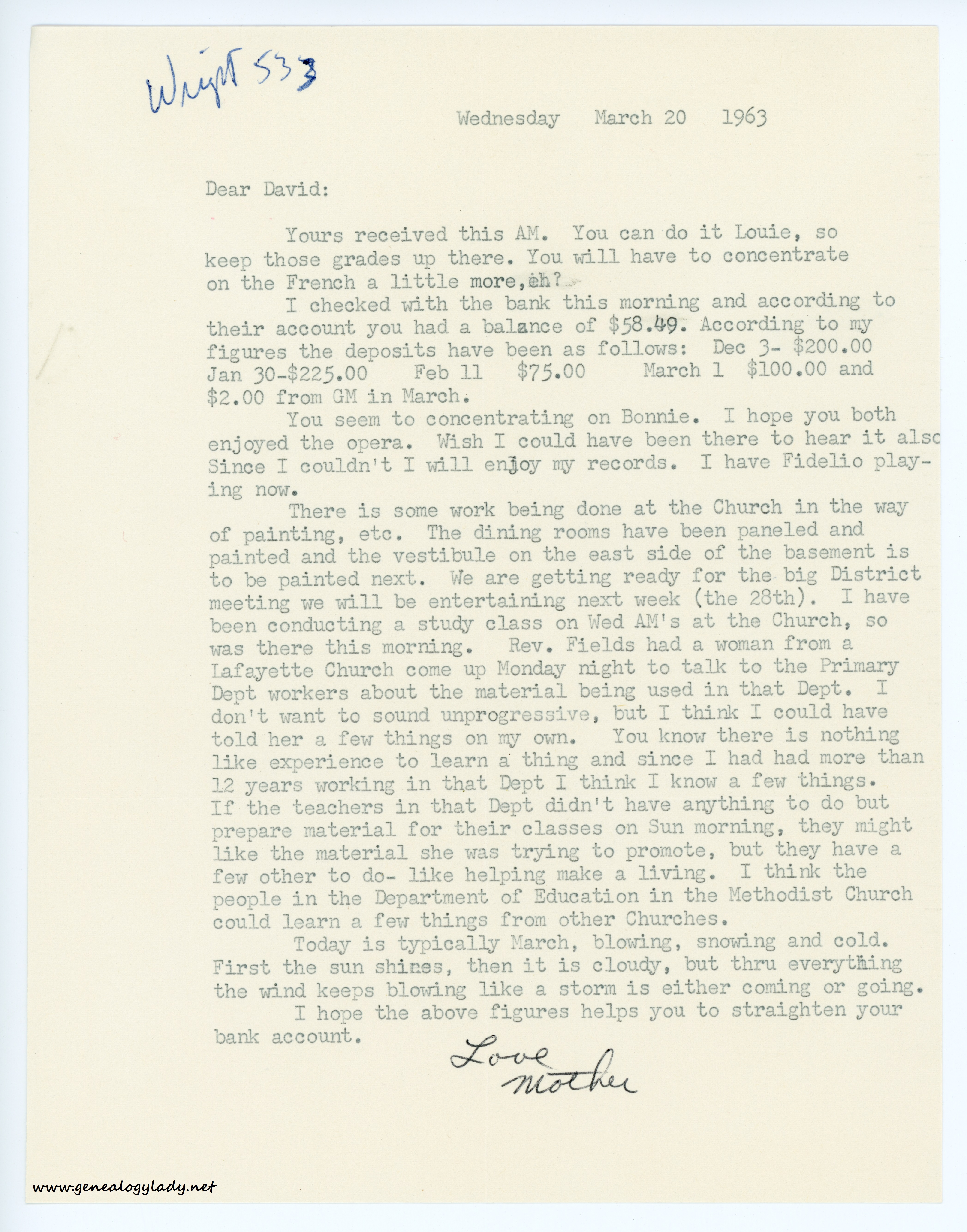
1963-03-20-gry-p-1Letter transcription:

[Wright 533 – Handwritten by David]
Wednesday March 20 1963

Dear David:

Yours received this AM. You can do it Louie, so keep those grades up there. You will have to concentrate on the French a little more, eh?

I checked with the bank this morning and according to their account you had a balance of $58.49. According to my figures the deposits have been as follows: Dec. 3 – $200.00; Jan. 30 – $225.00; Feb. 11 – $75.00; March 1 – $100.00 and $2.00 from GM in March.

You seem to [be] concentrating on Bonnie. I hope you both enjoyed the opera. Wish I could have been there to hear it also. Since I couldn’t I will enjoy my records. I have Fidelio playing now.

There is some work being done at the Church in the way of painting, etc. The dining rooms have been paneled and painted and the vestibule on the east side of the basement is to be painted next. We are getting ready for the big District meeting we will be entertaining next week (the 28th). I have been conducting a study class on Wed. a.m.’s at the Church, so was there this morning. Rev. Fields had a woman from a Lafayette church come up Monday night to talk to the Primary Dept. workers about the material being used in that Dept. I don’t want to sound unprogressive, but I think I could have told her a few things on my own. You know there is nothing like experience to learn a thing and since I had had more than 12 years working in that Dept. I think I know a few things. If the teachers in that Dept. didn’t have anything to do but prepare material for their classes on Sunday morning, they might like the material she was trying to promote, but they have a few other to do – like helping make a living. I think the people in the Department of Education in the Methodist Church could learn a few things from other churches.

Today is typically March, blowing, snowing, and cold. First the sun shines, then it is cloudy, but thru everything the wind keeps blowing like a storm is either coming or going.

I hope the above figures helps you to straighten your bank account.
Love Mother

©2016 copyright owned and transcribed by Deborah Sweeney
Post originally found: https://genealogylady.net/2016/11/04/sunday-school-materials/